
Neurorehabilitation in Abu Dhabi
Occupational therapy for neurological conditions and improving daily independence at AHLI Specialists Medical Center - Al Shamkha
Does your child or family member suffer from decreased mobility after a neurological condition?
Is there difficulty using the hand, walking, balancing, dressing, eating, writing, or performing daily tasks?
Does the person need more help after a stroke, brain injury, cerebral palsy, or neurological problem?
Is there difficulty concentrating, planning, perceiving, or controlling the body during daily activities?
Are you looking for a rehabilitation program that helps improve independence and gradually return to daily life?
Neurorehabilitation is a therapeutic program that helps children and adults with motor, sensory, or cognitive difficulties resulting from conditions that affect the nervous system. Occupational therapy in neurorehabilitation focuses on improving a person's ability to perform activities of daily living, such as dressing, eating, writing, using the hand, mobility, personal care, school or work participation, and organizing daily routines.
At AHLI Specialists Medical Center in Al Shamkha - Abu Dhabi, we provide evaluation and occupational treatment for neurological conditions, with an individual plan that suits the patient’s age, condition, and daily needs, with the aim of improving function, independence, safety, and confidence at home, school, work, and society.
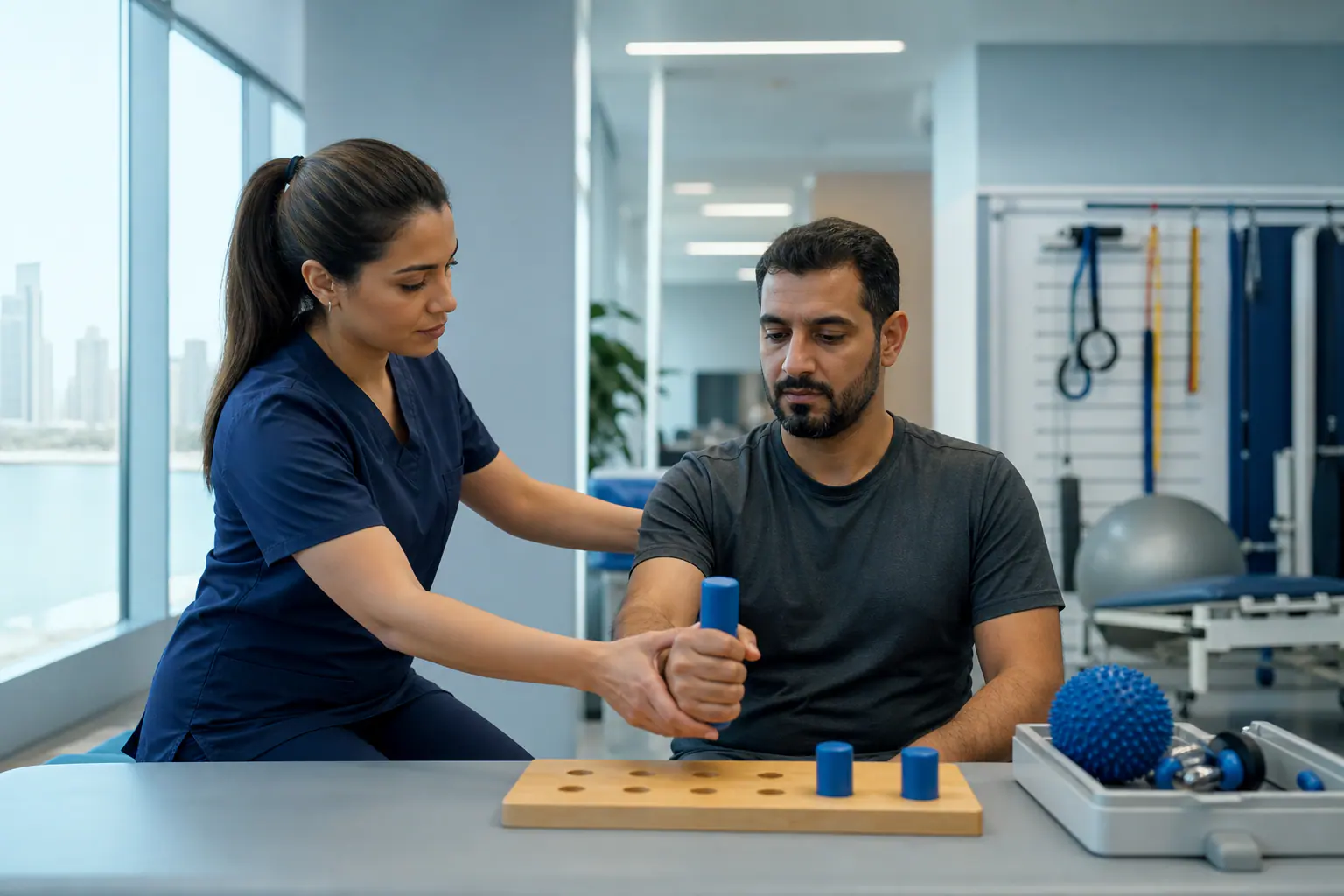
What is neurorehabilitation?
Neurorehabilitation is a set of therapeutic interventions that aim to help a person restore, improve or compensate for skills that have been affected due to a problem with the brain, spinal cord, nerves or nervous system in general.
Neurological conditions may affect:
The role of occupational therapy in neurological rehabilitation is to link treatment to daily life. The goal is not just to move the hand or strengthen the muscle, but to use the movement and skill in a real, meaningful activity, such as getting dressed, using a spoon, holding a pen, opening a door, arranging tools, writing, or returning to an activity that is important to the patient.
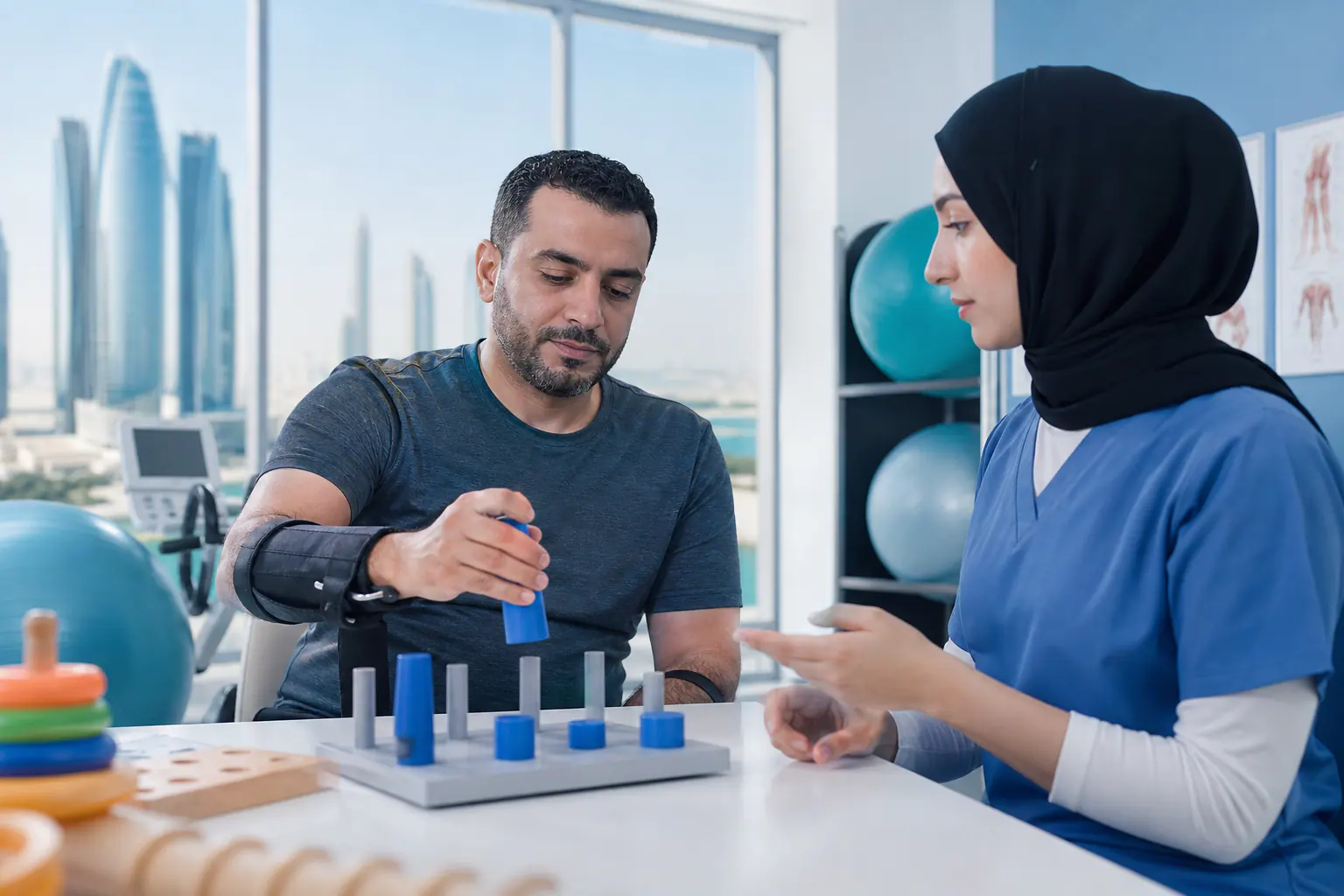
Who needs neurological rehabilitation?
A child or adult may need a neurorehabilitation evaluation if they have a condition or symptoms that affect movement or daily skills.
Evaluation helps to find out exactly what is affected: Is the problem in the force? Consistency? Sensation? Planning? Attention? Use of hand? Balance? Or more than one side together?
Neurorehabilitation for children
In children, neurorehabilitation may be important for conditions such as cerebral palsy, motor delays, brain injuries, certain neurological syndromes, poor balance, difficulties using the hand, or motor planning difficulties.
- ● Does not use one hand as well as the other
- ● He has difficulty holding a pen or spoon
- ● Delays in dressing or eating skills
- ● Stumbles or falls frequently
- ● He finds it difficult to jump or climb stairs
- ● He has stiffness or weakness in one limb
- ● Avoids using a specific hand
- ● He cannot use both hands
- ● He has difficulty in motor play
- ● He needs a lot of help with daily skills appropriate for his age
- ● He finds difficulty in school due to writing, sitting, or moving
Pediatric occupational therapy focuses on making the skill part of play, learning, and daily routines, so that the child develops in the most natural and comfortable way possible.
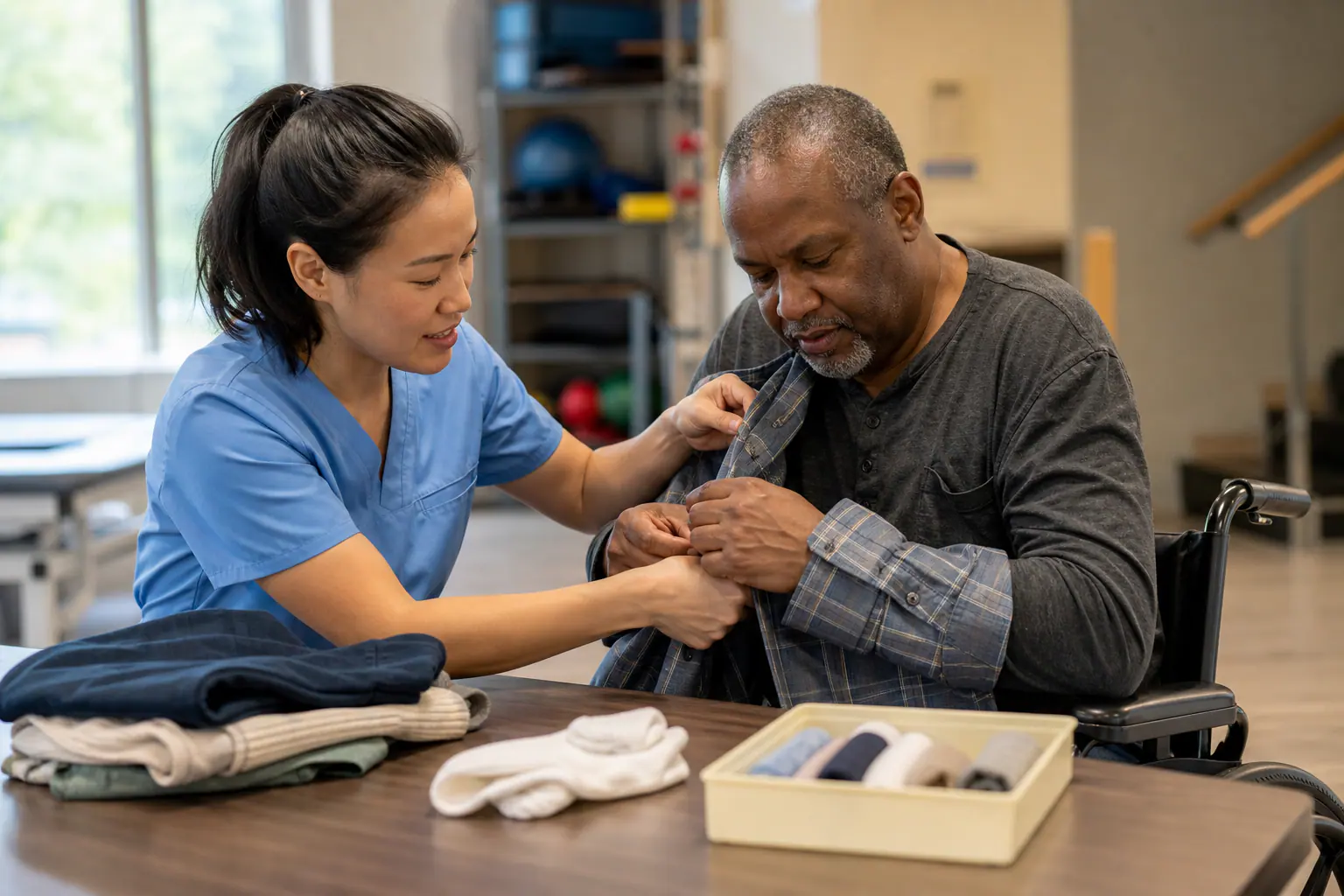
Neurorehabilitation for adults
In adults, neurorehabilitation may be necessary after strokes, brain injuries, nerve injuries, or neurological diseases that affect movement and independence.
- ● Weakness in the hand or arm
- ● Difficulty dressing, bathing, or eating
- ● Poor balance during daily activities
- ● Difficulty using tools
- ● Difficulty writing or using the phone
- ● Weak sensation or numbness
- ● Difficulty planning or remembering
- ● Fatigue quickly during tasks
- ● Difficulty returning to work or leading daily routines
- ● Need to modify the environment or auxiliary tools
- ● Greater dependence on family after a neurological condition
The goal is to help the person regain as much independence as possible, or learn safe alternative ways of performing daily activities.
Cases that may require neurological rehabilitation
Strokes
A stroke may affect movement, sensation, balance, cognition, hand use, or daily living skills. Occupational therapy helps a person retrain the affected limb, learn compensatory strategies, and improve independence in activities such as dressing, eating, bathing, and writing.
Brain injuries
After a brain injury, difficulties with movement, concentration, memory, impulse control, organization, or use of the hands may occur. Occupational therapy helps rebuild everyday skills step by step.
Cerebral palsy
Children with cerebral palsy may need support with movement, balance, hand use, fine motor skills, dressing, eating, writing and sitting. Occupational therapy helps each child improve participation and independence according to their abilities.
Spinal cord injuries
Spinal cord injuries may affect movement, sensation, limb strength, and mobility. Occupational therapy focuses on daily independence, adaptive tools, use of the hands, and modifying the environment as needed.
Neurological diseases
Some neurological diseases may gradually affect movement, balance, hand use, or daily energy. Occupational therapy helps maintain function, reduce stress, and use appropriate strategies for daily living.
Peripheral nerve injuries
It may affect hand strength, sensation, or the ability to grip objects. Occupational therapy helps improve hand use, protect joints, train fine skills, and choose appropriate tools.
Signs that may indicate the need for neurological rehabilitation
A person may need an occupational therapy evaluation if one or more of the following signs appear:
The sooner rehabilitation begins appropriately, the easier it is to develop a clear plan to improve function and reduce complications.
When are symptoms an emergency?
If you develop sudden weakness in the face, arm, or leg, sudden change in speech, severe dizziness, sudden loss of balance, unusually severe headache, or sudden confusion, seek emergency medical help immediately.
Neurological rehabilitation begins after medical assessment and the condition has stabilised. Do not wait for a therapy appointment when neurological symptoms are sudden or severe.
How do neurological conditions affect daily life?
Neurological conditions may affect skills that seem simple but are essential for independence.
Impact on self-care
Dressing, bathing, using the bathroom, washing hands, brushing teeth, or eating may become more difficult due to poor movement, balance, or use of the hand.
Impact on hand use
The ability to grasp, open, close, write, use the telephone, cook, or handle everyday tools may be affected.
Impact on mobility
The person may have difficulty walking, standing, moving from a chair, climbing stairs, or moving around the house safely.
Impact on school or work
Children may have difficulty with writing, playing, and school activities. Adults may find it difficult to return to work or perform professional tasks.
Influencing thinking and organization
Some neurological conditions affect attention, memory, planning, problem solving, or impulse control, making daily routines more difficult.
Impact on psychological confidence
When a person is no longer able to do things they used to do easily, they may feel frustrated, afraid, or lose confidence. Rehabilitation helps to gradually regain a sense of power and control.
What is the role of occupational therapy in neurological rehabilitation?
Occupational therapy focuses on a person's function in their daily life. In neurorehabilitation, the specialist helps assess what a person can do, what has become difficult, and what is the appropriate way to develop or replace skills.
The goal is for therapy to become connected to what actually matters in the person's life, rather than simply exercises disconnected from reality.
Physiotherapy
It often focuses on general movement, walking, strength, balance, flexibility, and mobility.
Occupational Therapy
Focuses on the use of movement and skills in activities of daily living, such as dressing, eating, writing, hand use, personal care, school, work, and environmental modification.
Speech and language therapy
It may be important if speech, language, swallowing, voice, or communication are affected after a neurological condition.
In many cases, the patient requires the cooperation of more than one specialty to achieve the best functional outcome.
What does a neurorehabilitation evaluation include?
At AHLI Specialists Medical Center, neurological rehabilitation begins with a comprehensive assessment to understand the impact of the condition on the person’s daily life.
After the assessment, the results are explained to the patient or family in a clear way, outlining treatment priorities and next steps.
What happens after the evaluation?
After the evaluation, a treatment plan is developed according to the person's condition and daily needs. The plan may include:
- ✓ Regular occupational therapy sessions
- ✓ Hand and arm training
- ✓ Functional exercises related to daily tasks
- ✓ Training in dressing, eating, and personal care skills
- ✓ Balance training within activities
- ✓ Support cognitive and organizational skills
- ✓ Activities to improve coordination and control
- ✓ Home exercises
- ✓ Recommendations to modify the environment
- ✓ Helpers or adaptive solutions
- ✓ Family or caregiver training
- ✓ Coordination with the doctor, physical therapist, or speech therapist when needed
The plan is flexible and is modified according to improvement, goal, and general condition.
Neurological rehabilitation steps in occupational therapy
Setting Priorities
We start by asking: What is the most important skill that a person or family wants to improve? Is it the use of the hand? Dress? eater? Writing? sit? Back to school? Back to work?
Evaluate current capacity
We determine what the person can do now, what they need help with, and what skills can be trained or replaced.
Set realistic goals
Goals should be clear and practical, such as using the hand to help with dressing, eating more independently, improving writing, or reducing help with bathing.
Movement training within a real activity
Instead of focusing on movement alone, movement is trained through activities such as holding a cup, opening a can, arranging tools, putting on a shirt, or using a pen.
Use purposeful repetition
Repetition is important in neurorehabilitation, but it must be linked to a functional goal in order to be beneficial and motivating.
Teaching compensatory strategies
If some skills take a long time to improve, alternative methods are taught to help the person perform the task safely and more independently.
Choose auxiliary tools when needed
The person may need tools to help with eating, dressing, writing, sitting, or home safety. It is selected according to evaluation.
Family training
The family learns how to help in the right way, without doing everything for the patient, and without exposing him to danger.
Track progress
Improvement is measured and the plan is modified based on response, with goals updated when required skills are achieved.
Hand and arm training in neurorehabilitation
The use of the hand and arm is one of the aspects that may be most affected in neurological conditions. There may be weakness, stiffness, lack of control, decreased sensation, or difficulty using the hand in purposeful activity.
- ● Reach and grasp training
- ● Training of opening and closing the hand
- ● Practice using your hands together
- ● Fine skills training
- ● Improved finger control
- ● Using the hand to eat, dress, or write
- ● Training eye-hand coordination
- ● Reduce ignoring the affected hand
- ● Repetitive job activities
- ● Joint protection and proper posture
- ● Use splints or devices when needed according to medical and functional evaluation
The goal is not just for the hand to move, but for it to become useful in everyday life.
Neurological rehabilitation and daily living skills
Daily living skills are one of the most important goals of neurological rehabilitation. The person may need to relearn or modify how to perform tasks such as:
- ● Dressing
- ● Dressing
- ● Eating
- ● Drinking
- ● Using the bathroom
- ● Shower
- ● Teeth cleaning
- ● Wash hands
- ● Make the bed
- ● Using the phone
- ● Open doors
- ● Simple cooking
- ● Writing
- ● Arrange tools
- ● Moving around the house
These skills are trained step by step, gradually reducing assistance as much as possible.
Neurorehabilitation and cognitive skills
Some neurological conditions not only affect movement, but may affect thinking and organization.
- ● Attention
- ● Memory
- ● Planning
- ● Problem solving
- ● Order of steps
- ● Risk assessment
- ● Impulse control
- ● Start the task
- ● Finish the task
- ● Transition between activities
- ● Organizing time
Occupational therapy helps use practical strategies such as schedules, lists, reminders, dividing tasks, practicing routines, and reducing distractions.
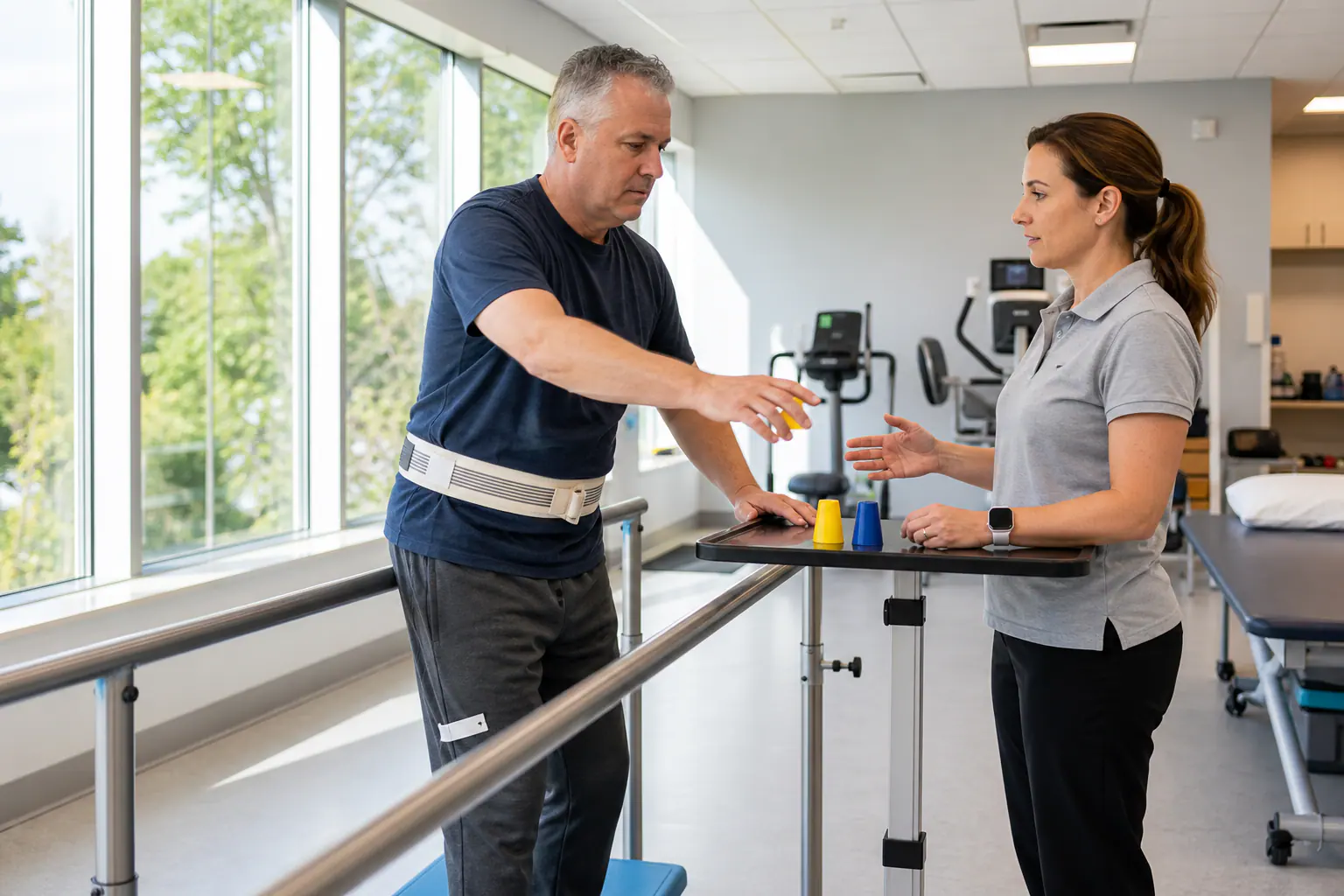
Neurological rehabilitation and sensation
Sensation may be affected after some neurological conditions. The person may feel numbness, weak sensation, pain, change in temperature sensation, or difficulty knowing where the limb is without looking at it.
- ● Objects falling from the hand
- ● Difficulty using tools
- ● Not paying attention to heat or pain
- ● Difficulty writing or holding
- ● Poor balance
- ● Difficulty using the affected limb
Occupational therapy may include sensory training, teaching limb protection, modifying the environment, and using safe strategies depending on the situation.
Neurological rehabilitation and return to school
Children after neurological conditions or with chronic neurological conditions may need support to return to school or improve classroom participation.
- ● Writing
- ● Sitting
- ● Use of hand
- ● Carry the bag
- ● Participate in sports
- ● Attention
- ● Rapid fatigue
- ● Difficulty moving between classes
- ● Using the bathroom
- ● Organize tools
- ● Interaction with children
An occupational therapist may make recommendations for school such as seat adjustments, writing aids, reduced copying, rest breaks, a safety plan, or specific skills training.
Neurological rehabilitation and return to work
For adults, the goal may be to return to work or perform important household and social tasks. Occupational therapy helps evaluate the demands of work and daily life, and determine what needs training or modification.
- ● Training the use of the hand in practical tasks
- ● Improve activity tolerance
- ● Fatigue management
- ● Organizing time
- ● Use assistive tools
- ● Modify the way tasks are performed
- ● Computer or typing skills training when needed
- ● Recommendations for the operating environment depending on the situation
- ● Develop a gradual return plan when possible
The goal is to support safe and realistic participation, depending on medical condition and available capabilities.
Adaptive devices and solutions in neurorehabilitation
Sometimes a person needs tools or modifications to help them become independent. These tools do not mean failure, but rather can be an important means of daily engagement.
Tools are selected based on evaluation, not randomly.
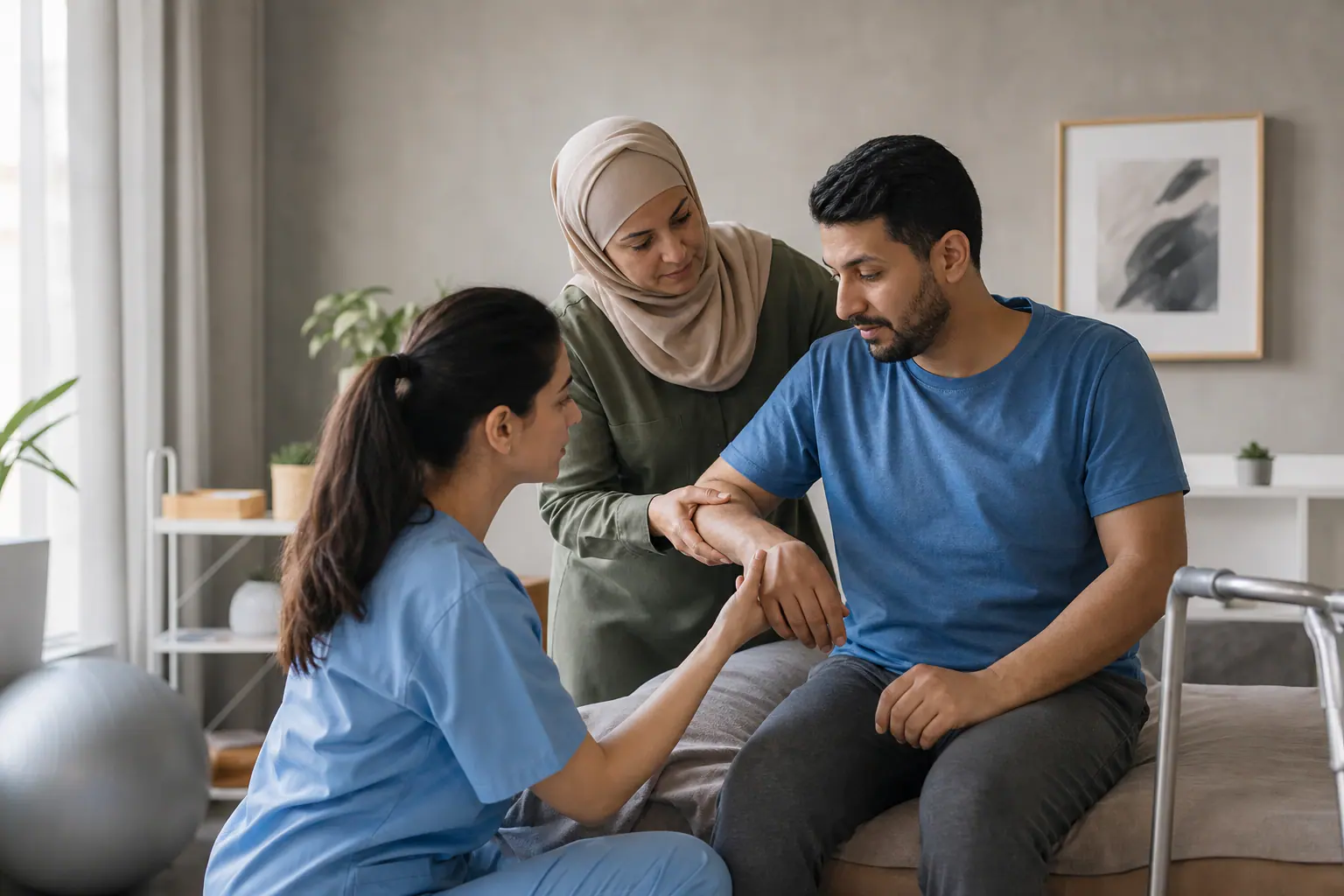
The role of the family and caregiver
The family is an important part of neurological rehabilitation. The manner of daily assistance may affect a person's progress and independence.
- ✓ Encourage the person to try within safe limits
- ✓ Not doing everything for him if he is capable of part of the task
- ✓ Give enough time to complete tasks
- ✓ Divide tasks into steps
- ✓ Use clear instructions
- ✓ Reduce distractions
- ✓ Home exercises application
- ✓ Pay attention to fatigue and do not overexert yourself
- ✓ Providing a safe environment
- ✓ Follow up on treatment recommendations
- ✓ Report any new changes
- ✓ Cooperation with the medical and therapeutic team
Proper support means helping a person become independent, not increasing their dependence on others.
Home safety in neurorehabilitation
After certain neurological conditions, the risk of falls or home accidents may increase. Therefore, the person may need a slight adjustment in the environment.
- ● Removing obstacles from walkways
- ● Improve lighting
- ● Use suitable shoes
- ● Install or remove carpet if it is dangerous
- ● Arrange tools in easy-to-access places
- ● Use a suitable chair for showering when needed
- ● Develop support tools according to the evaluation
- ● Organize the kitchen and bathroom to reduce risks
- ● Safe transition training between poses
- ● Do not leave a person in unsafe situations if he or she needs supervision
Safety is an essential part of independence, not the opposite.
Does neurological rehabilitation take a long time?
The duration of rehabilitation varies according to the cause of the condition, the severity of the condition, the age of the person, the general health condition, the time of starting treatment, and the application of exercises at home.
- ✓ Increased use of the affected hand
- ✓ Reduced help with confusion
- ✓ Improve balance during daily tasks
- ✓ Use the tool independently
- ✓ Partial return to school or work
- ✓ Improve safety inside the home
Some people improve within a short period in specific skills, some need a longer program, and some cases require continuous follow-up to maintain function and prevent decline. Every small advance in daily functioning is an important step.
Is it possible to improve after a long period of injury?
Improvement varies from person to person. In some cases, progress can be made even after time, especially when treatment is focused on clear functional goals and repeated training. Not all skills may return to what they were, but performance can be improved or alternative methods can be learned to aid independence.
Evaluation is the best way to know what can be worked on at the current stage, and what realistic goals are appropriate.
Common mistakes to avoid
- ✗ Postpone treatment after the condition stabilizes
- ✗ Always do all the tasks instead of the person
- ✗ Focus on movement only without linking it to daily life
- ✗ Using auxiliary tools without evaluation
- ✗ Ignore attention or memory difficulties
- ✗ Ignoring the affected hand instead of involving it in activities
- ✗ Exhausting training without allowing for fatigue
- ✗ Do not modify the environment despite the risk of falling
- ✗ Comparing the patient to others
- ✗ Expecting rapid improvement is unrealistic
- ✗ Ignoring signs of difficulty swallowing or speaking
- ✗ Lack of cooperation between disciplines when needed
Better rehabilitation is realistic, gradual, and based on goals that are important to the person and family.
Neurological rehabilitation in Al Shamkha - Abu Dhabi
If you are looking for neurological rehabilitation in Abu Dhabi or occupational therapy for neurological conditions in Al Shamkha, AHLI Specialists Medical Center provides an assessment and treatment plan that helps children and adults improve movement, hand use, daily independence, balance, cognition, and the ability to participate in daily life.
We help the patient and family understand current difficulties, set priorities, and develop a practical occupational treatment plan that fits home, school, work, and daily life.
Specialized evaluation
Evaluation of specialized occupational therapy for neurological conditions.
Individual plan
Individual plan for children and adults.
Daily independence
Focus on daily living skills and independence.
Hand training
Training the use of the hand and arm in functional activities.
Balance and coordination
Support balance and coordination during daily tasks.
Cognitive skills
Training cognitive skills such as attention, planning and organization.
Adaptive solutions
Recommendations for adaptive tools and solutions when needed.
Family training
Guidance for family and caregivers.
Multidisciplinary Coordination
Possibility of cooperation with physical therapy, speech therapy and medical specialties.
Distinctive location
Close to Al Shamkha, Baniyas, Al Falah, Shakhbout and Abu Dhabi areas.
Sub-treatments
Direct links to specialized treatment pages.
Post-stroke rehabilitation
Specialized evaluation and treatment for post-stroke rehabilitation - periodic follow-up at AHLI Specialists Medical Center.
Rehabilitation of nerve injuries
Evaluation and treatment specialized in the rehabilitation of neurological injuries - periodic follow-up at AHLI Specialists Medical Center.
Hand injury rehabilitation
Evaluation and treatment specialized in the rehabilitation of hand injuries - periodic follow-up at AHLI Specialists Medical Center.
Upper limb rehabilitation
Evaluation and treatment specialized in upper limb rehabilitation - periodic follow-up at AHLI Specialists Medical Center.
Services related to neurorehabilitation
The auditor may need one or more of the following services depending on the assessment:
Neurorehabilitation assessment
To understand the impact of neurological conditions on movement, hand, balance, cognition, and daily living skills.
Hand and arm training
To improve grasping, reaching, control, fine skills, and use of the affected limb in real-world activities.
Daily life skills training
Such as dressing, eating, bathing, using the bathroom, writing, and arranging tools.
Rehabilitation after strokes
To support regaining independence and improving performance of daily activities after stroke.
Rehabilitation for children with cerebral palsy
To support functional movement, hand use, everyday skills, writing, and play.
Support cognition and organization
For people who have difficulty with attention, memory, planning, or sequencing tasks.
Adaptive devices and solutions
To choose tools or modifications that help with safety and independence at home, school, or work.
Family training
To teach the family appropriate support and encourage independence safely.
When do I book an appointment?
Book an assessment if your child or adult has:
- ● Weakness in the hand or arm
- ● Difficulty using a limb of the body
- ● Difficulty dressing, eating, or personal care
- ● Poor balance or frequent falls
- ● Difficulty writing or using tools
- ● Daily skills are affected after a stroke or injury
- ● Cerebral palsy with motor or daily difficulties
- ● Difficulty with planning or memory after a neurological condition
- ● Need for assistive devices or environment modification
- ● Excessive dependence on the family for tasks that can be developed
- ● Difficulty returning to school or work
If the symptoms appeared suddenly or were accompanied by sudden weakness, speech change, difficulty breathing, or confusion, emergency medical help must be sought first.
The first step after stabilizing the condition is a clear assessment that determines priorities and develops an appropriate treatment plan.
Book a neurorehabilitation assessment
If your child or family member is experiencing difficulty with mobility, hand use, balance, daily independence, or cognitive skills after a neurological condition, we can help you with a neurorehabilitation occupational therapy evaluation and develop a plan tailored to their needs.
AHLI Specialists Medical Center - Al Shamkha, Abu Dhabi
Al Qayed Street, Al Shamkha, Abu Dhabi
Frequently asked questions about neurorehabilitation
What is neurorehabilitation?
What is the role of occupational therapy in neurological rehabilitation?
Is neurorehabilitation suitable for children?
Is neurological rehabilitation appropriate after a stroke?
Is occupational therapy different from physical therapy?
Does the patient need assistive devices?
How long does neurological rehabilitation take?
Is it possible to improve after some time after the injury?
Does the family have a role in rehabilitation?
When do neurological symptoms become an emergency?
Our specialized team


Book a neurorehabilitation assessment
02-448-7553 — Al Shamkha, Abu Dhabi