
Language and communication disorders in Abu Dhabi
Speech and language evaluation and treatment for children at AHLI Specialists Medical Center - Al Shamkha
Do you feel that your child does not speak clearly?
Is he delayed in forming sentences?
Does he not understand instructions as well as children his age?
Does he rely on pointing or crying instead of talking?
Does he speak but cannot express his thoughts and needs clearly?
Language and communication disorders are among the most common problems that may affect a child at home, nursery, school, and social relationships. It may manifest as delayed speech, poor comprehension, difficulty with expression, stuttering, unclear pronunciation, poor eye contact, or difficulty using language in everyday situations.
At AHLI Specialists Medical Center in Al Shamkha - Abu Dhabi, we provide an evaluation and treatment service for language and communication disorders for children, through a speech and language therapist, with an individual treatment plan that suits the child’s age and needs, and clear support for parents to implement the instructions at home.

What are language and communication disorders?
Language and communication disorders are difficulties that affect a child's ability to understand speech, use words, form sentences, express needs, or communicate with others in an age-appropriate way.
The problem may be in one aspect only, such as delayed speech, or it may be in more than one aspect, such as poor understanding with poor expression and difficulty in social communication.
Language and communication do not just mean talking. The child also communicates through looks, pointing, facial expressions, playing, imitating sounds, understanding instructions, and using words at the appropriate time and situation.
Therefore, when evaluating a child, we do not just look at the number of words he says, but rather we look at the entire way he communicates: Does he understand? Does he respond? Is he trying to express himself? Does he use the signal? Does he interact with others? Can he ask for what he wants? Does he use language in play and dialogue?

The difference between speech, language and communication
It is important for parents to know the difference between these terms, because each child may need a different type of support.
Speech
Pronunciation
Speech is the way sounds and words are pronounced. The problem may be with speech if the child speaks but his speech is not clear, or he deletes sounds, or replaces a sound with a sound, or has difficulty pronouncing some letters.
the language
Comprehension and expression
Language is understanding and expression. The problem may be with language if the child does not understand instructions, does not know the names of things, does not form age-appropriate sentences, or cannot explain what he wants.
communication
Social interaction
Communication is the use of speech, language, sign, and interaction to communicate with others. The problem may be in communication if the child does not ask, does not participate, does not initiate dialogue, does not interact in play, or does not use language in a way appropriate to the situation.
At AHLI Specialists Medical Center, the evaluation helps determine exactly where the difficulty is located, so that the treatment plan is clear and appropriate.
What are the types of language and communication disorders in children?
Language and communication disorders include several problems, and they may appear separately or together.

Delayed speech in children
It appears when a child is late in using words or sentences compared to his age. He may say few words, rely on gestures, or be unable to express his needs verbally.
Expressive language disorders
The child finds it difficult to use words and sentences to express. He may know what he wants but can't explain it, use sentences that are too short, or mix up word order.

Receptive language disorders
The child finds it difficult to understand speech and instructions. He may not respond to simple commands, need to repeat himself often, or seem like he's not paying attention.

Speech and vowel disorders
The child speaks, but his speech is not clear. He may change some sounds, delete some letters, or be difficult to understand by people outside the family.

Stuttering and stammering
It appears in the form of repetition of sounds or words, prolongation of the sound, sudden pauses during speech, or tension when trying to pronounce the word.
Social communication disorders
The child may have difficulty using language to interact with others, such as initiating a conversation, taking turns talking, understanding facial expressions, or using language in play.

Developmentally related communication difficulties
Some children have difficulties in language and communication related to developmental delays, poor attention, hearing difficulties, sensory disturbances, or conditions that require evaluation from more than one specialty.
Signs that may indicate a language or communication disorder
A child may need a speech and language evaluation if you notice one or more of the following signs:
- ● He does not use age-appropriate words
- ● Doesn't make simple sentences
- ● He doesn't understand everyday instruction.
- ● Doesn't respond well to his name
- ● It depends on crying or pointing instead of talking
- ● Does not imitate sounds or words
- ● His words are incomprehensible to his family or others
- ● He doesn't know how to ask for what he wants
- ● He does not participate in play or dialogue
- ● Repeats words without using them appropriately
- ● He finds it difficult to name things
- ● He cannot describe what happened to him
- ● He gets nervous or angry because he cannot express himself
- ● He avoids talking to strangers or at school
- ● He has stuttering or frequent pauses during speech
- ● Losing words or skills they used previously
Having just one sign does not necessarily mean there is a major problem, but it is reason enough to seek an evaluation if anxiety is persistent or if the child is not progressing linguistically over time.
When should you book an evaluation with a speech and language pathologist?
It is preferable to book an evaluation if the parents feel that the child’s development in speech, understanding, or communication is less than expected for his age, or if the difficulty begins to affect his daily life.
It is not recommended to wait long when there is obvious concern. Some children only need simple guidance and follow-up, while others need regular therapy sessions. Early assessment helps parents know the situation instead of relying on guesswork or comparison with other children.
Book an assessment if you notice your child:
- → He doesn't speak like children his age
- → He does not understand speech easily
- → He cannot express his needs
- → His words are not clear
- → He communicates more with gestures than words
- → Avoids playing or talking
- → Stutters or pauses frequently while speaking
- → Having difficulty in nursery or school
- → Feels frustrated because of difficulty communicating
- → He lost some of the words or skills he used
What are the causes of language and communication disorders?
Language and communication disorders may occur for different reasons, and sometimes there is no clear single cause. In many cases, the goal of the evaluation is not to make a “scary diagnosis,” but rather to understand the cause of the difficulty and develop a plan that will help the child communicate better.
- Hearing loss or recurrent ear infections
- A general delay in development
- Lack of daily language interaction
- Excessive use of screens
- Having a family history of delayed speech or language disorders
- Difficulties with attention and concentration
- Social communication difficulties
- Speech and vowel disorders
- Sensory or developmental problems
- A multilingual environment needs careful evaluation
- Medical or neurological conditions that affect speech and language
- Difficulties with oral muscles or motor control of speech
How do language and communication disorders affect the child?
Some people may think that language and communication disorder is a simple problem that will go away with time, but it may affect many aspects of a child’s life if it is not dealt with in an appropriate manner.
Expressing needs
A child who cannot speak or express clearly may not know how to ask for food, water, toys, bathroom, help, or comfort.
Behavior
Many children become irritable or cry a lot because they cannot explain what they want. Sometimes behavior is a message that substitutes for speech.
Learning
Language is very important for understanding instructions, learning concepts, following lessons, and succeeding in preschool or school.
Social relations
A child who cannot communicate easily may avoid other children, not know how to participate in play, or have difficulty making friends.
Self-confidence
When a child feels that his speech is not understood or that he cannot express himself, he may become less involved or more shy.
Treatment of language and communication disorders aims not only to increase the number of words, but also to improve the child’s daily life and strengthen his ability to understand, express, participate, and communicate with confidence.
How are language and communication disorders evaluated?
At AHLI Specialists Medical Center, treatment begins with a comprehensive assessment from a speech and language therapist. Evaluation is carried out in a comfortable and age-appropriate manner, often through play, dialogue, observation, and interactive activities.
- ✓ Taking detailed information from the parents about the child’s development
- ✓ Knowing the age of the first words and first sentences
- ✓ Assess the child's understanding of words and instructions
- ✓ Evaluate the child's ability to express and use sentences
- ✓ Observe the way of playing and interacting
- ✓ Assess eye contact, pointing, and attention
- ✓ Evaluating speech clarity and letter output
- ✓ Noticing the presence of stuttering or difficulty with fluency
- ✓ Assessing language use in social situations
- ✓ Determine whether the child needs a hearing test or other evaluations
- ✓ Setting treatment goals appropriate to the child’s age and needs
After the evaluation, the results are explained to the parents in clear language, specifying the type of difficulty, its severity, and the appropriate plan.
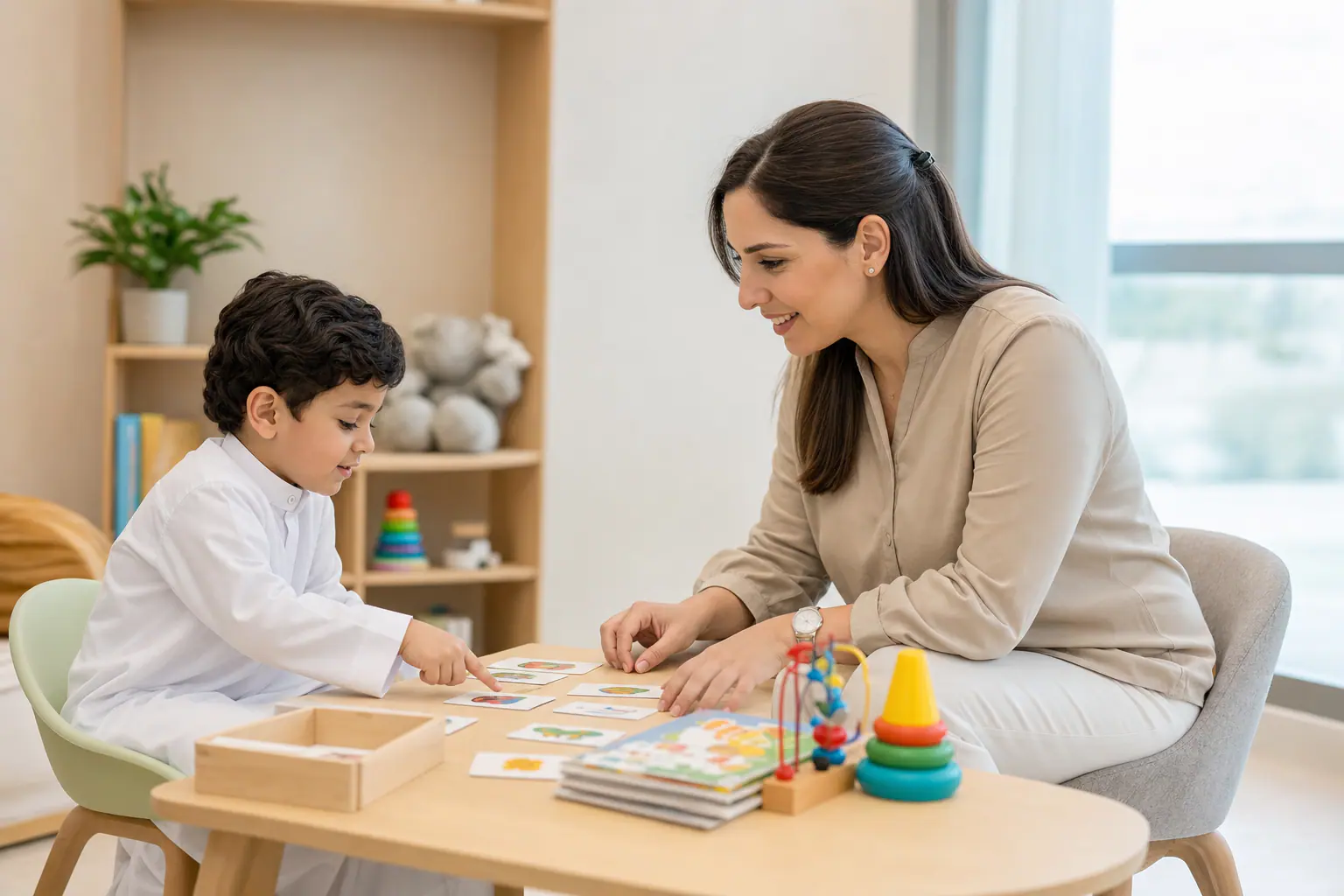
Steps to treat language and communication disorders
The treatment plan varies from one child to another. There is no one session or exercise that fits all. So we start by understanding the child and then build a program that suits him.
Determine the child's current level
Does he understand? Is he imitating? Is he pointing? Does he use words? Does he form sentences? Does he interact with others?
Develop an individual treatment plan
Clear goals: vocabulary, comprehension, sentence comprehension, speech clarity, stuttering reduction, or social communication.
Therapy through play
Play, pictures, stories, games, imitation, repetition, and simple dialogue to stimulate language.
Training comprehension and expression
Nouns, verbs, adjectives, questions, requests, refusals, choices, sentences, and narrations of simple events.
Improve speech clarity
Voice production, auditory discrimination, and clearer pronunciation when needed.
Social media support
Taking turns, asking for help, starting a dialogue, responding, and playing together.
Parent guidance and training
Simple ways to support language in daily routines: play, food, bathing, stories.
Monitor progress and modify the plan
Measure progress and adjust goals — short sessions or longer program depending on intensity.
The role of parents in treating language and communication disorders
Speech therapy sessions are important, but the child needs daily opportunities to communicate outside of the session. Therefore, we focus on training parents because the home is the basic environment for language development.
- ✓ Talk to him during daily activities
- ✓ Use short, clear sentences
- ✓ Naming things around him
- ✓ Give him enough time to respond
- ✓ Encourage any attempt to communicate
- ✓ Read comics
- ✓ Reduce screen time
- ✓ Interactive play instead of silent play
- ✓ Do not pressure him to repeat words too often
- ✓ Not comparing him to his siblings or other children
- ✓ Praise communication, not just correct speech
- ✓ Turn daily routine into a learning opportunity
When parents cooperate with the specialist, the chances of improvement become better because the child practices in the session and at home together.
Are language and communication disorders related to screens?
Excessive use of screens may reduce opportunities for dialogue and real interaction, especially in the early years. The child does not learn the language from watching only, but he needs someone to talk to him, listen to him, wait for his response, and play with him.
Not every language problem is caused by screens, but reducing screen time and increasing daily interaction can help a lot, especially in children with delayed speech or poor communication.
Does the child need a hearing test?
In some cases, yes. Hearing is an essential part of speech and language development. If the child does not respond to his name, does not pay attention to sounds, has frequent ear infections, or has a significant delay in speech, the specialist may advise a hearing test to ensure that the child hears speech clearly.
A hearing test does not mean that a child has a definite problem, but it is an important step to rule out a cause that may affect language development.
Subservices within Language and Communication Disorders
A speech and language therapy plan can include one or more of the following services:
Treatment of delayed speech in children
For children who use few words or do not form age-appropriate sentences.
Learn more →Treatment of stuttering and stuttering
Repetition, pauses, or tension during speech.
Learn more →Treatment of speech and vowel disorders
Unclear speech or difficulty pronouncing some sounds.
Learn more →Treating difficulties in understanding and expression
Poor understanding instructions or expressing ideas and needs.
Learn more →Treating social communication difficulties
Difficulty using language to interact and participate in play.
Learn more →Parent guidance and training
Supporting the family to apply the instructions at home correctly.
Learn more →Treatment of language and communication disorders in Al Shamkha - Abu Dhabi
If you are looking for a speech and language pathologist in Abu Dhabi or treatment of language and communication disorders for children in Al Shamkha, AHLI Specialists Medical Center provides an appropriate assessment and treatment plan for children who suffer from delayed speech, comprehension difficulties, expression difficulties, speech disorders, stuttering, or social communication difficulties.
We help parents clearly understand the child’s condition, and develop a practical plan that helps him communicate better at home, nursery, and school.
Why choose AHLI Specialists Medical Center?
Comprehensive evaluation
For speech, language, and communication — not just word count.
Individual plan
It suits the child's age, type and severity of difficulty.
Interactive sessions
Play and interact — a comfortable environment for children.
Parental support
Practical instructions that can be applied at home every day.
Clear follow-up
Track your baby's development step by step.
Family environment
A quiet medical center suitable for children and families.
Central location
Al Shamkha – Baniyas, Al Falah, Shakhbout, and Abu Dhabi.
Multidisciplinary Coordination
Directing for additional evaluations when needed.
Related sections
When should I book an appointment for my child?
Book an evaluation if you feel your child is not communicating appropriately for their age, or if their speech is slurred, does not understand instructions, or cannot easily express their needs.
Waiting is not always the answer. Sometimes a simple first step, an assessment, is enough to clarify the picture, reassure parents, or start an early treatment plan.
Book a speech and language assessment for your child
If you have any concerns about your child's speech, comprehension, pronunciation, or communication, we can help you with a straightforward step: a comprehensive language and communication assessment.
AHLI Specialists Medical Center - Al Shamkha, Abu Dhabi
Al Qayed Street, Al Shamkha, Abu Dhabi
Frequently asked questions about language and communication disorders
What is the difference between delayed speech and language disorder?
Does every child with delayed speech need speech therapy?
Do language and communication disorders affect school?
Can a child be intelligent and have a language disorder?
Do screens cause language delay?
How many speech therapy sessions does a child need?
Should my hearing be tested before speech therapy?
Can language and communication disorders be treated?
Speech and language therapist


Book a speech and language assessment for your child
AHLI Specialists Medical Center - Al Shamkha, Abu Dhabi — 02-448-7553