
Metal and ceramic braces in Abu Dhabi
Fixed braces to treat dental crowding and occlusion problems at AHLI Specialists Medical Center - Al Shamkha
Are you looking for stable and effective braces to straighten your teeth?
Do you have crowding, protrusion, gaps, a deep bite, or an open bite?
Do you want to know the difference between metal braces and ceramic braces?
Are clear, strong braces suitable for you, or less visible braces with a color close to the teeth?
Are you looking for metal and ceramic braces in Abu Dhabi or braces in Al Shamkha near Baniyas, Al Falah and Shakhbout?
Metal and ceramic braces are among the most popular types of fixed braces for treating dental and occlusal problems. Both rely on brackets that attach to the teeth and orthodontic wires that help gradually move the teeth into a better position. The main difference between them is that metal braces are more visible and are mostly made of metal, while ceramic braces use brackets that are a color close to the teeth to be less noticeable.
At AHLI Specialists Medical Center in Al Shamkha - Abu Dhabi, we provide a comprehensive evaluation of orthodontic cases, determining whether metal braces, ceramic braces, clear braces, or another treatment plan is most appropriate for your case according to the degree of crowding, occlusal shape, age, gum health, and the patient’s desire in terms of appearance and comfort. We serve clients from Al Shamkha, Baniyas, Al Falah, Al Shawamekh, Shakhbout, Mohammed bin Zayed City, Khalifa City, Al Bahia, Al Raha, and various areas of Abu Dhabi.
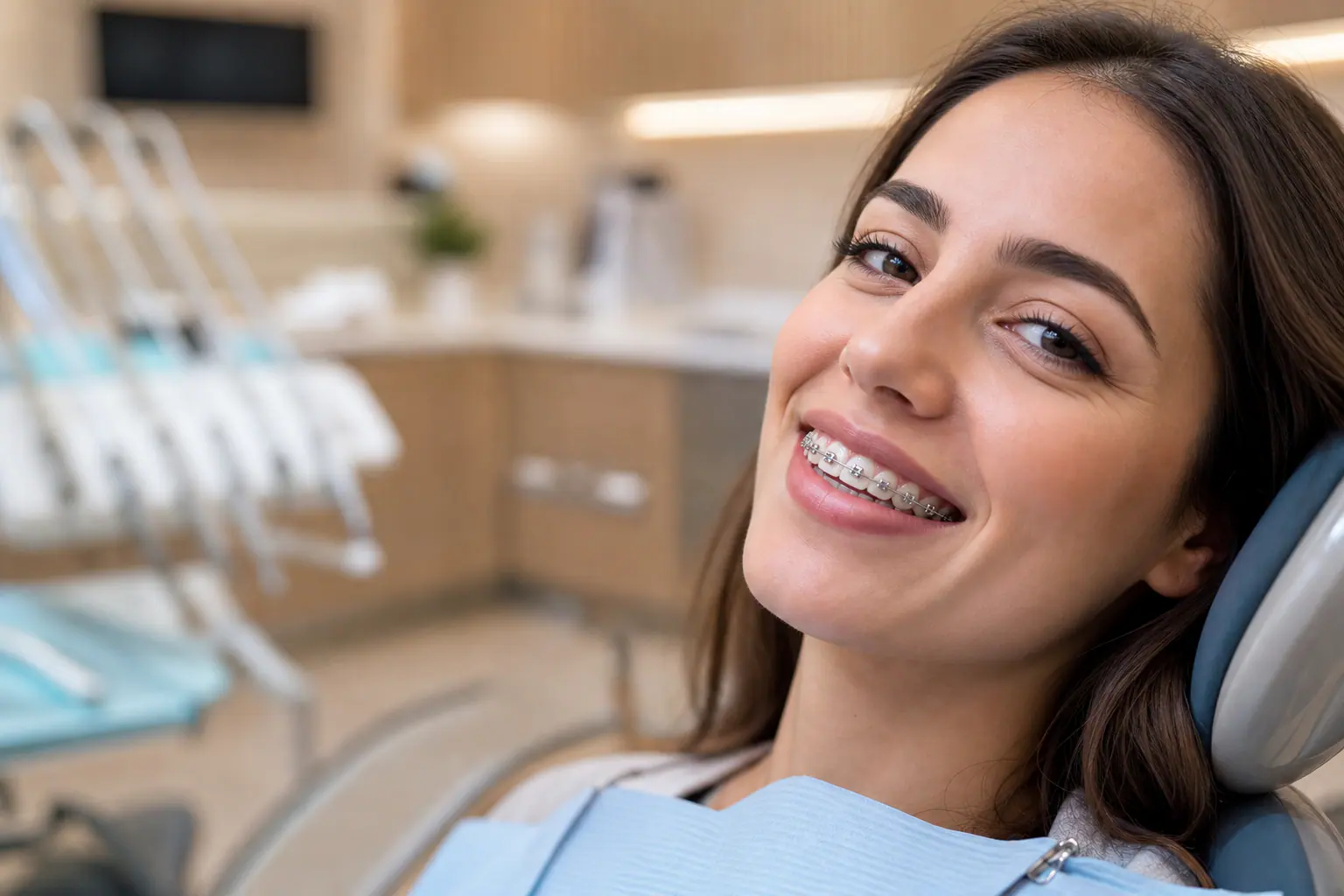
What are metal and ceramic braces?
Metal and ceramic braces are two types of fixed braces, meaning that the brackets remain attached to the teeth throughout the treatment period and the patient does not remove them himself. The doctor adjusts the wires or components during regular visits to gradually move the teeth. The goal of braces is not only to make teeth straight, but to improve occlusion, facilitate tooth cleaning, reduce crowding, and improve smile appearance and chewing function.
Fixed braces require periodic follow-up and daily hygiene care to maintain healthy teeth and gums during treatment.
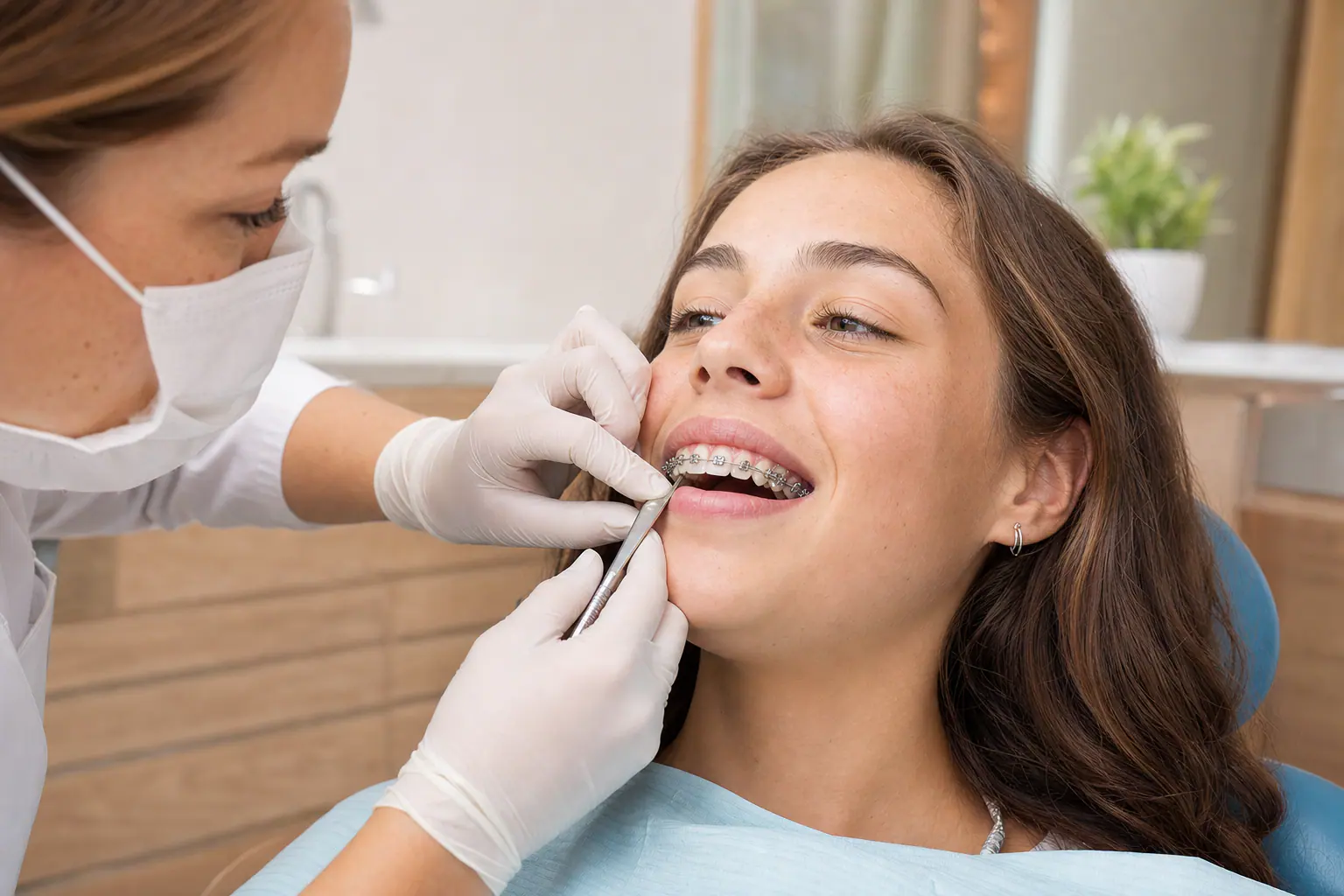
The difference between metal braces and ceramic braces
Metal braces
- ● More visible on the teeth
- ● Strong and suitable for many situations
- ● Withstands daily use well
- ● May be suitable for children and teenagers
- ● Allows the use of different rubber colors
- ● A practical choice for complex situations or those requiring precise control
Ceramic braces
- ● Less visible because the brackets are close to the color of the teeth
- ● A more aesthetic choice for adults and teens
- ● It works in a similar way to metallic
- ● Needs more attention to hygiene
- ● It may be more likely to stain rubber if proper handling and cleaning are not taken care of
- ● It may not be the first choice for all severe cases, according to the doctor’s assessment
The choice between metal and ceramic depends not only on the shape, but also on the orthodontic condition, the patient’s age, bite force, lifestyle, budget, and the ability to clean the teeth during treatment.
Which is better: metal or ceramic braces?
Metal braces may be better if
- ● The condition requires strong evaluative control
- ● Crowding or protrusion is evident
- ● The patient is an active child or teenager
- ● You want a practical and robust option
- ● Don't mind the orthodontic treatment showing up
- ● Needs complex stretches or movements
Ceramic braces may be better
- ● You want a less noticeable look
- ● You are an adult or teen and want a more aesthetic option
- ● You need fixed braces, not transparent templates
- ● You can commit to good cleaning
- ● There are no factors that make metal better for your condition
There is no type that is best for everyone. In the consultation, we explain the two options to you and explain which one is most suitable for your case and why.
What conditions do metal and ceramic braces treat?
- ● Crowded teeth
- ● Overlapping teeth
- ● Spaces between teeth
- ● Eruption of front teeth
- ● Deep bite
- ● Open bite
- ● Crossbite in some cases
- ● Teeth tilt
- ● Tooth rotation
- ● Irregular smile line
- ● Occlusal problems between the upper and lower jaw
- ● Teeth movement after previous braces
- ● Cases that require orthodontics before veneers, implants, or prosthetics
- ● Cases where teeth need to be arranged to facilitate cleaning
Who is suitable for metal and ceramic braces?
- ● Crowding of teeth
- ● Gaps between teeth
- ● Eruption of teeth
- ● Deep bite
- ● Open bite
- ● Crossbite
- ● Crooked or tilted teeth
- ● Uncomfortable occlusion
- ● Difficulty in cleaning teeth due to their irregularity
- ● Teeth restoration after previous braces
- ● Desire to arrange teeth before veneers or implants
- ● Healthy gums that allow for orthodontics
- ● Commitment to periodic reviews and cleaning
The final decision requires examination, pictures and x-rays when necessary.
Who may not be directly suitable for braces?
- ● Untreated caries
- ● Gingivitis
- ● Dense lime
- ● Movement of teeth due to gum problems
- ● Severe weakness in the bone supporting the teeth
- ● Broken teeth that need treatment
- ● Abscess or untreated pain
- ● Difficulty adhering to oral hygiene
- ● Unrealistic expectations about the duration or outcome of treatment
- ● Severe structural condition that requires advanced evaluation
- ● Severe squeaking requires a protection plan
Before braces, the teeth and gums must be in a condition that allows the teeth to be moved safely.
Types of fixed orthodontic treatment
What is metal braces?
Metal braces are the traditional and most common type of fixed braces. It is characterized by its strength and ability to deal with many cases, from simple crowding to more complex cases that require precise control of tooth movement. Metal braces are more visible than ceramic braces, but they are practical and effective in many cases.
- ● Children and adolescents
- ● Adults who want consistent, effective treatment
- ● Cases of dental crowding
- ● Cases of tooth eruption
- ● Spaces between teeth
- ● Deep bite
- ● Open bite
- ● Crossbite in some cases
- ● Cases that require orthodontic elastics
- ● Situations that require greater control than transparent templates
Metal braces are a strong and practical option, especially when the condition requires careful orthodontic control or long treatment.
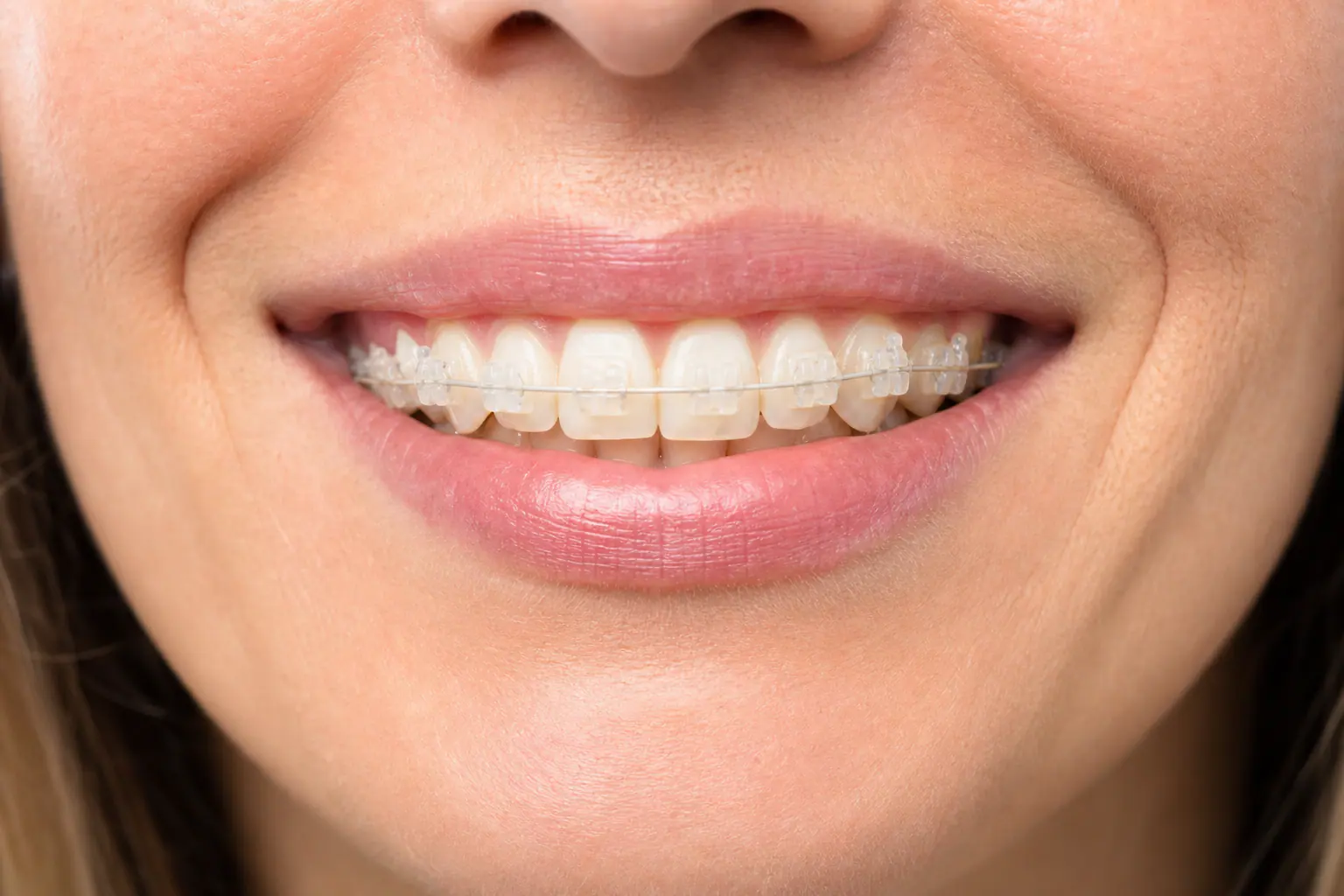
What is ceramic braces?
Ceramic braces are fixed braces that are similar to metal braces in the way they work, but they use ceramic brackets or a color close to the teeth, so they are less visible than metal braces. Ceramic braces are a more aesthetic choice than metal braces, but they require good care for hygiene and avoiding some habits that may affect their shape or the elastics associated with them.
- ● Adults who want a calmer appearance during treatment
- ● Teenagers who prefer less visible braces
- ● Patients who need fixed braces but do not want the obvious metal look
- ● Some cases of crowding, protrusion, and voids
- ● Cases for which clear braces are not suitable
- ● Patients who are able to maintain good dental hygiene
Ceramic braces work in a similar way to metal braces, but require a greater commitment to cleanliness to maintain their appearance.
Important topics in metal and ceramic braces
Metal and ceramic braces to treat crowded teeth
Crowded teeth are one of the conditions for which fixed braces are most suitable. When teeth are overlapping or crooked, braces help gradually move them into a more regular row.
- ● Arrangement of overlapping teeth
- ● Reduce the difficulty of brushing teeth
- ● Improving the shape of the smile
- ● Reducing the accumulation of plaque between the teeth
- ● Improved occlusion
- ● Preparing teeth for later cosmetic or restorative treatments
Metal and ceramic braces to treat gaps between teeth
If you have gaps between your teeth due to the distribution or tilt of your teeth, braces may help close the spaces gradually and orderly. In some cases, we may need to combine braces with cosmetic fillings or veneers if the teeth are small in size.
- ● Multiple spaces between teeth
- ● Gaps between the front teeth
- ● Gaps resulting from teeth tilt
- ● Spaces returned after a previous evaluation
- ● Gaps associated with malocclusion
- ● Need for stabilizer after closing
Metal and ceramic braces to treat protruding teeth
The protrusion of the front teeth may require fixed braces if it is obvious or accompanied by crowding, difficulty closing the lips, or risk of injury to the front teeth.
- ● Return protruding teeth to a better position
- ● Improve lip closure
- ● Reducing the risk of front tooth injuries
- ● Improving the shape of the smile and profile
- ● Improving occlusion between teeth
- ● Reducing the need to file teeth before cosmetic surgery
Metal and ceramic braces to treat deep bites
In cases of a deep bite, the upper teeth cover the lower teeth more than normal. This may cause tooth erosion or pressure on the gums or roof of the mouth.
- ● Reduce excess overlap
- ● Improving the relationship of the upper and lower teeth
- ● Reduce wear of the front teeth
- ● Improved bite force distribution
- ● Protecting gums from pressure
- ● Preparing teeth for cosmetic or restoration if necessary
Metal and ceramic braces for treating open bite
An open bite occurs when the upper and lower teeth do not meet when the mouth is closed. It may be due to the habit of thumb sucking, tongue thrusting, or causes related to bite and jaw.
- ● Open bite closure
- ● Improve bite
- ● Improving pronunciation in some cases
- ● Treating the associated voids or protrusion
- ● Improving the relationship of the front teeth
- ● Stabilize the result after treatment
Metal and ceramic braces to treat crossbites
A crossbite occurs when the lower teeth are in front of the upper teeth, and may be dental or skeletal. In some cases, fixed braces can help correct tooth position and improve bite.
- ● Fixed orthodontic treatment
- ● Orthostatic elastics
- ● Expansion of the jaw in some cases of children
- ● Growth devices for children when needed
- ● Surgical evaluation of severe skeletal conditions in adults
Metal and ceramic braces for children
Children and teenagers are among the groups that benefit most from braces, especially during the growth stage of teeth and jaws. Metal braces may be suitable for many children due to their strength and durability, while some teens may choose ceramic braces if they are appropriate for their condition.
- ● Obvious crowding
- ● Eruption of the front teeth
- ● Deep or open bite
- ● Crossbite
- ● Gaps between teeth
- ● Permanent teeth appear out of place
- ● Fangs out of line
- ● Difficulty in brushing teeth
- ● Premature loss of baby teeth
- ● An oral habit that affected the teeth
Early evaluation helps know the best time for treatment. Check out the service
Metal and ceramic braces for adults
Adults can get braces in many cases, provided that the gums, bone and teeth are in appropriate condition. Age alone is not a contraindication, but treatment for adults requires more careful evaluation if there are fillings, crowns, implants, erosion, or gum disease.
- ● Old crowding
- ● Spaces that bother you
- ● Eruption of teeth
- ● Teeth restoration after previous braces
- ● Desire to arrange teeth before veneers
- ● Difficulty in cleaning teeth due to their irregularity
- ● Uncomfortable bite
- ● Desire for a fixed option instead of transparent templates
- ● A condition in which clear braces alone are not suitable
Many adults prefer ceramic braces because they are less noticeable, but metal braces may be a better option for some cases. Check out the service
Steps for installing metal and ceramic braces
First consultation
The doctor begins by examining the teeth and occlusion and listening to the patient’s complaint, whether it is crowding, protrusion, gaps, or a problem with the bite.
Pictures and x-rays
We may need pictures, x-rays, and dental scans to evaluate the roots, bone, relationship of the jaws, and the degree of the problem.
Develop a treatment plan
The doctor explains the appropriate type of braces, the expected duration of treatment, the need for extraction, expansion or elastics, and expectations of the result.
Cleaning and treating teeth before orthodontics
The patient may need teeth cleaning, tooth decay treatment, or gum treatment before braces are fitted.
Installation of brackets
Brackets are attached to the teeth and the first orthodontic wire is placed. Installation is often painless, but it takes time to get used to.
Periodic visits
The aligners are reviewed and the wires or elastics are adjusted according to plan.
Move the teeth gradually
The teeth move step by step until they reach a better position.
Termination of treatment
After achieving the desired result, the braces are removed and the teeth are cleaned.
Installing the stabilizer
A retainer is essential to maintain the result and reduce the possibility of teeth coming back.
Care guide and frequently asked questions during braces
Is braces installation painful?
Fitting the braces itself is often not painful, but after fitting or after adjustments, the patient may feel pressure or discomfort in the teeth for several days. This feeling is normal because it indicates that the teeth are starting to respond to movement.
- ● Pressure on teeth
- ● Temporary difficulty in chewing
- ● Slight friction on the inside of the cheek or lip
- ● Need to eat soft foods for the first days
- ● Discomfort after tightening braces or changing wires
- ● Need to use orthodontic wax if brackets cause friction
If the pain is severe or there is a persistent wound or wire that is tingling, you should see the clinic.
How long does metal and ceramic braces treatment last?
The duration of orthodontic treatment varies from one patient to another. Some simple cases may require a shorter period, while complex cases that include severe crowding, a deep bite, protrusion, or dislocation may require a longer time.
- ● Intensity of crowding or prominence
- ● Type of occlusal problem
- ● The patient's age
- ● Gum and bone health
- ● Adherence to appointments
- ● Adhere to elastics if prescribed
- ● Cleaning teeth during treatment
- ● Need for orthodontic extraction
- ● Need for expansion or additional hardware
- ● The speed of the teeth’s response to movement
- ● Broken blockers or delayed reviews
The exact duration cannot be determined without an orthopedic examination, but the approximate duration after diagnosis is indicated.
Do ceramic braces stain?
Ceramic brackets themselves are often relatively resistant to staining, but the elastics or bands used around the brackets may be affected by colored foods and drinks. Therefore, ceramic braces require greater care in hygiene and avoiding some habits.
- ● Limit coffee, tea and colored drinks
- ● Avoid smoking
- ● Brush teeth after eating
- ● Clean around the brackets well
- ● Adhere to the rubber change times
- ● Avoid heavily colored sauces
- ● See the clinic if the color of the elastics changes disturbingly
Ceramic braces are an aesthetic choice, but they require daily attention to maintain their appearance.
Are metal braces more suitable for children than ceramic braces?
Metal braces are often a practical choice for many children and teens because they are strong and can withstand daily use. As for ceramic braces, they may be suitable for some older teenagers or adults who care about appearance, provided that they adhere to cleanliness and care.
- ● The child is very active
- ● The case needs higher tolerance
- ● The child loves choosing the colors of the rubber bands
- ● Commitment to cleanliness requires follow-up
- ● The condition requires vigorous movement or long treatment
But the final decision depends on the situation, cooperation, and the desire of the parents and child.
Eating with metal and ceramic braces
During braces, you should avoid certain foods that may break the brackets, bend the wires, or get stuck tightly around the braces. You can eat normally with some modifications, such as cutting food into small pieces and avoiding direct biting on hard objects.
- ● Hard nuts
- ● Chewing gum
- ● Caramel and sticky sweets
- ● Snow
- ● Hard popcorn
- ● Bite whole apples or carrots without cutting them
- ● Very hard foods
- ● Opening objects with teeth
- ● Biting pens or nails
- ● Tough meat or large pieces without cutting
Avoiding sticky and tough foods reduces blocker breakage and treatment delays.
Teeth cleaning with braces
Cleaning your teeth with braces is very important because food and plaque easily collect around the brackets and wires. Poor cleaning may lead to white spots, cavities, gingivitis, or bad breath.
- ● Brush your teeth after every meal as much as possible
- ● Use a soft brush or straightening brush
- ● Clean around the brackets from the top and bottom
- ● Use interdental brushes as recommended
- ● Use floss intended for braces if possible
- ● Use a suitable lotion if recommended by your doctor
- ● Reduce sugar and soft drinks
- ● Attend regular cleaning at the clinic
- ● Do not ignore bleeding gums
- ● Watch for any white spots around the brackets
Related page: Teeth cleaning before and during braces. Check out the service
White spots during braces
White spots may appear around the brackets due to plaque buildup and poor dental cleaning. These spots may be the beginning of weakening of the enamel or the beginning of decay, so preventing them is very important.
- ● Clean the teeth well around the braces
- ● Limit sweetened drinks
- ● Avoid eating frequent sweets
- ● Use a suitable fluoride toothpaste
- ● Commit to regular cleaning
- ● See a doctor if you notice a discoloration around the brackets
- ● Do not wait until the pits or pain appear
Braces arrange the teeth, but hygiene maintains dental health during treatment.
What should I do if the bracket breaks or the wire comes out?
A bracket may break or a wire may come out due to hard foods, a wrong bite, or a simple accident. Do not attempt to repair braces yourself in a way that may harm your gums or teeth.
- ● Call the clinic to book an appointment
- ● Use orthodontic wax if the wire cuts your cheek or lip
- ● Do not cut the wire unless directed by your doctor in an emergency
- ● Do not leave a broken bracket on for a long time
- ● Avoid hard foods until repaired
- ● If you accidentally swallow a small piece and feel shortness of breath or severe pain, seek medical help immediately
Repairing faults quickly helps not to delay treatment.
Orthodontic elastics
The doctor may ask some patients to use intermaxillary elastics to improve occlusion. These elastics are an important part of treatment, not just a simple addition.
- ● Improving the relationship of the upper and lower jaw
- ● Protrusion correction
- ● Treating some cases of deep or open bite
- ● Improved gap closure
- ● Adjust final occlusion
Failure to adhere to the elastics may prolong the duration of treatment or affect the result, so they must be used according to the doctor’s instructions.
Metal braces colors
In metal braces, patients can choose the colors of the elastics in many cases. This makes the braces more fun for children and teens, and the patient may change the color at periodic visits. As for ceramic braces, patients often prefer to choose elastics that are clear or close to the color of the teeth to maintain a less noticeable appearance.
- ● Calm colours
- ● Clear colors
- ● Seasonal colours
- ● School or team colors
- ● One or more colors depending on availability
- ● Transparent or tooth-colored elastics in ceramic braces
Choosing the color of the elastics makes the braces experience more enjoyable for children and teens.
Metal and ceramic braces or clear braces?
Metal and Ceramic Braces
- ● Fixed and the patient does not need to remember to wear it
- ● Suitable for many simple and complex cases
- ● It gives the doctor precise control over tooth movement
- ● Needs more care when eating and cleaning
- ● It is visible, especially metallic
Clear Aligners
- ● Less visible
- ● Removable for eating and cleaning
- ● Requires strict commitment to wearing casts
- ● Suitable for some simple and moderate cases
- ● May not be suitable for all complex cases
Choosing the appropriate type depends on the situation and not just the desire for appearance. Check out the service
Can braces be made with fillings or crowns?
Yes, braces can be done with fillings or crowns in many cases, but they must be evaluated before starting. Some teeth may need treatment or adjustment before braces are fitted.
- ● Safety of fillings
- ● The presence of cavities around the fillings
- ● Condition of crowns
- ● Gum health around crowns
- ● Having dental implants
- ● Missing teeth
- ● Occlusion of restorations
- ● The need for restorations after orthodontics
If you have an implant, you should know that the implant does not move like natural teeth, so it is involved in the orthodontic planning in a special way.
Braces before veneers or Hollywood smile
Some patients want veneers to treat crowding or minor protrusion, but braces may be the best option before cosmetic surgery in many cases. Getting the teeth in order first may reduce the need for filing teeth and make the veneers more natural.
- ● Reduce crowding
- ● Improved occlusion
- ● Reduce prominence
- ● Distribute the spaces correctly
- ● Reduce the need for significant cold
- ● Improve smile result
- ● Protecting the veneer from breakage due to occlusion
Successful cosmetic surgery begins with the correct position of the teeth, not just with color and shape. Check out the service
Braces with dental implants or missing teeth
If you have a missing tooth and need an implant or bridge, braces may be part of the plan before replacement. In some cases, we need to open or regularize the space before implanting the tooth.
- ● Opening a suitable area for agriculture
- ● Adjusting the inclination of adjacent teeth
- ● Improving occlusion before implantation
- ● Better tooth distribution
- ● Facilitating implant crown design
- ● Improving the shape of the smile before compensation
Braces may help prepare the space and occlusion before implantation or bridgework. Check out the service
Do braces cause cavities?
Braces themselves do not cause cavities, but poor tooth cleaning during braces may lead to the accumulation of plaque around the brackets, increasing the risk of cavities and white spots.
- ● Clean teeth well
- ● Reducing sugars
- ● Use fluoride toothpaste
- ● Regular cleaning in the clinic
- ● Do not postpone treatment for any pain or tooth decay
- ● Follow your doctor's instructions
A beautiful orthodontic result requires healthy teeth, not just neat teeth.
Do braces weaken teeth?
With good planning and proper follow-up, braces should not weaken teeth. But moving teeth requires healthy gums and bone, so the gums and teeth must be examined before treatment.
- ● Braces were started with severe gingivitis
- ● There was untreated gum disease
- ● The patient did not comply with the reviews
- ● Cleaning was poor
- ● Inappropriate forces were used
- ● The patient neglected the doctor’s instructions
- ● There is a squeak or intense non-continuous pressure
For this reason, braces must be under medical supervision and regular follow-up.
Dental retainer after metal and ceramic braces
After removing the braces, a very important stage begins, which is the retainer. Without a retainer, the teeth may gradually move and problems such as crowding, gaps, or protrusion may return.
- ● Movable stabilizer
- ● Fixed retainer behind the teeth
- ● A combination of the two depending on the situation
- ● Maintaining dental arrangement
- ● Reduce crowding back
- ● Keep gaps closed
- ● Occlusal fixation
- ● Protect the result of treatment
- ● Reduces the need for new braces later
The retainer is an essential part of the success of orthodontic treatment and should not be neglected. Check out the service
When do I see a doctor during braces?
You must adhere to the regular appointments determined by the doctor, but there are cases that require contacting the clinic before your appointment.
- ● Bracket fracture
- ● A wire cuts the cheek or gum
- ● Severe pain that does not improve
- ● Severe swollen or inflamed gums
- ● Persistent bleeding gums
- ● An elastic or an important part of the braces falls off
- ● Loss or breakage of a device or elastics
- ● Extreme difficulty eating
- ● Clear white spots appear
- ● Tooth decay or pain
- ● Long delay in the date of the amendment
Regular follow-up helps the treatment succeed and not delay it.
Common errors during orthodontic treatment
Some errors may prolong the duration of treatment or affect the result.
- ● Eat nuts or tough foods
- ● Chewing gum
- ● Neglecting to brush your teeth
- ● Do not use elastics as prescribed by the doctor
- ● Postpone appointments
- ● Broken brackets are not repaired quickly
- ● Drink sweetened beverages often
- ● Failure to treat bleeding gums
- ● Expect a very quick result
- ● Comparing the situation with the situation of another person
- ● Do not use a retainer after removing the braces
- ● Choose the type of braces based on the shape only without evaluating the condition
Orthodontics requires a partnership between the doctor and the patient throughout the treatment period.
Metal and ceramic braces in Al Shamkha - Abu Dhabi
If you are looking for metal and ceramic braces in Abu Dhabi or braces in Al Shamkha, AHLI Specialists Medical Center offers a comprehensive orthodontic evaluation to determine the best type of braces for your condition.
We help you determine whether metal braces, ceramic braces, clear braces, or another treatment plan is most appropriate for your case, depending on the shape of your teeth, occlusion, gums, and your aesthetic needs.

Why choose AHLI Specialists Medical Center?
- ✓ A comprehensive evaluation before installing the braces
- ✓ Multiple braces options: metal, ceramic, clear
- ✓ Treating crowded teeth, gaps, protrusion, and occlusal problems
- ✓ Clearly explain the difference between metal and ceramic braces
- ✓ Periodic follow-up of tooth movement
- ✓ Detailed cleaning instructions during straightening
- ✓ Evaluate the health of your gums and teeth before treatment
- ✓ Sticky plan after the end of the orthodontic treatment to maintain the result
- ✓ Location close to Al Shamkha, Baniyas, Al Falah, Shakhbout and Abu Dhabi areas
- ✓ A quiet medical environment suitable for families
Services related to metal and ceramic braces
Orthodontics
Home page for orthodontic and occlusal correction services.
Clear Aligners
A less noticeable option for some crowding, gaps and protrusions.
Dental retainer after orthodontics
It is important to maintain the orthodontic result after removing the brackets.
Treatment of crowded teeth
A service related to cases of overlapping teeth and limited spaces.
Treating gaps between teeth
A service related to closing spaces between teeth with braces or cosmetic solutions.
Open bite treatment
A service related to cases of non-contact of teeth when the mouth is closed.
Deep bite treatment
A service related to cases of excessive overlap of the upper teeth over the lower ones.
Crossbite treatment
A service related to cases where the lower teeth advance in front of the upper teeth.
Protruding teeth treatment
A service related to cases of prominent front teeth.
Teeth cleaning
It is important before and during braces to maintain healthy gums and teeth.
Pediatric dentistry
Follow up on children before and during the evaluation phase.
Dental Veneers
It may be an option after braces to improve shape or color in specific cases.
When should I book an appointment for metal or ceramic braces?
The first step is a comprehensive orthodontic examination to determine the appropriate type and treatment plan.
AHLI Specialists Medical Center - Al Shamkha, Abu Dhabi
For reservations and inquiries: 02-448-7553
Location: Al Qayed Street, Al Shamkha, Abu Dhabi
Short answers
What are metal and ceramic braces?
Metal and ceramic braces are two types of fixed braces that use brackets and wires to gradually move teeth and correct crowding, gaps, protrusion, and occlusal problems.
What is the difference between metal and ceramic braces?
Metal braces are clearer, stronger, and more practical, while ceramic braces use brackets that are close to the color of the teeth to be less noticeable, but require greater attention to hygiene.
Which is better, metal or ceramic braces?
Which is best depends on the situation. Metal is suitable for many cases and is strong, while ceramic is suitable for those who want a less noticeable appearance if their condition allows it.
Do ceramic braces treat the same problems as metal braces?
In many cases yes, because they work in a similar way. However, in some complex cases, metal braces may be more practical, according to the doctor’s assessment.
Where can I find metal and ceramic braces in Abu Dhabi?
A metal and ceramic braces consultation can be booked at AHLI Specialists Medical Center in Al Shamkha - Abu Dhabi to evaluate the condition and choose the appropriate type of braces.
Orthodontists

Frequently asked questions about metal and ceramic braces
Are metal braces painful?
Are ceramic braces clear?
Do ceramic braces stain?
Are metal braces better for children?
Are ceramic braces suitable for adults?
Can crowding be treated with metal or ceramic braces?
Can gaps be treated with fixed braces?
Can protruding teeth be treated with metal or ceramic braces?
Does braces require teeth extraction?
How long do metal and ceramic braces last?
Is it possible to eat normally with braces?
How do I clean my teeth with braces?
Do braces cause cavities?
What do I do if the braces break?
Is a retainer necessary after braces?
Book a metal and ceramic braces consultation
A comprehensive evaluation and explanation of the difference between metal and ceramic — a treatment plan suitable for your condition.