
Dental implants in Abu Dhabi
Replacing missing teeth with safe and studied implants at AHLI Specialists Medical Center - Al Shamkha
Have you lost a tooth and want to replace it permanently?
Do you find it difficult to chew due to missing teeth?
Do you have a moving denture that is causing you discomfort or instability?
Are you afraid that losing teeth will change the shape of your smile or weaken your bones?
Are you looking for dental implants in Abu Dhabi or dental implants in Al Shamkha near Baniyas, Al Falah and Shakhbout?
Dental implants are one of the most important modern solutions to replace missing teeth, because they aim to replace the root of the missing tooth with an implant inside the jaw bone, then install a crown, bridge, or fixed denture over it, depending on the case. But the success of the implant does not depend on placing the implant only, but rather on a comprehensive examination, bone assessment, gum health, careful planning, choosing the appropriate type of prosthesis, and follow-up after treatment.
At AHLI Specialists Medical Center in Al Shamkha - Abu Dhabi, we provide dental evaluation and implantation services within an individual treatment plan that suits the condition of the mouth, the number of missing teeth, bone quality, gum health, occlusion, age, and the functional and cosmetic needs of the patient.
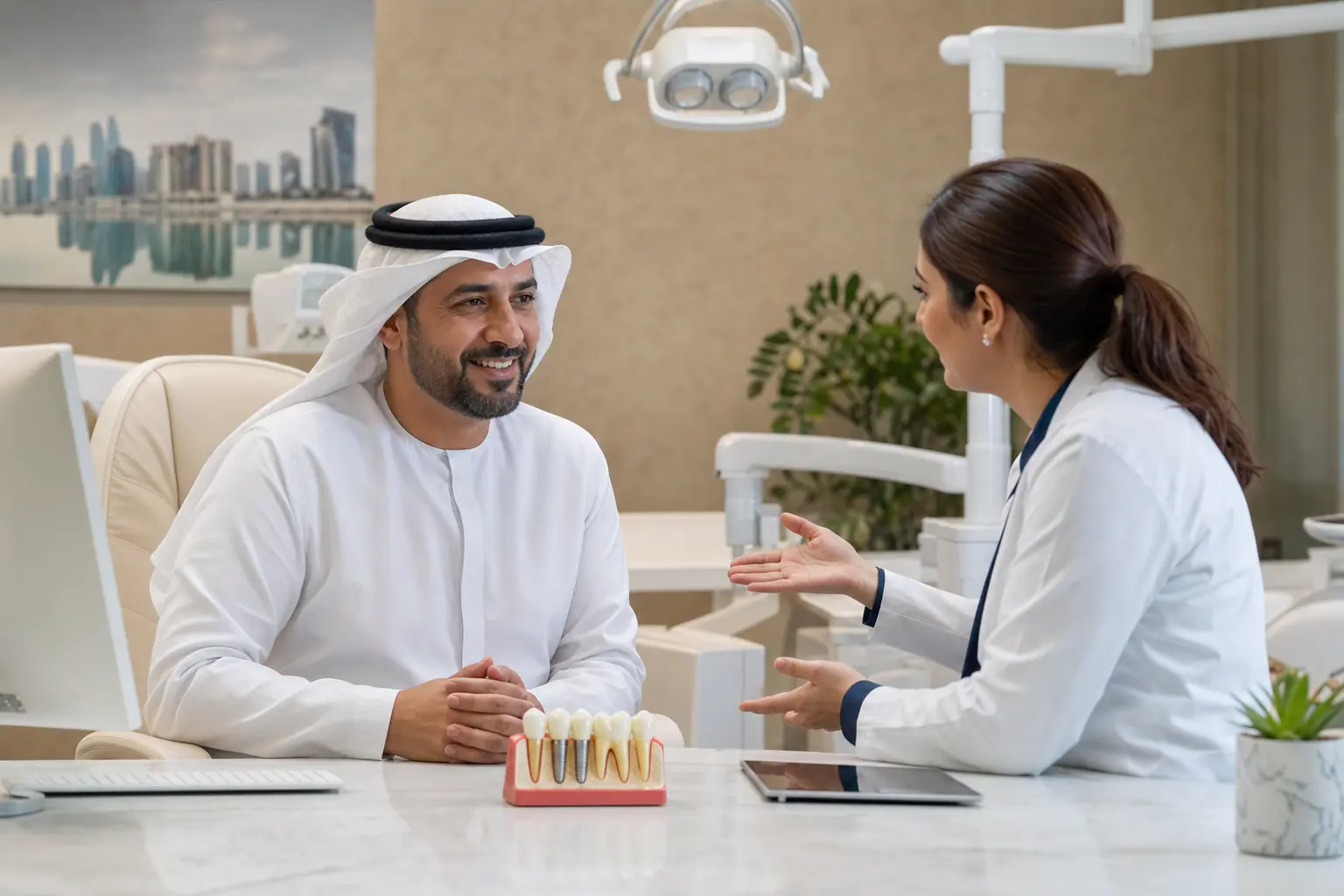
Comparison: implant, bridge and denture
We honestly explain the differences — and help you choose what's right for you.
Dental implants
Fixed compensation
- ●There is no restoration of adjacent teeth in many cases
- ●Supports the jaw bone
- ●Normal appearance and function
- ●Long term solution
Fits: Who wants consistent, natural-looking compensation
Dental bridge
Fixed alternative
- ●It depends on the adjacent teeth
- ●Adjacent teeth may need to be filed
- ●Suitable if adjacent teeth need crowns
- ●Faster in some cases
Fits: When adjacent teeth need treatment
Moving kit
Removable
- ●Often lower initial cost
- ●Less stable and comfortable
- ●It may need modifications over time
- ●It can be supported with implants in some cases
Fits: A temporary solution or when direct planting is not suitable
What are dental implants?
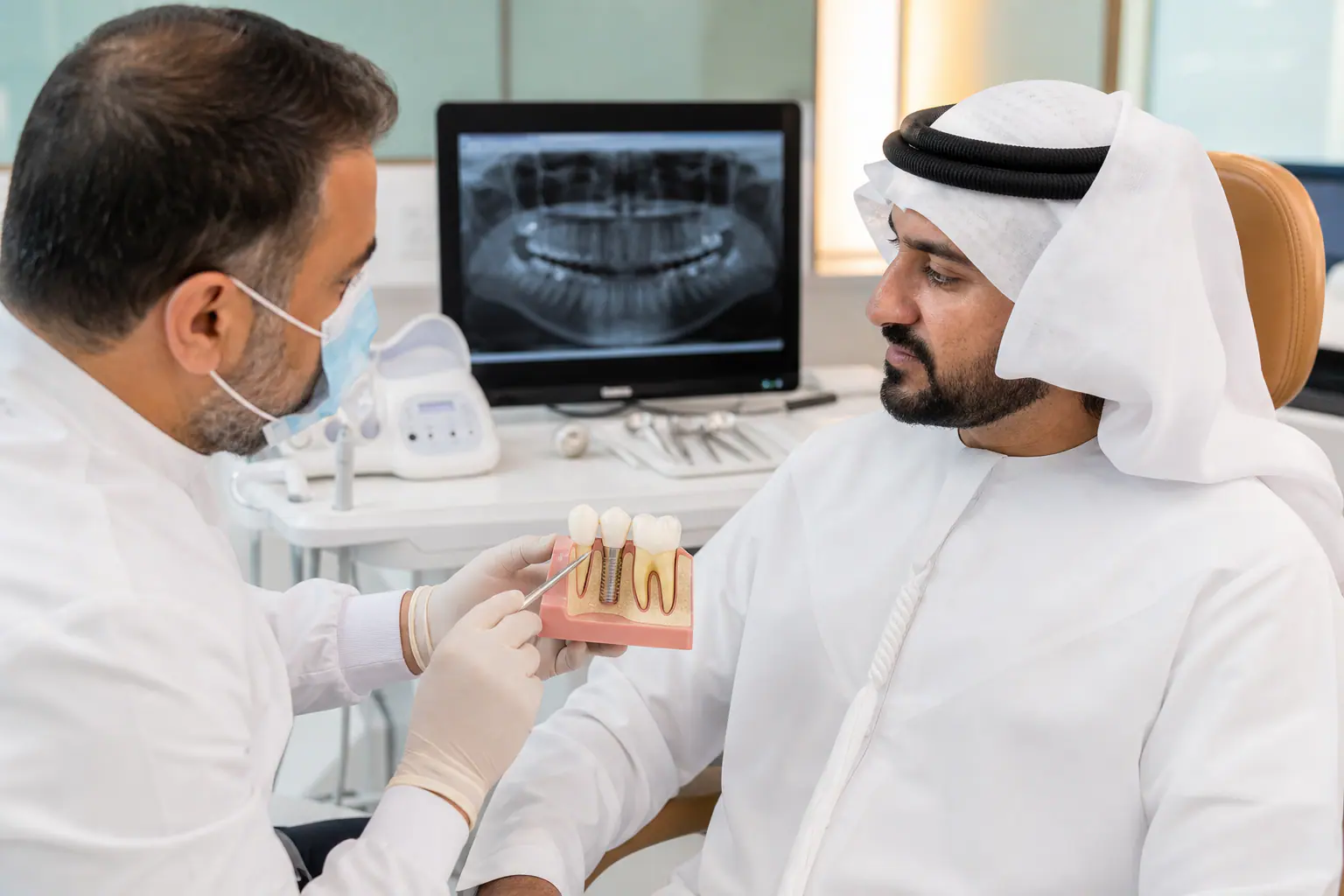
A dental implant is a procedure in which an implant, often in the form of a small custom screw, is placed inside the jawbone in place of the root of a missing tooth. After the implant has healed with the bone, an abutment and crown, bridge, or fixed prosthesis are placed over it, helping to restore the tooth's shape and function.
Implant body
The part that is placed inside the jawbone to act as a replacement for the tooth root.
prop
The piece that connects the implant to the crown or final prosthesis.
Crown or final compensation
The visible part that resembles a tooth, and is designed in terms of color, shape, and size to blend in with the surrounding teeth.
Implants may be used to replace one tooth, several teeth, or entire teeth in the jaw, depending on the case.
Why are missing teeth replaced?
Losing one or more teeth not only affects appearance, but may affect oral health, chewing ability, and dental balance.
Replacing a missing tooth in a timely manner may help maintain oral function, tooth symmetry, and smile.
Why are dental implants an important option?
Dental implants may be a suitable option for many cases of tooth loss because they replace the tooth in a stable way without the need to file the adjacent teeth as happens in some types of traditional bridges.
But transplantation is not automatically suitable for everyone, and the condition must be evaluated before making a decision.
Who is suitable for dental implant treatment?
Dental implants may be appropriate if you are missing one or more teeth, have general and oral health that allows for the procedure, and sufficient or prepareable bone for implantation.
- ● One missing tooth
- ● Several teeth are missing
- ● An unstable moving set
- ● Difficulty chewing due to missing teeth
- ● Healthy adjacent teeth that you do not want to file to create a bridge
- ● Desire for consistent, natural-looking compensation
- ● Gums that are in good health or treatable
- ● Sufficient bone to support the implant or possible bone grafting
- ● Commitment to daily care and periodic reviews
The examination is what determines whether an implant is the best option or whether a bridge, denture, or other treatment is more suitable for your condition.
Who may not be suitable for direct dental implants?
Implantation may not be suitable immediately in some cases, or it may require preparation and treatment before starting.
- ● Untreated gingivitis
- ● Severe bone deficiency
- ● Caries or infections in adjacent teeth
- ● Heavy smoking
- ● Uncontrolled diabetes
- ● Grinding or intense pressure on the teeth
- ● Severe poor oral hygiene
- ● Diseases or medications that affect bone healing
- ● History of radiation treatments in the jaw area
- ● Unrealistic expectations about time or outcome
- ● Inability to commit to reviews and care
The presence of these factors does not always mean that transplantation is impossible, but it does mean that the condition needs careful evaluation and a safe plan before starting.
Types of dental implants depending on the case
Single tooth implant
It is used to replace one missing tooth with one implant and one crown. This option often preserves adjacent teeth without having to file them, if the condition is appropriate.
Details ←Instant cultivation
In some cases, the implant can be placed at the same time as a tooth extraction, provided that adequate bone is available, there is no severe active inflammation, and adequate initial stability of the implant.
Details ←Full jaw implant
Used when a patient is missing most or all of the teeth in one or both jaws, a full bridge or fixed denture may be supported by a certain number of implants depending on the plan.
Details ←Bone evaluation before transplantation
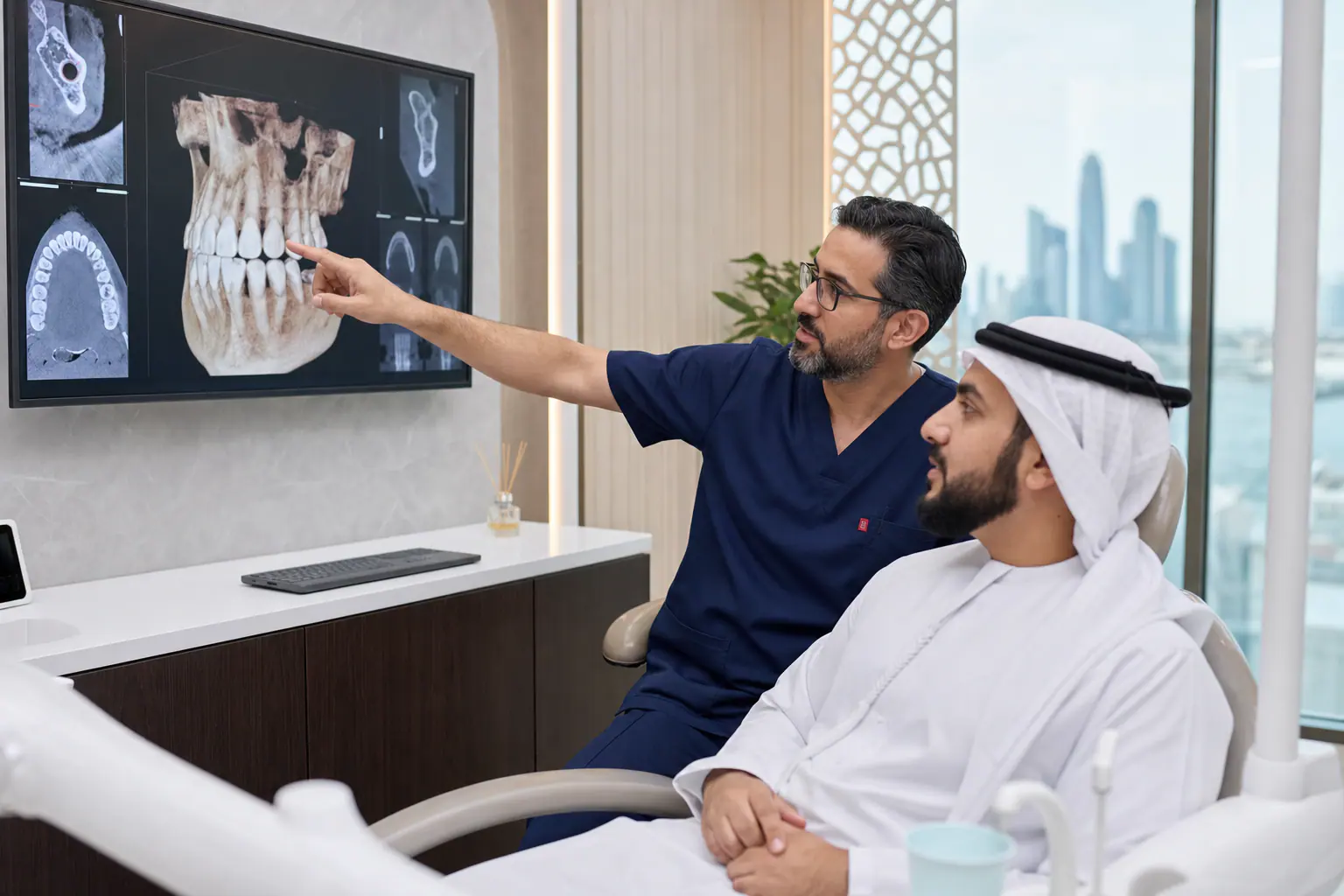
Before implantation, it is necessary to ensure that there is an adequate amount and quality of bone to support the implant. Some cases require 3D x-rays or detailed evaluation.
Details ←Implant crown
After the implant is stabilized and healed, the final crown or prosthesis is placed over the implant. Crown quality is very important for shape, chewability, occlusion, and ease of cleaning.
Details ←Dental implants for the elderly
Age alone is not a contraindication for transplantation. What is important is general health, bone condition, gum health, ability to care, and medications or comorbidities.
Details ←What is the difference between implantation and bridge?
Dental implants
An implant is placed inside the jawbone and then a crown is placed on it. You often do not need to file adjacent teeth if they are healthy.
Traditional bridge
It depends on the teeth adjacent to the space, as they are filed to form supports for the bridge. It may be a suitable option if adjacent teeth already need crowns.
There is no one answer for everyone. The decision depends on examination, x-rays, gum health, bone condition, budget, time, and patient preference.
What is the difference between implants and mobile dentures?
Dental implants
They provide fixed or semi-fixed compensation depending on the situation, and may help improve stability, chewing and confidence.
Moving kit
It can replace several teeth or the entire jaw, often at a lower cost, but may move or cause discomfort for some patients.
In some cases, the goal is not to replace every tooth with an implant, but rather to use a number of implants to improve the stability of the removable denture.
What is the difference between a single tooth implant and a full jaw implant?
Single tooth implant
Replaces a missing tooth with an implant and crown. The goal is often to restore shape and chewiness in a specific area.
Full jaw implant
Treats multiple or complete tooth loss. The plan is larger and includes the number of implants, type of compensation, occlusion, smile shape, and daily cleaning.
Full jaw implants require comprehensive planning because they do not replace only one tooth, but rather rebuild function and an entire smile.
Why is bone evaluation important before transplantation?
The implant needs suitable bone in terms of quantity, density and location. If an implant is placed in inappropriate bone or without careful planning, the risk of implant failure or subsequent problems may increase.
Pre-transplant planning is an essential part of treatment success.
Do I need bone grafting before transplantation?
Some patients may need a bone graft if the jaw bone is insufficient to support the implant. Osteopenia sometimes occurs after prolonged tooth loss, chronic inflammation, old extractions, injury, or gum disease.
- ● Losing a tooth years ago
- ● Receding shape of the gums or bone
- ● Previous periodontitis
- ● Difficult dislocation or bone loss
- ● Desire for cosmetic implants in the anterior area
- ● A clear decrease in jaw thickness
- ● Need for full jaw implant
- ● A previous evaluation told you that the bone was insufficient
Bone grafting does not always mean that implantation is difficult, but it may be a necessary step to obtain better stability and a safer result.
What is instant farming?
Immediate implantation means placing the implant at the same time as the tooth extraction or immediately after it in specific cases. It may be a suitable option for some patients because it reduces the number of stages and helps maintain the shape of the gums and bone in some cases.
Not every extraction case is suitable for immediate transplantation. Sometimes it is better to extract the tooth, clean the area, wait or place bone, and then implant later.
Dental implant steps
Consultation and examination
A comprehensive examination of the mouth, teeth and gums, and knowledge of the history of tooth loss and general health condition.
Radiology and bone evaluation
2D or 3D x-rays, depending on the case, to evaluate the bone, adjacent roots, and nerves.
Develop a treatment plan
Determine the number of implants, their locations, type of compensation, and chronological order.
Treating existing problems
Treating gums, removing cavities, extracting an untreatable tooth, or cleaning teeth before starting.
Implant placement
Place the implant inside the bone under local anesthesia according to appropriate planning.
Healing period
Time for the bone to heal around the implant — time varies depending on the condition and location of the implant.
Installing the stent
After ensuring the stability of the implant, the abutment is installed to receive the crown.
Crown design and installation
Taking measurements or digital scanning to design the implant crown in terms of colour, shape and size.
Follow-up and maintenance
Periodic reviews and good cleaning around the implant to maintain healthy gums and bone.
How long do dental implants take?
The duration of dental implant treatment varies from one case to another. Some simple cases may be completed faster, and some cases may require several months if there is a dislocation, infection, bone grafting, or a need to wait for the bone to heal.
It is best not to compare your condition with someone else's condition, because the transplant plan varies depending on the examination and x-rays.
Are dental implants painful?
Dental implants are often performed under local anesthesia, and the patient feels pressure or movement more than pain. After the procedure, you may feel discomfort, slight swelling, or mild to moderate pain, depending on the condition.
- ● The case is well planned
- ● Inflammation is treated before transplantation
- ● The patient adheres to post-operative instructions
- ● Avoid smoking after the procedure
- ● Take medications as prescribed by the doctor
- ● See a doctor if any abnormal pain appears
If you are afraid of dental implants, tell the doctor at the consultation so that the steps can be explained and you can be reassured before starting.
Are dental implants safe?
Dental implants are a popular procedure that is successful in many cases when planned, implemented and followed up properly. But like any surgical procedure, there are potential risks that should be known before treatment.
- ● Inflammation in the implant area
- ● Failure of the implant to bond to the bone
- ● Pain or swelling after surgery
- ● Temporary bleeding or bruising
- ● Nerve involvement in rare cases
Good evaluation, appropriate x-rays, careful case selection, and post-transplant care reduce these risks.
What are the success factors for dental implants?
Implantation is not a process that ends only after installing the crown, but rather requires care and follow-up to maintain it.
Does smoking affect dental implants?
Yes, smoking may affect the healing of gums and bone, and increases the possibility of infections and implant problems. The doctor may advise you to stop or reduce smoking before and after the transplant, especially during the healing period.
Dental implants and diabetes
Diabetes does not always prevent transplantation, but it should be under control as much as possible. Uncontrolled diabetes may affect wound healing and increase the risk of infection. The doctor may need to coordinate with the treating physician when necessary.
Dental implants with bruxism
Teeth grinding or nighttime pressure may put excessive force on implants and crowns. If you have bruxism, you may need to have your bite evaluated, use a night guard after the prosthesis is fitted, and have regular follow-ups.
Implant crown: why is it important?
Many people focus on the implant itself, but the final crown is very important. The crown is the part that appears in the mouth and is used for chewing and smiling.
- ● It is compatible with adjacent teeth
- ● It is suitable for biting and chewing
- ● Does not put pressure on the gums incorrectly
- ● Allows cleaning around the implant
- ● It is not loud or annoying in occlusion
- ● Be properly installed
- ● It achieves a special aesthetic result in the front teeth
If the implant is excellent but the crown does not fit, problems with comfort, shape, or cleaning may arise.

Special cases in dental implants
Front tooth implants
Front tooth implants require more attention to the cosmetic aspect, because the tooth appears when smiling and speaking.
- ● The amount of bone in the anterior region
- ● Gum shape and level
- ● Crown color
- ● Accurate implant location
- ● The need for bone or gum grafts
- ● Smile line
Posterior dental implants
The back teeth are important for chewing and distributing force. Loss of a back molar may cause the patient to chew on one side.
- ● Bone strength
- ● The distance between the jaws
- ● Near the sinuses or jaw nerve
- ● Withstand chewing force
- ● Design the crown appropriately
- ● Clean the area around the implant
Dental implants for the elderly
Seniors may benefit from dental implants if their general and oral health allows it. Age alone is not a problem.
- ● Improve chewing
- ● Install the moving kit
- ● Improve confidence while speaking
- ● Support daily nutrition and comfort
- ● Consider chronic diseases and medications
Full jaw implant
Full jaw implants are suitable for some people who have lost most or all of their teeth. A specific number of implants may be used to support a fixed bridge or a complete prosthesis.
- ● Evaluate the entire jawbone
- ● Occlusion study
- ● Smile shape
- ● Type of final compensation
- ● Possibility of cleaning
- ● Gum health
Care after dental implants
- ● Do not touch the planting site with your tongue or fingers
- ● Avoid forceful rinsing the mouth for the first day, according to the doctor’s instructions
- ● Take medications as prescribed by the doctor
- ● Avoid smoking
- ● Eat soft food at first
- ● Avoid chewing on the implant site if requested
- ● Maintain gentle oral hygiene
- ● Use cold compresses as directed by your doctor
- ● See a doctor on time
- ● Contact the clinic if there is severe pain or abnormal swelling
Post-transplant instructions may vary depending on the type of procedure, so you must follow your doctor's instructions specific to your condition.
How do I maintain dental implants after installation?
- ● Brush your teeth twice daily
- ● Use floss or interdental brushes as recommended
- ● Clean around the implant crown well
- ● See a doctor periodically
- ● Clean teeth and implants in the clinic regularly
- ● Avoid smoking as much as possible
- ● Do not use teeth to break hard objects
- ● Use a night guard if you have stridor
- ● Watch for any bleeding or swelling around the implant
- ● Do not ignore any movement, pain or change in the crown
The implant does not suffer from decay, but the gums and bone around it can become affected by infection if they are not cleaned well.
Signs that need to be reviewed after transplantation
Early review helps solve the problem before it develops.
Are dental implants permanent?
Dental implants can be a very long-term solution with good planning and proper care, but they are not guaranteed for life without follow-up.
- ● Maintain oral hygiene
- ● See a doctor periodically
- ● Treat gums early
- ● Avoid smoking
- ● Use a night protector if prescribed by your doctor
- ● Do not neglect any pain or movement
- ● Maintain professional cleaning around the implants
Implants require maintenance like any important dental treatment.
Common mistakes before dental implants
- ● Choosing transplantation without a comprehensive examination
- ● Ignoring periodontal treatment before implantation
- ● Not taking appropriate x-rays when needed
- ● Urging immediate transplantation in unsuitable condition
- ● Ignore bone deficiency
- ● Hiding health information or medications from the doctor
- ● Continue smoking heavily
- ● Expect the final tooth to be installed immediately in all cases
- ● Compare the duration of treatment with another person’s condition
- ● Neglecting to clean the mouth after transplantation
- ● Not attending follow-up appointments
- ● Ignore teeth grinding
- ● Choose treatment based only on price

Before your consultation — ask yourself
- ? Do you have one or more missing teeth?
- ? Do you use a moving kit?
- ? Do you have difficulty chewing?
- ? Have you lost your tooth a long time ago?
- ? Do you smoke or have diabetes?
- ? Do you have teeth grinding?
Dental Implant Services
Single tooth implant
A steady solution to compensate one missing age with a crown over a plant.
Instant cultivation
Assess the possibility of placing the transplant immediately after the dislocation in appropriate cases.
Full jaw implant
Replacing missing teeth in the entire jaw with a number of implants.
Bone evaluation
Examine the quantity and quality of the bone and determine the need for skeletal flare.
Implant crown
Design and installation of the final crown over the plantation.
Agriculture for the elderly
Transplant evaluation of older patients with general health in mind.
Book the dental consult.
The first step is to examine and assess the bone and the gum, then determine the appropriate plan for your situation.
Why AHLI Dental Implant Center?
Comprehensive pre-implant evaluation
Examination, radiation, bone assessment-- we don't start without a clear plan.
Careful planning
Plan based on state of bone, gum and applicability.
Multiple options
One, several teeth, instant farming, full jaw.
Custom crown
Crown design in terms of shape, color and occlusion.
Specialization
Cleaning, gum, beauty, and fittings in an integrated plan.
Location in Al Shamkha
Close to Baniyas, Al Falah, Shakhbout and Abu Dhabi areas.
Follow-up after transplantation
Periodic reviews to maintain results.
Clear explanation
The steps, duration and expectations are explained before starting.
Family-friendly environment
A quiet clinic and a comfortable revisiter service.
When do I book the dental consult?
Related Services
Dental Implant Team

Dental implants in Al Shamkha - Abu Dhabi
AHLI Specialists Medical Center — Al Qayed Street, Al Shamkha, Abu Dhabi
For reservations and inquiries: 02-448-7553
Book a consultationCommon questions about dental farming
What are dental implants?
Are dental implants painful?
How long do dental implants take?
Do I need bone before transplantation?
Is it possible to have an immediate implant after extraction?
Are dental implants better than a bridge?
Is it possible to implant only one tooth?
Is it possible to implant the entire jaw?
Can elderly people get dental implants?
Does smoking affect agriculture?
Does diabetes prevent dental implants?
Can the implant fail?
Do implants need cleaning like teeth?
Do I need a night guard after the transplant?
What is an implant crown?
Are dental implants permanent?
Related services
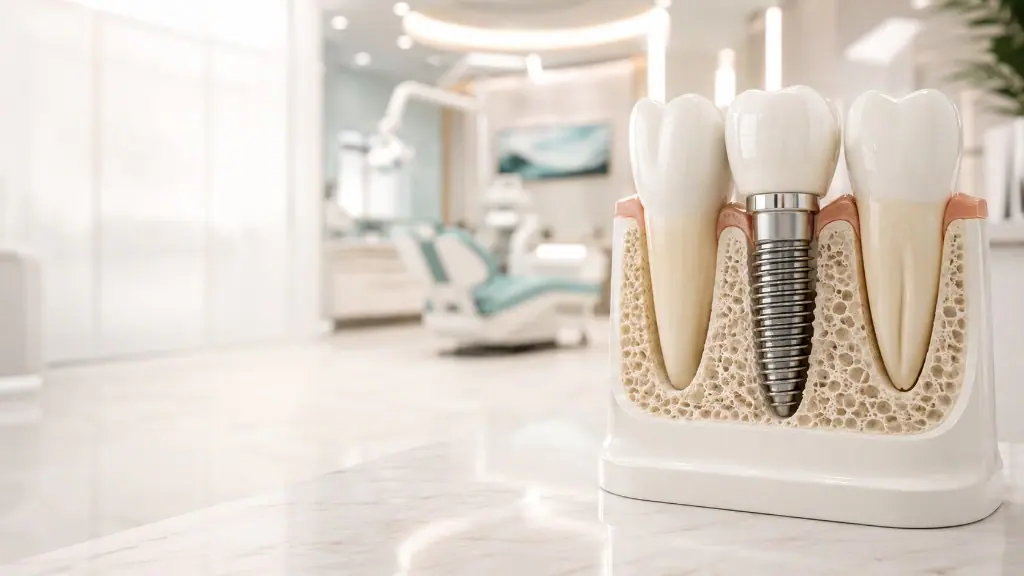
Dental implants
Safe and durable dental implants using modern techniques to restore the smile and natural function of the teeth.
Learn more
Start with a dental implant evaluation
Book your consultation at Al Shamkha — our team explains the options and creates a clear treatment plan.