
Clear aligners in Abu Dhabi
Transparent aligners to straighten teeth in a less visible way at AHLI Specialists Medical Center - Al Shamkha
Want to straighten your teeth without the obvious look of metal braces?
Do you have slight crowding or gaps between your teeth and are looking for a more comfortable solution in daily life?
Do you want braces that can be removed while eating and brushing your teeth?
Are you considering clear aligners but don't know if they are suitable for your condition?
Are you looking for clear aligners in Abu Dhabi or clear aligners in Al Shamkha near Baniyas, Al Falah and Shakhbout?
Clear aligners are one of the modern orthodontic options, and rely on a series of specially designed clear trays to gradually move teeth toward a better position. It is characterized by being less visible than metal and ceramic braces, and it can be removed when eating, drinking, and brushing teeth, but it requires great commitment to wearing the trays according to the doctor’s instructions.
At AHLI Specialists Medical Center in Al Shamkha - Abu Dhabi, we provide a comprehensive evaluation of clear aligners cases, examining the teeth, gums, and occlusion, and determining whether clear trays are suitable for your case or whether metal or ceramic braces or another plan will be more effective. We serve clients from Al Shamkha, Baniyas, Al Falah, Al Shawamekh, Shakhbout, Mohammed bin Zayed City, Khalifa City, Al Bahia, Al Raha, and various areas of Abu Dhabi.
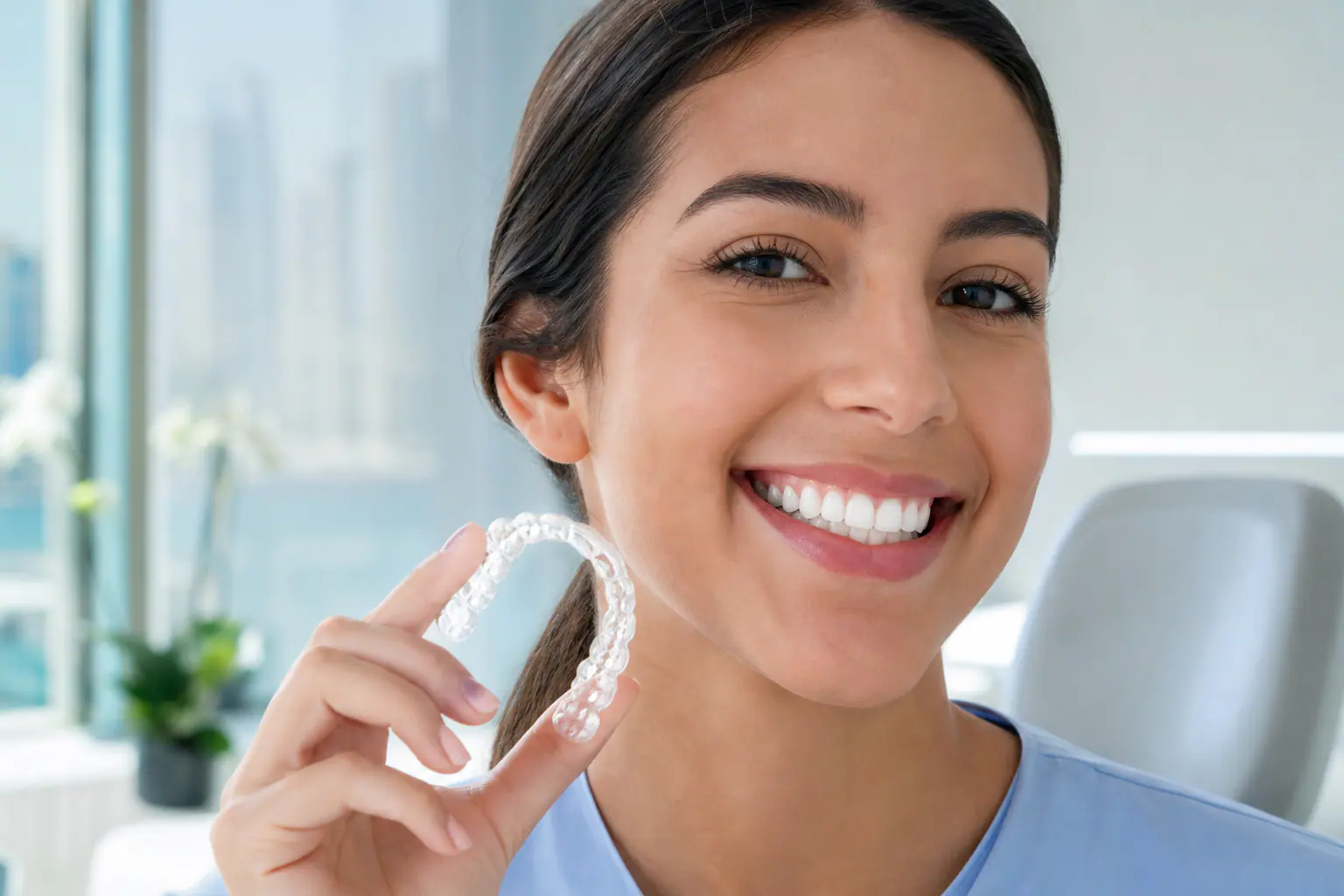
What Are Clear Aligners?
Clear aligners are an orthodontic treatment that uses clear, removable trays that are designed according to the shape of the patient's teeth. The patient wears each tray for a specific period according to the doctor’s plan, then moves to the next tray, so the teeth gradually move until they reach a better position. Clear aligners differ from fixed braces because they do not use metal or ceramic brackets fixed to the teeth, but rather rely on thin, transparent aligners that cover the teeth.
Although it is less visible than traditional braces, it is not magic and does not suit all cases. Its success depends on the correct diagnosis, the quality of the plan, and the patient’s commitment to wearing the casts.
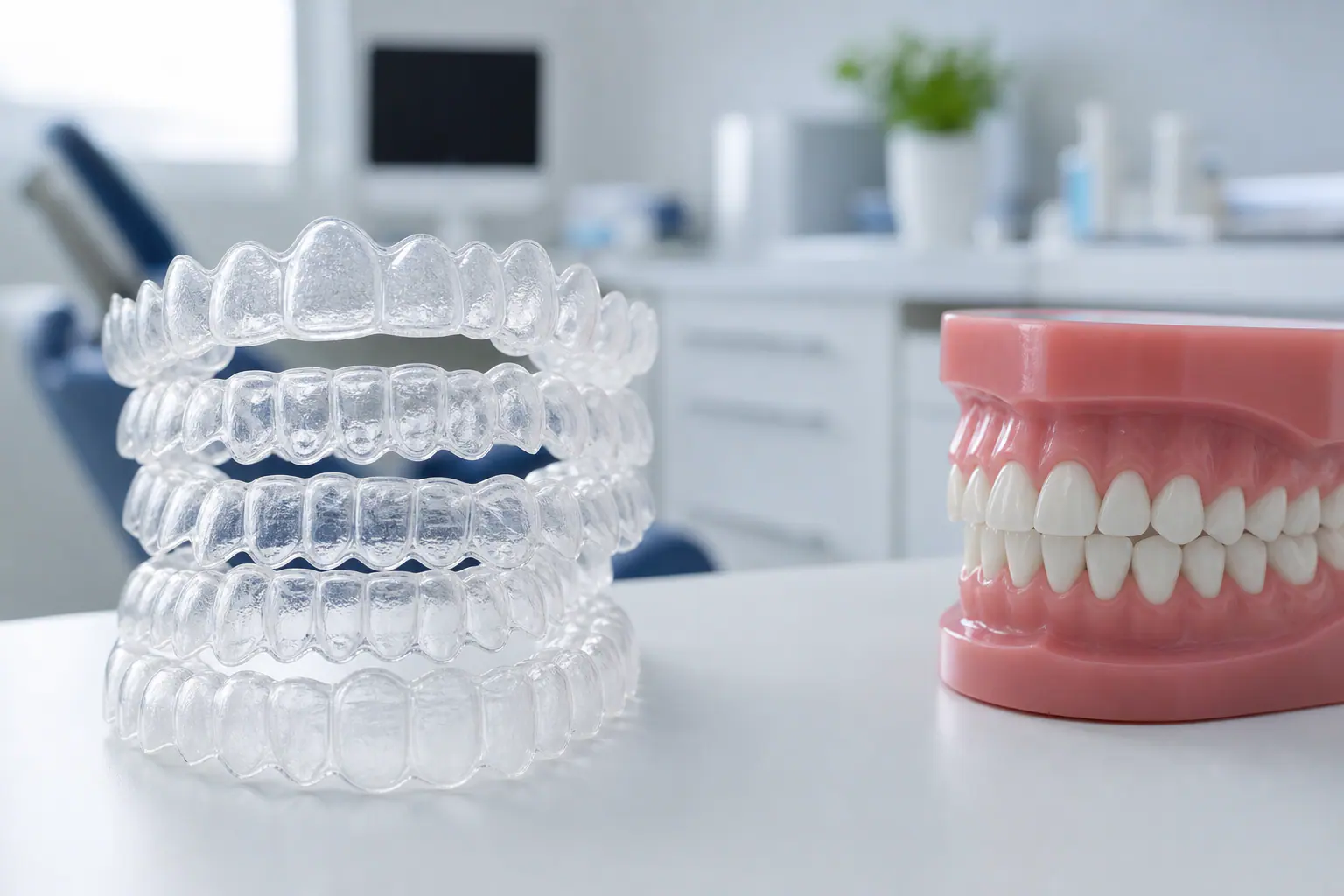
How do clear aligners work?
Custom clear trays gradually move your teeth — with regular follow-ups for the result and retainer.
Dental and occlusal examination
The doctor begins with a comprehensive examination of the teeth, gums, and occlusion and determines the patient's goal of treatment.
Digital Scan or Impressions
Tooth digital scans or impressions are taken to accurately design the clear trays.
Design a tooth movement plan
Tooth movement is planned gradually and the approximate number of trays and expected duration of treatment are determined.
Manufacture a Series of Aligners
Each tray is custom made to move the teeth a small, measured amount at each stage.
Wear the aligners sequentially
The patient wears each aligner according to the doctor's instructions, then moves to the next aligner.
Periodic reviews
Tooth movement is reviewed and the trays are working as planned.
Accessories and elastics when needed
Small attachments or orthodontic elastics may be used to improve tooth movement and occlusion.
Retainer after treatment
After the end of treatment, a retainer is used to maintain the arrangement of the teeth and prevent relapse.
The aligner alone is not enough if the patient does not wear it regularly. The better the adherence, the closer the tooth movement will be to plan.
The difference between clear aligners and metal and ceramic braces
Clear Aligners
- ● Less visible
- ● Removable
- ● It can be removed while eating and drinking
- ● Teeth are easier to clean compared to fixed braces
- ● It requires high commitment to wearing casts
- ● Suitable for some simple and moderate cases
- ● Not suitable for all complex cases
- ● Treatment may be delayed if the patient does not wear the casts adequately
Metal and Ceramic Braces
- ● Fixed on teeth
- ● It does not depend on the patient remembering to wear it
- ● Suitable for many simple and complex cases
- ● Gives the doctor greater control over some movements
- ● Needs more care when eating and cleaning
- ● The metallic is more visible
- ● Ceramic is less visible than metal but is also stable
Clear aligners are excellent for some patients, but metal or ceramic braces may be better in cases that require greater control or less commitment in terms of wearing the appliance. Check out metal and ceramic braces
Clear aligners or ceramic braces?
Choose Clear Aligners When
- ● You want to remove the device when eating
- ● You can commit to wearing aligners
- ● Your condition is suitable for aligners
- ● You want to clean your teeth more easily
- ● You don't want braces on your teeth
- ● You have a lifestyle that fits the moving aligner
Choose Ceramic Braces When
- ● You want braces that are stable but less noticeable than metal
- ● Your condition needs stronger control
- ● You don't want to worry about forgetting aligners
- ● You have crowding or occlusion that does not fit the diaphragm
- ● The doctor believes that fixed braces are better for your condition
The correct choice depends on the examination, not only on the appearance.
What conditions do clear aligners treat?
- ● Mild to moderate tooth crowding
- ● Spaces between teeth
- ● Teeth that are crooked to specific degrees
- ● Teeth eruption in some cases
- ● Simple to moderate deep bite
- ● Open bite in selected cases
- ● Simple or dental crossbite
- ● Some cases of smile line irregularity
- ● A simple return after a previous correction
- ● Arranging teeth before veneers or cosmetic surgery
- ● Organizing spaces before planting or covering in some cases
But for some severe or structural cases that require complex movements, metal or ceramic braces may be more suitable.
Who Are Clear Aligners Suitable For?
- ● Minor or moderate crowding
- ● Gaps between teeth
- ● Slight or moderate protrusion
- ● Mild to moderate deep or open bite depending on assessment
- ● Teeth and gums in good condition
- ● Desire for less visible braces
- ● Ability to wear casts for long hours daily
- ● Commitment to removing aligners when eating and drinking
- ● Commitment to cleaning the teeth before returning the trays
- ● There is no severe structural problem in the jaw
- ● Desire for a practical option for cooperative adults or teens
Clear aligners require a committed patient. If the patient frequently forgets the trays or does not wear them as instructed, the result may not be as desired.
Who may not be suitable for clear aligners?
- ● Very intense crowding
- ● Severe rotation of some teeth
- ● Complex bite that needs strong control
- ● Severe open bite
- ● Skeletal crossbite
- ● Extreme protrusion associated with the jaws
- ● Clear need for orthodontic extraction with complex motion
- ● Unhealthy gums or untreated gum disease
- ● Untreated caries
- ● Inability to adhere to wearing aligners
- ● An uncooperative adolescent in wearing casts
- ● Usually losing or forgetting aligners
- ● Unrealistic expectations about the speed of treatment
- ● A condition that requires metal or ceramic braces for better control
In these cases, metal or ceramic braces or another treatment plan may be more appropriate.
Clear aligners for specific cases
Clear aligners to treat crowded teeth
Clear aligners may be appropriate for treating mild to moderate dental crowding, especially if the patient is committed to wearing trays and space can be adequately spaced.
- ● Arrangement of the front teeth
- ● Reduce overlay
- ● Improving the shape of the smile
- ● Facilitate teeth cleaning
- ● Simple revision treatment after previous orthodontics
- ● Move teeth gradually without fixed brackets
See the associated service. Check out the service
Clear aligners to treat gaps between teeth
Gaps between teeth are one of the conditions that clear aligners may be suitable for, especially if the gaps result from the distribution or tilt of the teeth.
- ● Closing the spaces between the teeth
- ● Improve smile symmetry
- ● Arranging teeth before veneers if the patient needs
- ● Treating the return of gaps after previous braces
- ● Improved occlusion in some cases
See the associated service. Check out the service
Clear aligners to treat protruding teeth
Clear aligners may help treat some mild to moderate cases of tooth protrusion, especially if the problem is in the tilt of the teeth and not a severe structural problem in the jaw.
- ● Slight or moderate protrusion
- ● Front teeth tilted forward
- ● Prominence with minor voids
- ● Emergence after the return of a previous orthodontist
- ● Cases that do not require extraction or complex movements
- ● A patient who is very committed to wearing casts
See the associated service. Check out the service
Clear aligners for treating deep bites
Clear aligners may help in some cases of simple to moderate deep bites, but they are not suitable for all cases. Treating a deep bite requires good control of tooth movement and occlusion.
- ● Simple deep bite
- ● Aligner-correctable average overlay
- ● Good gum health
- ● Adherence to aligners and elastics if necessary
- ● No severe corrosion or obvious structural problem
See the associated service. Check out the service
Clear aligners for treating open bite
Clear aligners may be appropriate for some mild to moderate open bite cases, especially if the problem is dental rather than skeletal, and if the patient is compliant with treatment.
- ● Assess tongue thrusting and finger sucking
- ● Assess mouth breathing
- ● Determine the type of open bite
- ● Is the problem dental or structural?
- ● Does the condition require oral treatment?
- ● Are the aligners capable of giving predictable movement?
See the associated service. Check out the service
Clear aligners for treating crossbites
Clear aligners may treat some cases of simple crossbites, especially if the problem is the position of one or more teeth and not the growth of the jaw.
- ● Simple crossbite
- ● The problem is dental, not structural
- ● There is no obvious advancement in the lower jaw
- ● The case does not require significant expansion
- ● The patient is obligated to wear casts and elastics if prescribed
See the associated service. Check out the service
Clear aligners before veneers or smile design
Clear aligners may be an excellent step before veneers or smile design, especially if the teeth need a simple arrangement before cosmetic surgery.
- ● Reducing the need to file teeth
- ● Arranging teeth before cosmetic surgery
- ● Better distribution of spaces
- ● Improved occlusion
- ● Make veneers more natural
- ● Reduce the risk of restorations breaking due to occlusion
- ● Improving the shape of the smile before choosing the color and shape of the veneer
See the associated service. Check out the service
Clear aligners for missing teeth or implants
If you have missing teeth or are planning dental implants, clear aligners may be part of the plan in some cases to regulate spaces and improve occlusion before replacement.
- ● Opening a suitable area for agriculture
- ● Close unwanted spaces
- ● Adjusting the inclination of adjacent teeth
- ● Improving the position of the teeth before the implant crown
- ● Arrangement of teeth before bridge or crowns
- ● Improving the shape of the smile before compensation
It should be known that the dental implant itself does not move like natural teeth, so careful planning is done if there are existing implants. Check out the service
Clear Aligner Treatment Steps
Consultation and evaluation
The doctor begins by examining the teeth, teeth, and gums, and finding out the patient's goal for treatment.
Confirm Treatment Suitability
It is evaluated whether clear aligners are suitable or whether metal or ceramic braces are better.
Photographs and X-rays
We may need pictures and x-rays to evaluate the roots, bone, occlusion, and missing teeth.
Digital Scan or Impressions
Tooth digital scans or impressions are taken to design aligners.
Preparing a treatment plan
Tooth movement is planned gradually, and the approximate number of trays and expected duration of treatment are determined.
Receive aligners
The patient receives the casts with clear instructions on how to wear, clean, and change them.
Place Attachments When Needed
Small attachments may be placed on the teeth to help the trays move.
Wear the aligners sequentially
The patient wears each aligner according to the doctor's instructions, then moves to the next aligner.
Follow-up reviews
Tooth movement is reviewed and the trays are working as planned.
Refinements or Additional Aligners
In some cases we may need additional aligners to improve the final result.
Retainer after treatment
After the clear aligners are finished, a retainer is used to maintain the result.
Advantages of clear aligners
- ● Less noticeable than metal braces
- ● Removable when eating
- ● Helps clean teeth more easily
- ● No brackets or fixed wires
- ● Relatively comfortable for many patients
- ● Suitable for adults who want a calm look
- ● Reduces dietary restrictions compared to fixed braces
- ● It can be used at work or university without an obvious appearance
- ● It helps in some cases of crowding, voids, and protrusion
- ● May be appropriate after a slight reversal from a previous orthodontic treatment
But these advantages are only achieved if the condition is suitable and the patient is committed.
Disadvantages of clear aligners
Despite its advantages, there are challenges that must be known before choosing clear aligners.
- ● Needs high commitment to wearing casts
- ● It can be lost or broken if not kept well
- ● May not be suitable for complex cases
- ● It must be removed when eating and drinking
- ● Teeth must be cleaned before returning it
- ● It may cause a slight lisp at first
- ● May need dental attachments
- ● It may require elastics in some cases
- ● It may become stained if you drink colored drinks while wearing it
- ● Additional casts may be needed at the end of treatment
- ● The outcome may be severely affected if the patient does not comply
Choosing clear aligners should be a realistic decision, not just because of appearance.
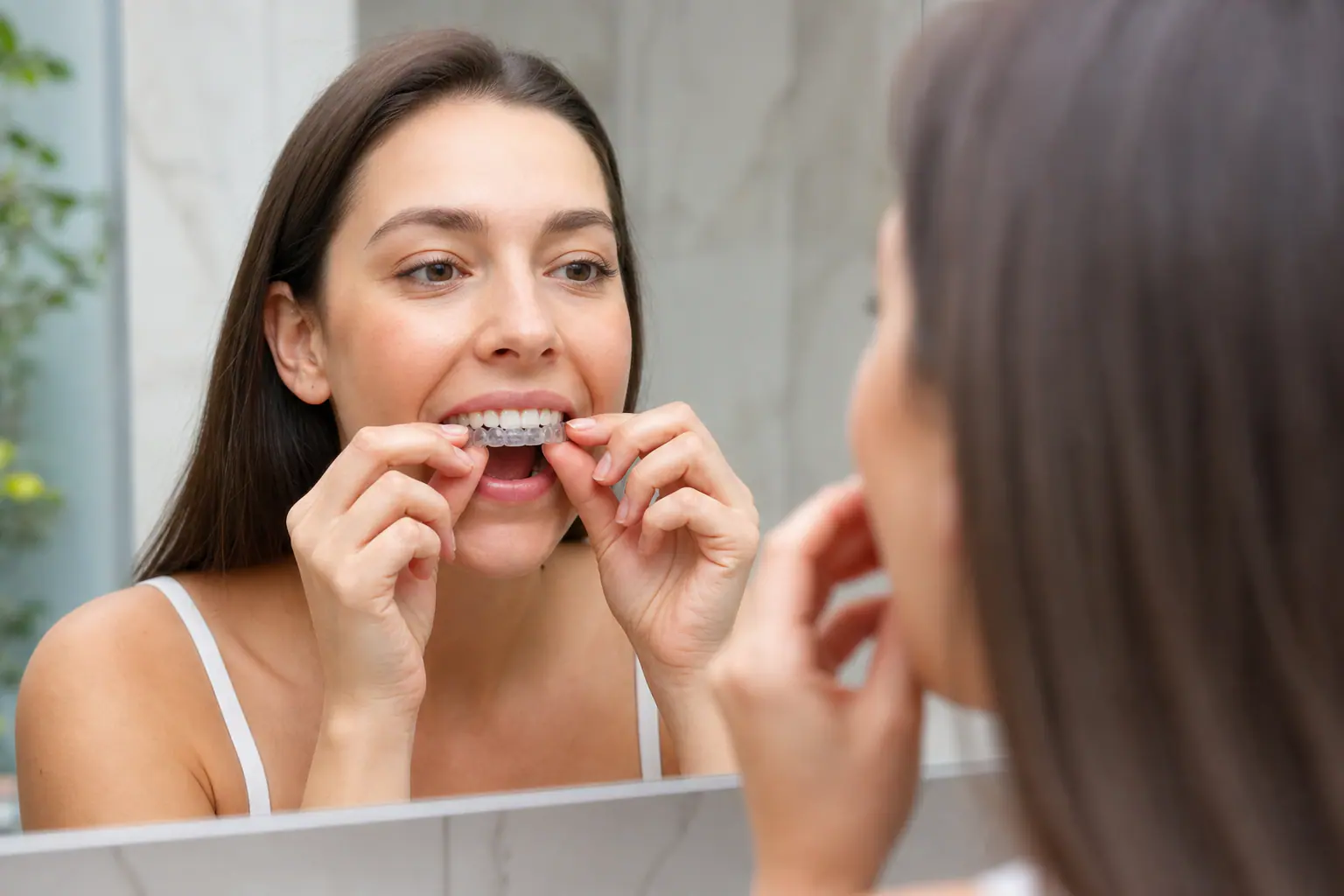

Care Guide and Common Questions During Clear Aligner Treatment
Are clear aligners completely invisible?
Clear aligners are much less noticeable than metal braces, but they are not completely invisible. People may notice them from a distance, especially if there are small attachments on the teeth or if the trays are not clean.
- ● The aligners are not cleaned well
- ● The patient drank colored drinks while wearing casts
- ● Stains or deposits have accumulated on the aligners
- ● Attachments are found on the teeth
- ● The aligners were not securely in place
However, it remains an aesthetically pleasing and safer option compared to metal and ceramic braces in many cases.
What are clear aligner accessories?
In some cases of clear aligners, the doctor needs to place small dots or protrusions of a color close to the teeth called attachments. These attachments are placed on some teeth to help the trays grip and move the tooth more precisely.
- ● Rotate teeth
- ● Move teeth more controlled
- ● Improve aligner stability
- ● Executing certain movements that the aligner alone is not enough to achieve
- ● Support the treatment plan for voids, crowding or protrusion
The attachments are often a color close to the tooth, but they may make the trays a little more noticeable. They are removed after the end of treatment.
What is simple dental filing with clear aligners?
In some cases, the doctor needs to provide a small space between the teeth to move them better. This may be done through a very simple and deliberate filing between the teeth, known orthodontically as IPR.
- ● Minor or moderate crowding
- ● Need for limited space
- ● Improving the shape of the contact points between the teeth
- ● Reducing the need for extraction in selected cases
- ● Improved score stability
This procedure is not suitable for all cases, and is not done randomly. It must be within a precise orthodontic treatment plan and in a safe quantity according to the doctor’s assessment.
Do clear aligners need elastics?
Yes, in some cases the patient may need to use orthodontic elastics with clear trays to improve the relationship of the upper and lower jaw or treat some occlusal problems.
- ● Eruption of teeth
- ● Deep bite
- ● Open bite
- ● Crossbite
- ● Mismatch of back teeth
- ● Need for improved occlusal closure
Elastics are an important part of treatment if prescribed by a doctor. Failure to adhere to it may prolong the duration of treatment or weaken the result.
How many hours should clear aligners be worn daily?
Clear aligners need to be worn for long hours every day according to the doctor’s instructions, and they are usually removed only when eating, drinking, and brushing the teeth. If the patient does not wear the trays for the required time, the teeth may not move as planned.
- ● Delayed treatment
- ● The aligner does not match the teeth
- ● Need for additional aligners
- ● Some movement returns
- ● Poor final result
- ● Increased treatment duration and potential cost
Therefore, before choosing clear aligners, you should ask yourself: Can I commit to wearing the trays daily?
Can I eat with clear aligners?
It is not preferable to eat with transparent aligners. The aligners must be removed before eating so that they do not deform, break, or become stained, and so that food does not get stuck between them and the teeth.
- ● Remove aligners before eating
- ● Place it in its designated box
- ● Do not put it in a tissue so that it does not get lost
- ● Do not put it in a pocket without protection
- ● Brush the teeth or rinse the mouth before replacing the trays
- ● Repeat the aligners quickly so that the wearing period does not decrease
Eating with aligners may damage them or make them unclean.
Can I drink coffee or tea with clear aligners?
It is preferable to remove the aligners when drinking coffee, tea, or colored or hot drinks, because these drinks may cause the aligners to become stained or change their shape if they are hot.
- ● With aligners, it is best to drink only water
- ● Remove the aligners before coffee or tea
- ● Rinse your mouth or brush your teeth after drinking
- ● Return the aligners after cleaning
- ● Do not leave the trays outside the mouth for a long time
Adherence to these steps maintains the transparency of the aligners and the cleanliness of the teeth.
Cleaning clear aligners
Cleaning transparent aligners is very important so that bacteria, odors, or stains do not accumulate on them.
- ● Rinse the aligners when removing them
- ● Clean gently as instructed by your doctor
- ● Do not use hot water as it may deform the aligner
- ● Do not use an abrasive paste if your doctor has not recommended it
- ● Do not leave the aligners exposed
- ● Place it in the designated box when not in use
- ● Do not eat or drink colored drinks while they are in the mouth
- ● Do not smoke while wearing the cast
- ● Keep the teeth clean before returning them
The clear aligner needs daily care to stay comfortable, clean and less visible.
Cleaning teeth during clear aligners
Although clear aligners make it easier to clean your teeth than fixed braces, hygiene is very important. If you put the trays back on unclean teeth, you may trap food debris and bacteria around the teeth.
- ● Brush teeth after meals before replacing trays if possible
- ● Floss daily
- ● Rinse the mouth if you cannot brush immediately
- ● Do not wear aligners over leftover food
- ● Clean the tongue
- ● Reduce sugar and acidic drinks
- ● Attend regular cleaning at the clinic
- ● See a doctor if you notice an odor, bleeding gums, or white spots
Related page: Teeth cleaning before and during clear aligners. Check out the service
Do clear aligners cause pain?
Clear aligners are not constantly painful, but they may cause slight pressure or pulling in the first days of wearing a new tray. This feeling is normal because the aligner gradually moves the teeth.
- ● Pressure on teeth
- ● Slight tightening when installing a new aligner
- ● Temporary sensitivity when chewing
- ● Discomfort in the first days of treatment
- ● Slight difficulty speaking in the first period
- ● Sometimes annoying edges that need to be evaluated
If the pain is severe or the aligner hurts the gums or does not fit well, you should see a doctor.
Do clear aligners affect speech?
Clear aligners may affect speech in the first days, and the patient may notice a slight lisp or a change in pronunciation until the tongue gets used to the presence of the trays. This often improves within a short period.
- ● Speak and read out loud
- ● Do not take off the casts too much due to talking
- ● Stick to the dress until the tongue gets used to it
- ● See a doctor if there is an edge causing discomfort
- ● Don't worry about small changes at first
Most patients adapt to the casts within a short period.
How long does clear aligners treatment take?
The duration of clear aligners treatment varies depending on the case. Simple cases may require a shorter period of time, while cases involving crowding, multiple spaces, or occlusal problems may require a longer time.
- ● Severity of crowding or voids
- ● Type of occlusal problem
- ● Number of aligners
- ● The patient’s commitment to wearing the casts
- ● Need for accessories
- ● Need for rubber
- ● The need for a slight filing between the teeth
- ● Gum and bone health
- ● Follow-up reviews
- ● The need for additional casts at the end of treatment
The exact duration cannot be determined without an examination, but the expected duration is explained after the evaluation.
Are clear aligners suitable for children?
Clear aligners may not be the first choice for young children, because they require a lot of commitment, keeping trays, and wearing them for long periods. But it may be appropriate for some adolescents who cooperate after dental and growth evaluation.
- ● He has permanent teeth suitable for treatment
- ● He can adhere to wearing casts
- ● Aligners are not easily lost
- ● Maintains cleanliness
- ● Its condition is suitable for aligners
- ● Parents can monitor compliance
- ● There is no severe orthodontic problem that requires fixed orthodontics
For younger or uncooperative children, fixed braces, follow-up or orthotics may be more appropriate depending on the situation.
Clear aligners for adults
Clear aligners are a popular choice among adults because they are less visible and can be removed for eating and cleaning. But it needs to evaluate the health of gums, bones and teeth before starting.
- ● Minor or moderate crowding
- ● Gaps between teeth
- ● A simple return after a previous correction
- ● Desire for less visible treatment
- ● Healthy teeth and gums
- ● Commitment to wearing aligners
- ● A desire to tidy up the teeth before bleaching or veneers
- ● Difficulty accepting the appearance of metal braces
If the adult has gum disease, missing teeth, implants or crowns, this is factored into the plan before starting.
Clear aligners after previous braces
Many patients notice a slight tooth loss years after their previous braces due to the retainer not being used, broken or lost. In these cases, clear aligners may be a suitable option if movement is minimal or moderate.
- ● Minor crowding returned after orthodontics
- ● Gaps returned between teeth
- ● Front teeth that have moved slightly
- ● Broken or missing retainer
- ● Desire for relatively quick correction of limited movement
- ● Good gum health
After patching, the installer will be very important so that the problem does not come back again. Check out the service
Do clear aligners cause cavities?
Clear aligners do not directly cause tooth decay, but wearing trays over unclean teeth or after consuming sugar and sweetened beverages may increase the risk of bacteria accumulating on the teeth.
- ● Clean teeth before re-casting
- ● Do not drink sweetened beverages while wearing casts
- ● Floss daily
- ● Clean the aligners regularly
- ● Do not sleep with unclean trays
- ● Attend regular cleaning at the clinic
- ● Do not neglect bad breath or bleeding gums
- ● Reduce frequent sugars
Good hygiene makes clear aligners safer and more comfortable.
Do clear aligners change tooth color?
Clear aligners do not whiten teeth or change their color. But it may make teeth look less clean if the trays are not cleaned well or if stains build up.
- ● Whitening is planned before or after braces, depending on the case
- ● It is not recommended to use random bleaching agents inside aligners without medical guidance
- ● Clean the aligners daily to avoid staining
- ● Avoid colored drinks with aligners
If you want to whiten your teeth, this is often planned before or after braces depending on the condition of the teeth and the doctor’s plan. Check out the service
What should I do if the clear aligner tray is lost?
If a tray of clear aligners is lost, do not randomly switch to another tray without consulting your doctor. Contact the clinic to find out the correct procedure.
- ● Return to the previous aligner temporarily
- ● Move to the next aligner if appropriate
- ● Request a replacement aligner
- ● Come for inspection if the aligner is not installed
- ● Modify the treatment plan if a delay occurs
Losing aligners may affect the treatment, so they should always be stored in the designated box.
What should I do if the aligner doesn't fit well?
If you feel that the tray is not fitting tightly or there is a clear gap between the tray and the teeth, the reason may be a lack of adherence, an early transition to the next tray, or a movement that is not according to plan.
- ● Do not press the aligner with harmful force
- ● The aligner does not fully insert
- ● Severe pain when installed
- ● A clear gap between the aligner and the tooth
- ● The aligner moves easily
- ● Fracture or deformation of the aligner
- ● Frequent mismatches with more than one aligner
Contact your doctor. You may need to use the previous aligner or scan to modify the plan.
Do I need a retainer after clear aligners?
Yes, retainer is necessary after clear aligners like any other type of braces. After moving the teeth, it takes time for the teeth to settle into their new position.
- ● Back crowding
- ● Open new spaces
- ● Movement of the front teeth
- ● Partial recurrence of prominence
- ● Occlusal change
- ● Need for new treatment later
- ● A transparent retainer that is removable or fixed behind the teeth, or a combination of both
Without a retainer, the teeth may gradually move and some problems may return, such as crowding, gaps, or protrusion. Check out the service
Common mistakes during clear aligners
Some errors may affect the result or prolong the duration of treatment.
- ● Not wearing the aligners for the required period
- ● Eating with aligners
- ● Drink coffee or tea with the aligners
- ● Leave the aligners outside the box
- ● Forget the aligners in napkins or restaurants
- ● Not cleaning the teeth before replacing the trays
- ● Move to the next aligner without instructions
- ● Not attending reviews
- ● Ignore aligner mismatch
- ● Do not use elastics if prescribed
- ● Expect rapid treatment of a complex condition
- ● Do not use a retainer after the end of treatment
Avoiding these mistakes helps to achieve a better and more stable result.
Clear aligners in Al Shamkha - Abu Dhabi
If you are looking for clear aligners in Abu Dhabi or clear aligners in Al Shamkha, AHLI Specialists Medical Center provides a comprehensive evaluation to determine whether clear trays are suitable for your case or whether metal or ceramic braces are better.
We help you figure out whether crowding, gaps, overbites, deep bites, open bites, or crossbites can be treated with clear aligners, with a clear explanation of expectations and the commitment required.

Why choose AHLI Specialists Medical Center?
- ✓ A comprehensive evaluation before choosing clear aligners
- ✓ Determine whether the case fits the aligners or requires a fixed orthodontic treatment
- ✓ Multiple braces options: clear, metal, ceramic
- ✓ Examination of the occlusion and gums before starting treatment
- ✓ A clear explanation of how to wear and clean aligners
- ✓ Monitoring tooth movement during treatment
- ✓ Evaluate the need for attachments or elastics
- ✓ A proven plan after the end of treatment to maintain the result
- ✓ Location close to Al Shamkha, Baniyas, Al Falah, Shakhbout and Abu Dhabi areas
- ✓ A quiet medical environment suitable for families
Related Clear Aligner Services
Orthodontics
Home page for orthodontic and occlusal correction services.
Metal and Ceramic Braces
Fixed orthodontic treatment options for situations where you need more control.
Dental retainer after orthodontics
It is important to maintain the results of clear aligners after the end of treatment.
Treatment of crowded teeth
A service related to cases of overlapping teeth and limited spaces.
Treating gaps between teeth
A service related to closing spaces between teeth.
Open bite treatment
A service related to cases of non-contact of teeth when the mouth is closed.
Deep bite treatment
A service related to cases of excessive overlap of the upper teeth over the lower ones.
Crossbite treatment
A service related to cases where the lower teeth advance in front of the upper teeth.
Protruding teeth treatment
A service related to cases of prominent front teeth.
Teeth cleaning
It is important before and during clear aligners to maintain healthy teeth and gums.
Teeth whitening
It may be considered before or after orthodontics depending on the plan.
Dental Veneers
It may be an option after teeth straightening if the smile needs improving shape or colour.
When should I book an appointment for clear aligners?
The first step is a comprehensive orthodontic examination to determine whether clear trays are suitable for your condition.
AHLI Specialists Medical Center - Al Shamkha, Abu Dhabi
For reservations and inquiries: 02-448-7553
Location: Al Qayed Street, Al Shamkha, Abu Dhabi
Quick Answers
What Are Clear Aligners?
Clear aligners are an orthodontic treatment that uses clear, removable trays to gradually move teeth, and are a less visible option than metal and ceramic braces in appropriate cases.
Are clear aligners suitable for all cases?
No, clear aligners are not suitable for all cases. Mild to moderate crowding, gaps and protrusion may be suitable, while severe or complex cases may require fixed braces.
How many hours should clear aligners be worn?
Trays should be worn for long hours each day as instructed by the doctor, and are usually removed only when eating, drinking, and brushing the teeth.
What is the difference between clear aligners and metal braces?
Clear aligners are removable and less noticeable, but require a significant commitment. Metal braces are stable and give better control in some complex cases.
Where can I find clear aligners in Abu Dhabi?
A clear aligners consultation can be booked at AHLI Specialists Medical Center in Al Shamkha - Abu Dhabi to evaluate the teeth and occlusion and choose the appropriate plan.
Orthodontists

Frequently asked questions about clear aligners
Are clear aligners painful?
Are the clear aligners clear?
Is it possible to eat with clear aligners?
Is it possible to drink coffee with clear aligners?
Do clear aligners treat crowded teeth?
Do clear aligners treat gaps?
Do clear aligners treat tooth protrusion?
Are clear aligners suitable for teenagers?
Are clear aligners suitable for adults?
Do clear aligners need retainers after treatment?
What happens if I don't wear the casts enough?
Can aligners get lost?
Do clear aligners cause cavities?
Are clear aligners better than ceramic braces?
Do I need to clean my teeth before clear aligners?

Book your clear aligners consultation
A comprehensive evaluation to find out whether clear casts are suitable for your condition — with a proven post-treatment plan.