
Dental crowding treatment in Abu Dhabi
Straightening crowded teeth and improving smile and occlusion at AHLI Specialists Medical Center - Al Shamkha
Are your teeth crowded together or difficult to clean?
Have you noticed that your child's permanent teeth appear crowded or out of place?
Do you suffer from crowding in your front teeth that affects the shape of your smile?
Do you find it difficult to use floss due to the narrow spaces between your teeth?
Are you looking for crowded teeth treatment in Abu Dhabi or crowded teeth straightening in Al Shamkha near Baniyas, Al Falah and Shakhbout?
Teeth crowding is one of the most common orthodontic problems. It occurs when there is not enough space in the jaw to arrange the teeth correctly, so the teeth appear overlapping, crooked, or out of their natural alignment. Crowding may only affect the appearance of the smile in some cases, but it may also affect tooth cleaning, gum health, bite, chewing, and plaque buildup between the teeth.
At AHLI Specialists Medical Center in Al Shamkha - Abu Dhabi, we provide a comprehensive evaluation of cases of tooth crowding in children, adolescents, and adults, determining the degree of crowding, the cause of the problem, the condition of the jaw, gum health, and the patient’s treatment needs, then choosing the appropriate plan such as metal braces, ceramic braces, clear braces, expansion, or other orthodontic plans depending on the case. We serve clients from Al Shamkha, Baniyas, Al Falah, Al Shawamekh, Shakhbout, Mohammed bin Zayed City, Khalifa City, Al Bahia, Al Raha, and various areas of Abu Dhabi.

What is tooth crowding?
Tooth crowding is a condition that occurs when the teeth are larger than the available space in the jaw or when the jaw is narrow compared to the size of the teeth, which leads to the teeth overlapping, rotating, or moving out of their natural place.
Crowding may be minor and only affects appearance, or it may be moderate or severe and affects bite, cleaning, and gum health.
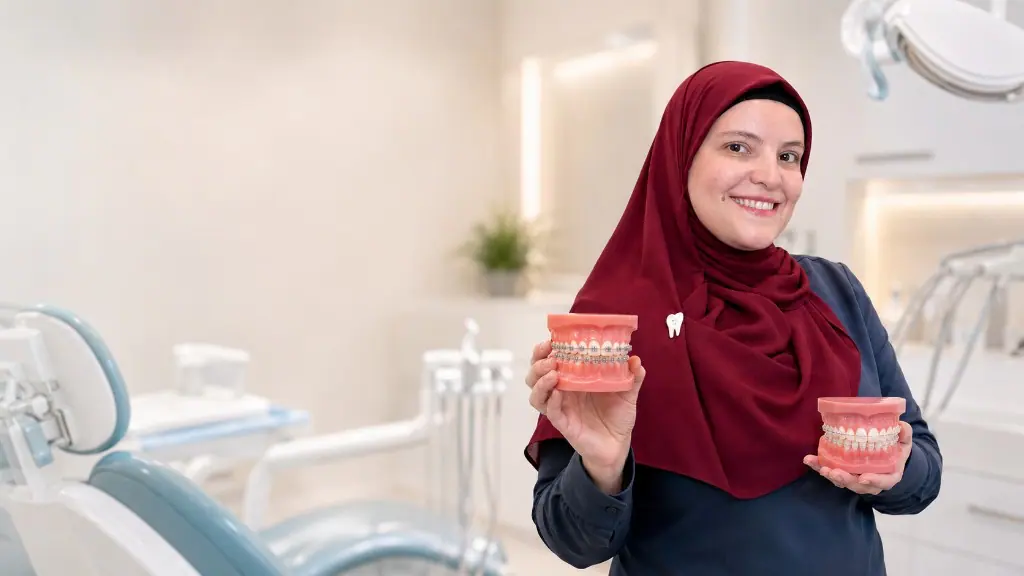
Why does tooth crowding occur?
Tooth crowding occurs due to an imbalance between the size of the teeth and the size of the jaw or due to factors that affect tooth growth and eruption.
- ● Small size of the jaw compared to the size of the teeth
- ● The large size of the teeth compared to the area of the jaw
- ● Genetic factors from the family
- ● Early loss of baby teeth
- ● Baby teeth last longer than normal
- ● Permanent teeth appear in the wrong direction
- ● Narrow upper jaw
- ● Oral habits such as prolonged finger sucking
- ● Mouth breathing in some cases
- ● Tooth extraction and failure to compensate for space
- ● Do not use a distance keeper after losing a baby tooth
- ● Failure to adhere to the retainer after the end of the orthodontic treatment
Knowing the cause helps choose the appropriate treatment, because crowding of teeth in a child during the growing stage is different from crowding of teeth in an adult.
Signs of crowded teeth
- ● Teeth overlapping each other
- ● Crooked or tilted teeth
- ● A tooth outside the normal range
- ● Tightness between teeth prevents the use of floss
- ● Food accumulation between teeth
- ● Difficulty brushing teeth
- ● Bleeding gums due to plaque accumulation
- ● Frequent mouth odor
- ● Crowded lower front teeth
- ● Asymmetric smile
- ● The appearance of a permanent tooth behind the baby tooth
- ● Canines that do not have enough space to erupt
- ● Repeated cavities between teeth due to difficulty in cleaning
If you notice these signs, it is best to book an orthodontic evaluation to find out the degree of crowding and treatment options.
Is crowded teeth only a cosmetic problem?
no. Teeth crowding may affect the appearance of the smile, but it is not only a cosmetic problem. When teeth are overlapping or crooked, they are more difficult to clean, and plaque may accumulate between the teeth and around the gums.
- ● Difficulty in brushing teeth
- ● Difficulty using floss
- ● Accumulation of plaque and cavities between teeth
- ● Problems with occlusion and chewing
- ● Uneven wear on some teeth
- ● The appearance of the smile and confidence are affected
Treating crowding may be important for health and function, not just appearance.
Degrees of tooth crowding
Simple crowding
The overlap is mild, and most often appears in the front teeth. A simpler treatment or clear braces may be suitable for him in some cases, depending on the occlusion and the condition of the teeth.
Moderate crowding
It shows rotation, overlapping, or clear narrowing of spaces. He may need fixed or clear braces depending on the case, and he may need a simple filing between the teeth, expansion, or a well-thought-out plan.
Severe crowding
There is a significant lack of space, and teeth may appear out of line or raised canines. It may require a comprehensive orthodontic plan, and perhaps orthodontic extraction in some cases after careful evaluation.
Determining the degree of crowding is not done only visually, but requires examination, photographs, x-rays, and analysis of occlusion and spaces.
Tooth crowding treatment options
Treatment for dental crowding varies according to the degree of crowding, age, condition of the jaw, gum health, and the patient’s desire. There is no single plan suitable for all situations.
Metal braces to treat crowded teeth
Metal braces are one of the most widely used options for treating tooth crowding, especially moderate to severe cases or cases that require precise control of tooth movement.
- ● Moderate or severe crowding
- ● Clearly crooked teeth
- ● Fangs out of line
- ● Need for occlusal adjustment
- ● A condition that requires complex tooth movement
Metal braces may be more visible, but they are effective in many cases of crowding.

Clear braces to treat crowded teeth
Clear braces or clear trays may be suitable for some cases of tooth crowding, especially mild to moderate crowding, if the patient is committed to wearing the trays for sufficient hours each day.
- ● Minor or moderate crowding
- ● Desire for less visible treatment
- ● Ability to adhere to wearing casts
- ● Teeth and gums in good condition
It may not be the best option if crowding is very intense or if there are complicated movements.
How is tooth crowding diagnosed?
Dental examination
Tooth arrangement, overlap, rotation, and areas of space constraints are examined.
Occlusal examination
We evaluate the way the teeth close, and whether there is a deep or crossbite or abnormal contact.
Gum examination and cleaning
You must know whether crowding is the cause of plaque buildup, gingivitis, or difficulty cleaning.
Pictures and x-rays
We may need x-rays to evaluate tooth roots, missing teeth, wisdom teeth, and bone.
Scans or prints
It helps to analyze the area, the degree of crowding, and the treatment plan.
Plan analysis
After collecting information, the appropriate type of braces and the required steps are determined.
Steps to treat crowded teeth
Consultation and evaluation
The doctor begins by examining the teeth, crowding, occlusion, and gums, and finding out the patient’s complaint and the goal of treatment.
Pictures and x-rays
Pictures, x-rays, and dental scans may be taken to analyze the spaces, roots, and jaw.
Determine the degree of crowding
It is determined whether the crowding is mild, moderate, or severe, and whether it affects the bite or gums.
Choose a treatment plan
The appropriate braces are chosen: metal, ceramic, transparent, expanding, or another plan.
Preparing the mouth before braces
The patient may need a teeth cleaning, cavity treatment, or gum treatment before starting braces.
Start the orthodontic treatment
The teeth begin to move gradually according to plan.
Periodic follow-up
The patient needs regular visits to adjust the braces and monitor tooth movement.
Finish the treatment and stabilizer
After aligning the teeth, the braces are removed and then a retainer is used to prevent crowding again.

Is treatment for crowded teeth painful?
Treating crowded teeth with braces is not constantly painful, but it may cause temporary pressure or discomfort after braces are placed or after adjustments.
- ● Pressure on teeth after adjustment
- ● Sensitivity when chewing in the first days
- ● Slight friction from the brackets
- ● Soft foods at first help with adaptation
This feeling is often temporary, and can be reduced by following your doctor's instructions.
Does crowding return after treatment?
Crowding may return if the patient does not use a retainer after braces. Teeth move naturally over time, and a retainer helps maintain the result.
- ● Movable stabilizer
- ● Fixed retainer behind the teeth
- ● Mix them together depending on the situation
- ● Retainer adherence is very important, especially in the lower front teeth
A retainer is not an optional step, but rather an essential part of treating crowded teeth.
Important topics in the treatment of crowded teeth
Teeth crowding in children
Teeth crowding in children may appear at the beginning of tooth replacement or when the first permanent teeth appear. Some crowding may be temporary during the developmental stage, and some may indicate a need for early orthodontic evaluation.
- ● A permanent tooth appears behind the baby tooth
- ● Crowded permanent front teeth
- ● Canines do not find enough space
- ● Premature loss of a baby tooth
- ● Tightness in the jaw
- ● Difficulty in brushing teeth
Early assessment helps to know whether the child only needs to be followed, maintain distance, expand, early correction, or wait for an appropriate stage. Check out the service
When should dental crowding in children be checked?
It is best to evaluate the child's teeth early if signs of crowding or irregular replacement appear. Not every child needs immediate braces, but early screening helps choose the best time to intervene.
- ● Obvious crowding in the front teeth
- ● A permanent tooth has appeared behind the baby tooth
- ● Premature loss of a baby tooth
- ● Canines appear in an abnormal place
- ● Tightness in the upper jaw
- ● Repeated caries due to crowding
Some cases improve with growth, and some require early intervention. Check out the service
Teeth crowding in adults
Teeth crowding in adults can be treated in many cases. Age alone is not a contraindication for braces, but the health of your gums, bone, and teeth should be evaluated before starting.
- ● Failure to treat crowding in childhood
- ● Teeth move with age
- ● Do not use a retainer after a previous brace
- ● Loss of teeth causing tooth movement
- ● Receding gums or gum disease
Treatment of adults requires special attention to the health of gums, fillings, crowns, and implants.
Crowded front teeth
Crowded front teeth are one of the most annoying conditions for patients because of their direct impact on the smile. It may appear in the upper or lower teeth.
- ● Irregular smile
- ● Difficulty cleaning between the incisors
- ● Tartar accumulation behind the lower teeth
- ● Bad breath and bleeding gums
- ● Dissatisfaction with the appearance of the smile
Treatment of crowded front teeth must take into account the entire occlusion and not just the arrangement of the front teeth.
Crowded lower teeth
Crowded lower front teeth are very common and may appear in teenagers and adults. Many patients notice that their lower teeth begin to overlap or curl over time.
- ● Narrowing of the lower dental arch
- ● Natural changes with age
- ● Do not use a retainer after a previous brace
- ● Tartar accumulation behind the lower teeth
- ● Difficulty using floss
Treating crowding in the lower teeth requires a plan that maintains occlusion and prevents crowding from returning after treatment.
Crowded upper teeth
Crowding of the upper teeth may clearly affect the appearance of the smile, especially if the front teeth or canines are out of line.
- ● Raised canine teeth
- ● Overlapping front teeth
- ● Narrow upper arch
- ● Asymmetry in the smile line
- ● Crossbite in some cases
Treatment of maxillary crowding depends on the amount of space required, the age of the patient, and the condition of the jaw.
Crowded fangs
Canines need enough space because they appear at an important stage of tooth replacement. If the canines do not find a place, they may appear raised or out of line.
- ● Canine raised above the teeth
- ● Fang out the smile
- ● Delayed appearance of the canine
- ● Obvious crowding in the front teeth
- ● Not enough space for the canine tooth
Canine crowding needs early evaluation, because some cases may require timely intervention.
Crowded teeth after orthodontics
Crowding may return after braces if the patient does not adhere to the retainer or if the teeth change over time. This is especially common in the lower front teeth.
- ● Do not use a stabilizer
- ● The fixed retainer is damaged or broken
- ● Loss of the movable stabilizer
- ● Natural changes with age
- ● Teeth grinding
If crowding returns after braces, the patient may need short corrective braces or clear braces.
Does tooth crowding cause cavities?
Teeth crowding does not directly cause tooth decay, but it does make cleaning teeth more difficult. When teeth overlap, plaque may accumulate in hard-to-reach areas.
- ● Thorough brushing
- ● Use floss or interdental cleaning tools
- ● Regular cleaning in the clinic
- ● Examination of cavities between teeth
- ● Address overcrowding if it affects cleanliness
Treating crowding may make tooth cleaning easier and improve long-term prevention.
Does crowded teeth cause gingivitis?
Teeth crowding may contribute to gingivitis if it leads to plaque buildup and difficulty cleaning. Gums around crowded teeth may become red or bleed when brushing.
- ● Bleeding when brushing
- ● Mouth odor
- ● Swollen or red gums
- ● Tartar accumulation between teeth
- ● Difficulty cleaning certain areas
Before starting braces, gingivitis must be treated and teeth cleaned. Check out the service
Does tooth crowding affect occlusion?
Yes, in some cases tooth crowding may affect occlusion, that is, the way the upper and lower teeth touch when you bite.
- ● Deep bite
- ● Crossbite
- ● Teeth tilt
- ● Unbalanced contact
- ● Erosion of the edges of some teeth
Treating crowding is not limited to making the teeth straight, but must also take into account the occlusal function.
Is it possible to treat crowded teeth without extraction?
Yes, many cases of tooth crowding can be treated without extraction, especially if the crowding is mild or moderate.
- ● Widening the dental arch in appropriate cases
- ● Gradually arrange the teeth
- ● Minor filing between the teeth in specific cases
- ● Early treatment in children
- ● Fixed or transparent braces, depending on the case
In cases of severe crowding or significant space shortage, orthodontic extraction may be an appropriate option after careful evaluation.
When do we need to extract teeth to treat crowding?
Removal of braces is not done randomly, but is used when space is very insufficient.
- ● Severe crowding
- ● Clear protrusion of teeth
- ● Significant lack of space
- ● Teeth that are significantly outside the arch
- ● Space cannot be safely saved in other ways
The decision requires pictures, x-rays, and analysis, and must be clearly explained to the patient before starting.
Is filing between teeth suitable for crowding?
A simple file between the teeth may be used in some cases of minor or moderate crowding to provide limited space. But it is not suitable for all cases and should not be performed without a orthodontic treatment plan.
- ● Overcrowding is slight to moderate
- ● Enamel is sufficient
- ● Only limited space needed
- ● Within a clear orthodontic treatment plan
It is not suitable if crowding is severe, the enamel is weak, or the patient requires a large space.
Does scaling help treat dental crowding?
Expansion may help in some cases of children and adolescents, especially if the upper jaw is narrow or there is a lack of space.
- ● Narrow upper jaw
- ● Crossbite
- ● Lack of space for permanent teeth
- ● Early crowding in children
- ● Early evaluation plan
In adults, expansion is more limited because jaw growth is complete.
Teeth cleaning during crowding treatment
Teeth cleaning is very important during crowding treatment, especially with fixed braces. Teeth that are already crowded are more difficult to clean, and with braces, plaque buildup may increase if the patient does not comply.
- ● Brush teeth after meals
- ● Use an aligner brush if you have fixed braces
- ● Use floss or tools designed for straightening
- ● Avoid frequent sugars
- ● Visit the clinic for regular cleaning
- ● Watch for white spots around the brackets
Braces arrange the teeth, but hygiene protects them during treatment.
Treating crowded teeth before veneers or cosmetic surgery
Some patients consider veneers to hide crowded teeth, but in many cases braces may be the best option or the first step before cosmetic surgery.
- ● The need for significant filing of the teeth
- ● Wide or abnormal tooth shape
- ● Occlusal problem
- ● Arrange the teeth with braces first, then whitening or veneers when needed
It may be better to arrange your teeth with braces first before thinking about veneers. Check out the service
Treating dental crowding and improving cleaning
One of the most important benefits of crowding treatment is that teeth become easier to clean. When the teeth are in order, the patient can brush and floss better.
- ● Cleaning between teeth
- ● Use floss
- ● Reduce lime buildup
- ● Reduce mouth odor
- ● Protecting gums
- ● Detecting any caries early
A tidy smile is not only prettier, it's also easier to maintain.
Common mistakes about tooth crowding
Some misconceptions may delay treatment or lead to unsatisfactory results.
- ● Consider crowding as a problem of form only
- ● Postpone the child’s examination until he is older
- ● Neglecting the retainer after braces
- ● Selection of veneers directly without evaluating the occlusion
- ● Not brushing teeth during braces
- ● Expect immediate results without appointments
Early evaluation and adherence to retainer and hygiene improves long-term outcome.
Dental crowding treatment in Al Shamkha - Abu Dhabi
If you are looking for treatment for crowded teeth in Abu Dhabi or orthodontics for crowded teeth in Al Shamkha, AHLI Specialists Medical Center offers a comprehensive evaluation of crowded teeth in children, adolescents and adults, determining the most appropriate plan based on the degree of crowding and the health of the teeth, gums and occlusion.
We help you know whether your case requires metal braces, ceramic braces, clear braces, expansion, simple restoration, orthodontic removal, or follow-up only according to the diagnosis.

Why choose AHLI Specialists Medical Center?
- ✓ A comprehensive assessment of the degree of tooth crowding
- ✓ Study occlusion, not just tooth shape
- ✓ Multiple treatment options depending on the condition
- ✓ Treatment of dental crowding for children and adults
- ✓ Evaluate gum health before braces
- ✓ A clear explanation of the difference between metal, ceramic, and clear braces
- ✓ Link treatment to a cleaning and prevention plan during orthodontics
- ✓ Periodic follow-up of tooth movement
- ✓ Pay attention to the retainer after braces to prevent crowding again
- ✓ Location close to Al Shamkha, Baniyas, Al Falah, Shakhbout and Abu Dhabi areas
Services related to the treatment of dental crowding
Orthodontics
The main service for correcting dental crowding and occlusal problems.
Clear Aligners
A less visible option for some minor to moderate crowding.
Metal and Ceramic Braces
Steady adjustment options for medium and severe coal treatment.
Dental retainer after orthodontics
An important step to maintain the result and prevent the return of crowding.
Pediatric dentistry
Follow up on dental crowding in children and replace teeth.
Children's dental examination
Evaluation of early tooth eruption and crowding in children.
Teeth cleaning
Cleaning tartar and plaque before and during braces.
Dental Veneers
A cosmetic option for some cases after dental alignment.
General Dentistry
Dental examination and treatment before starting braces when needed.
When do I make an appointment for dental crowding treatment?
The first step is a comprehensive orthodontic examination, then developing a treatment plan suitable for your condition.
AHLI Specialists Medical Center - Al Shamkha, Abu Dhabi
For reservations and inquiries: 02-448-7553
Location: Al Qayed Street, Al Shamkha, Abu Dhabi
Short answers
What is tooth crowding?
Teeth crowding is the overlapping or twisting of teeth due to a lack of space in the jaw, which makes the teeth appear out of their natural arrangement and may be difficult to clean properly.
What are the causes of crowded teeth?
Causes of tooth crowding include small jaw size, large tooth size, heredity, early loss of baby teeth, delayed loss of baby teeth, and a narrow jaw or lack of sufficient space for the eruption of permanent teeth.
Does crowded teeth require braces?
In many cases yes, especially if crowding affects the shape of the smile, bite, or teeth brushing. The type of braces depends on the degree of crowding and the patient's condition.
Is it possible to treat crowded teeth without extraction?
Yes, many cases can be treated without extraction, especially mild and moderate crowding. However, some cases of severe crowding may require orthodontic extraction after careful evaluation.
Where can I find treatment for dental crowding in Abu Dhabi?
A dental crowding treatment consultation can be booked at AHLI Specialists Medical Center in Al Shamkha - Abu Dhabi to assess the degree of crowding and choose the appropriate braces.
Orthodontists

Frequently asked questions about dental crowding treatment
Is tooth crowding dangerous?
Does tooth crowding affect the gums?
Do clear braces treat crowded teeth?
Are metal braces better for severe crowding?
Can dental crowding in adults be treated?
Does the child need early treatment for dental crowding?
Does tooth crowding cause cavities?
Can crowding be treated without braces?
Is filing between teeth safe?
Is tooth extraction necessary to treat crowding?
How long does it take to treat crowded teeth?
Is crowding treatment painful?
Does tooth crowding return after braces?
Can tooth crowding be treated before veneers?
Does dental crowding affect mouth odor?
Book a dental crowding treatment consultation
A comprehensive evaluation and appropriate orthodontic plan — metal, ceramic, or clear, depending on your condition.