
Adaptive devices and solutions for children in Abu Dhabi
Occupational therapy to choose appropriate tools and adjustments at AHLI Specialists Medical Center - Al Shamkha
Does your child find it difficult to eat, dress, or write despite training?
Does he need tools to help him hold a pen, use a spoon, or sit better?
Does he have difficulty toileting, showering, organizing tools, or participating in school?
Do you feel that your daily routine could be easier if the method, environment or tools were modified?
Have you bought many tools for your child but they did not work or he did not use them?
Adaptive devices and solutions are tools, modifications, and strategies that help a child perform daily activities with a greater degree of comfort, independence, and safety. It may be as simple as a suitable pen grip, a modified spoon, a visual chart, a supportive seat, or a modification in the way a task is performed. It may be more specialized depending on the child's needs and condition.
At AHLI Specialists Medical Center in Al Shamkha - Abu Dhabi, we provide an occupational therapy evaluation that helps identify appropriate adaptive tools and solutions for children who face difficulties in daily skills, writing, eating, dressing, sitting, sensory regulation, or participating in school and home.
What are adaptive devices and solutions?
Adaptive devices and solutions are any tools, modifications, or assistive methods that are used to make it easier for a child to perform daily activities. The goal is not necessarily to make a child dependent on a tool for the rest of his life, but rather to help him participate better, reduce frustration, and increase opportunities for independence.
An adaptive solution does not always mean a complex or expensive device. Sometimes a simple modification in the method or environment is more effective than purchasing an inappropriate tool.
Why does a child need adaptive tools or solutions?
Some children have difficulty with everyday skills not because they are not trying, but because their bodies, hands, sensory system, or ability to plan do not help them perform the task in the traditional way.
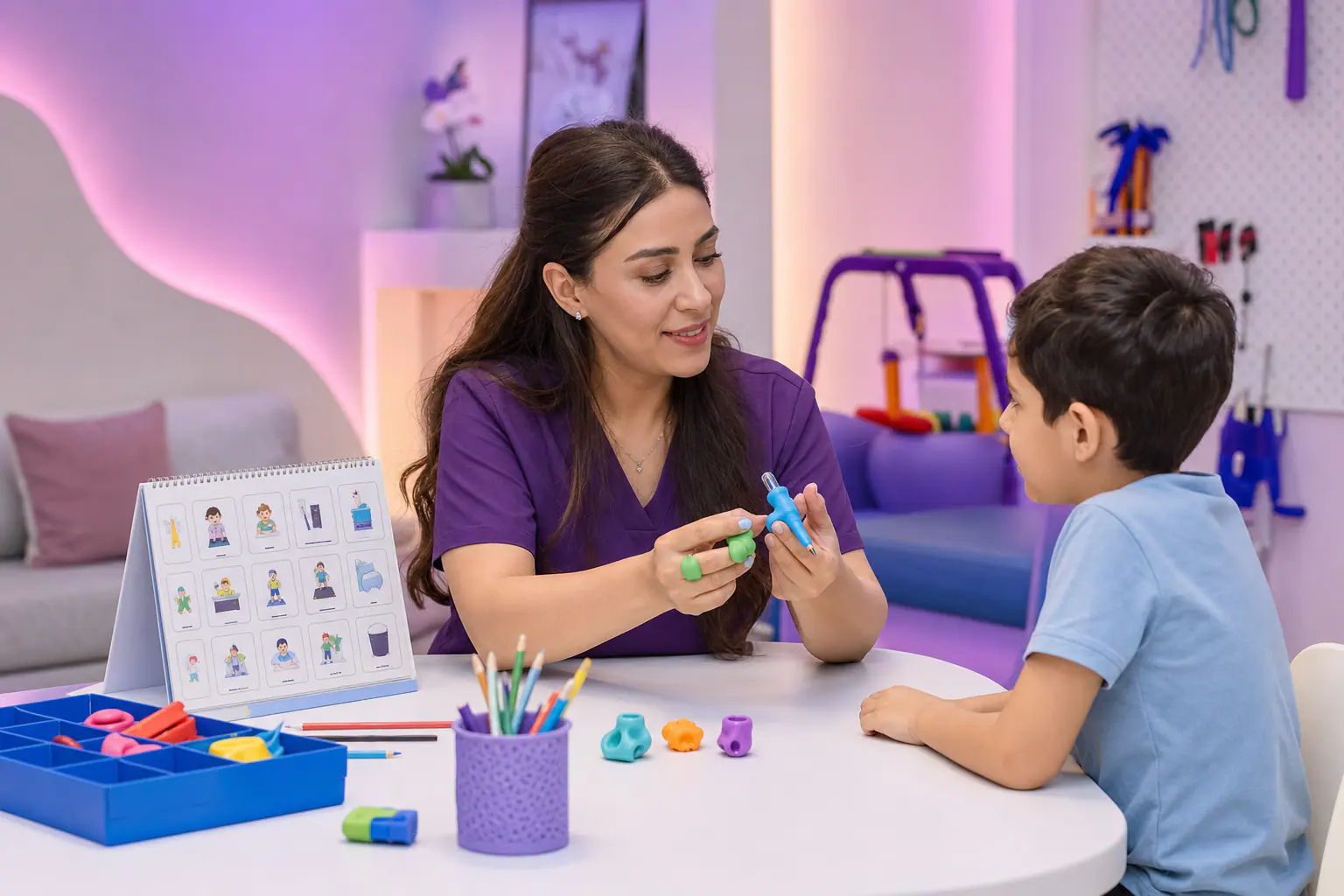
- ● A child with weak hands may not be able to hold a pen well, so he needs a tool to help him improve his grip.
- ● A child who has difficulty sitting may need postural support or seat adjustment.
- ● A child who has an allergy to clothing may need sensory development and adjustments in the type of clothing and method of dressing.
- ● A child who becomes easily distracted may need a visual schedule and organization of the environment.
- ● A child who cannot use a regular spoon may benefit from a spoon with a larger handle or a different training method.
The goal of adaptive solutions is to ask: How do we make the task appropriate to the child's abilities instead of pressuring him in the same way every day?
Therapeutic training
It focuses on developing the child's own skills, such as strengthening the hand, improving balance, developing motor planning, or improving sensory regulation.
Adaptive devices and solutions
Focuses on making the task easier now, reducing difficulty, and increasing engagement, such as using an aid, modifying the environment, or dividing the task.
Mostly the best
Combining the two: We develop the child’s skills through treatment, and we use appropriate tools or solutions that help him succeed in his daily life.
A child who has difficulty writing may need training in hand strength and pencil grip, and at the same time may benefit from a pen or paper grip with clear lines or extra time at school.
When does a child need an evaluation for adaptive devices and solutions?
A child may need an occupational therapy evaluation if he or she continues to have difficulty performing daily tasks despite trying and training.
- ● He cannot hold a pen comfortably
- ● He gets tired quickly while writing
- ● Does not use a spoon or fork well
- ● Spills food or drinks often
- ● He finds it difficult to dress or close buttons and zippers
- ● He cannot sit in a proper position while studying or eating
- ● Rejects certain clothes or items due to sensory sensitivity
- ● Needs great support in bathing or showering
- ● The order of steps in the daily routine is not known
- ● Gets distracted often during tasks
- ● Needs modifications at school or nursery
- ● Has motor weakness, developmental delay, or sensory difficulties
- ● He has cerebral palsy, autism, hyperactivity, or coordination difficulties that affect his daily life
- ● Uses tools but does not make use of them as expected
Evaluation helps choose the appropriate solution instead of trying many tools randomly.
Why don't we buy tools directly without evaluation?
Many parents buy tools from the Internet or based on another child's experience, then discover that the child does not use them or that they do not suit them. The reason is that every child is different, and the right tool for one child may not be right for another.
An inappropriate tool may cause frustration, cause the child to rely on it in an unhelpful way, or not use it at all. Therefore, evaluation is important before recommendation.
Writing and learning tools
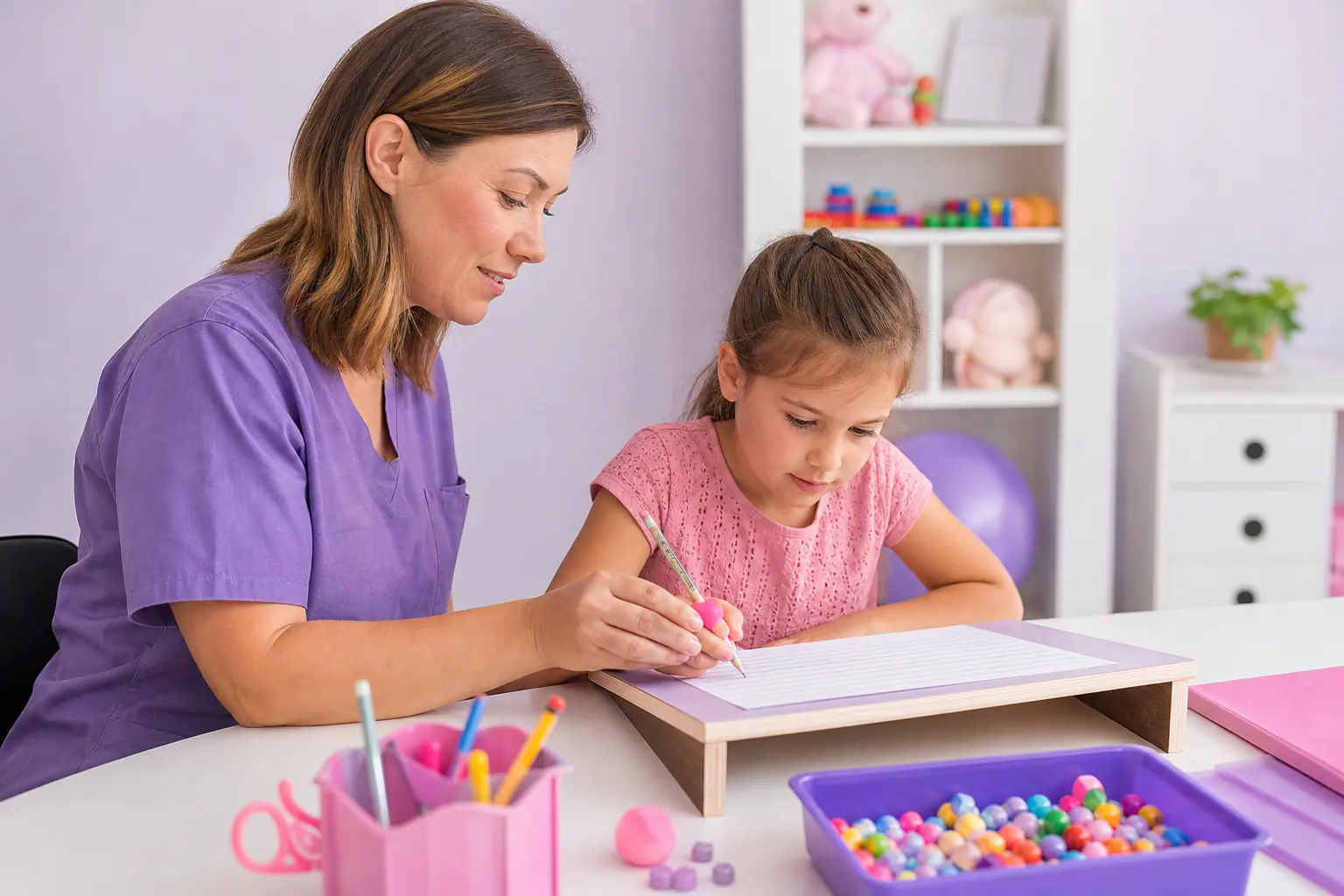
It helps children who have difficulty holding a pen, writing, coloring, cutting, or organizing a page.
- ● Pen grips
- ● Thicker pencils
- ● Tools that help position the fingers correctly
- ● Papers with clear lines or larger areas
- ● Slanted writing boards
- ● Sheet mounting tools
- ● Training or modified shears
- ● Visual means of organizing the page
- ● Schedules of steps for the assignment
- ● Tools to reduce distraction while writing
These tools are not used randomly, but rather according to the reason for difficulty writing: Is the problem with hand strength? Pen grip? Sitting position? Visual perception? Attention? Or fatigue quickly?
Eating and drinking utensils
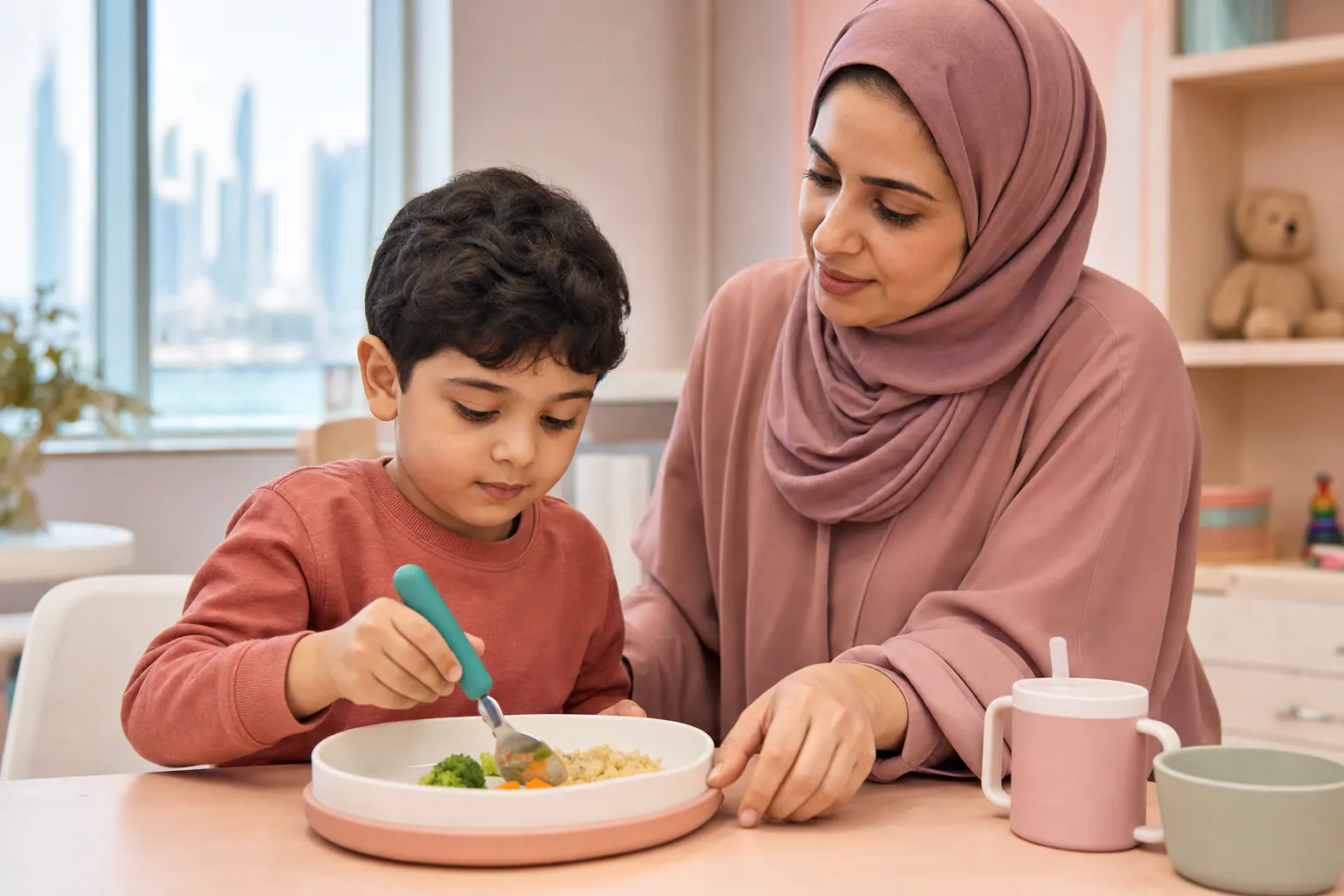
Helps the child to be independent during the meal and to use eating utensils better.
- ● Spoons or forks with larger handles
- ● Easier-to-hold eating utensils
- ● Dishes with auxiliary edge
- ● Suitable training cups
- ● Tools that reduce spillage
- ● Mounting bases for the dish
- ● Adjustments in sitting position while eating
- ● Organize the table to reduce distractions
- ● Visual steps for a meal routine
If a child has coughing, choking, difficulty swallowing, or obvious feeding problems, he or she may need a swallowing or medical evaluation, not just eating utensils.
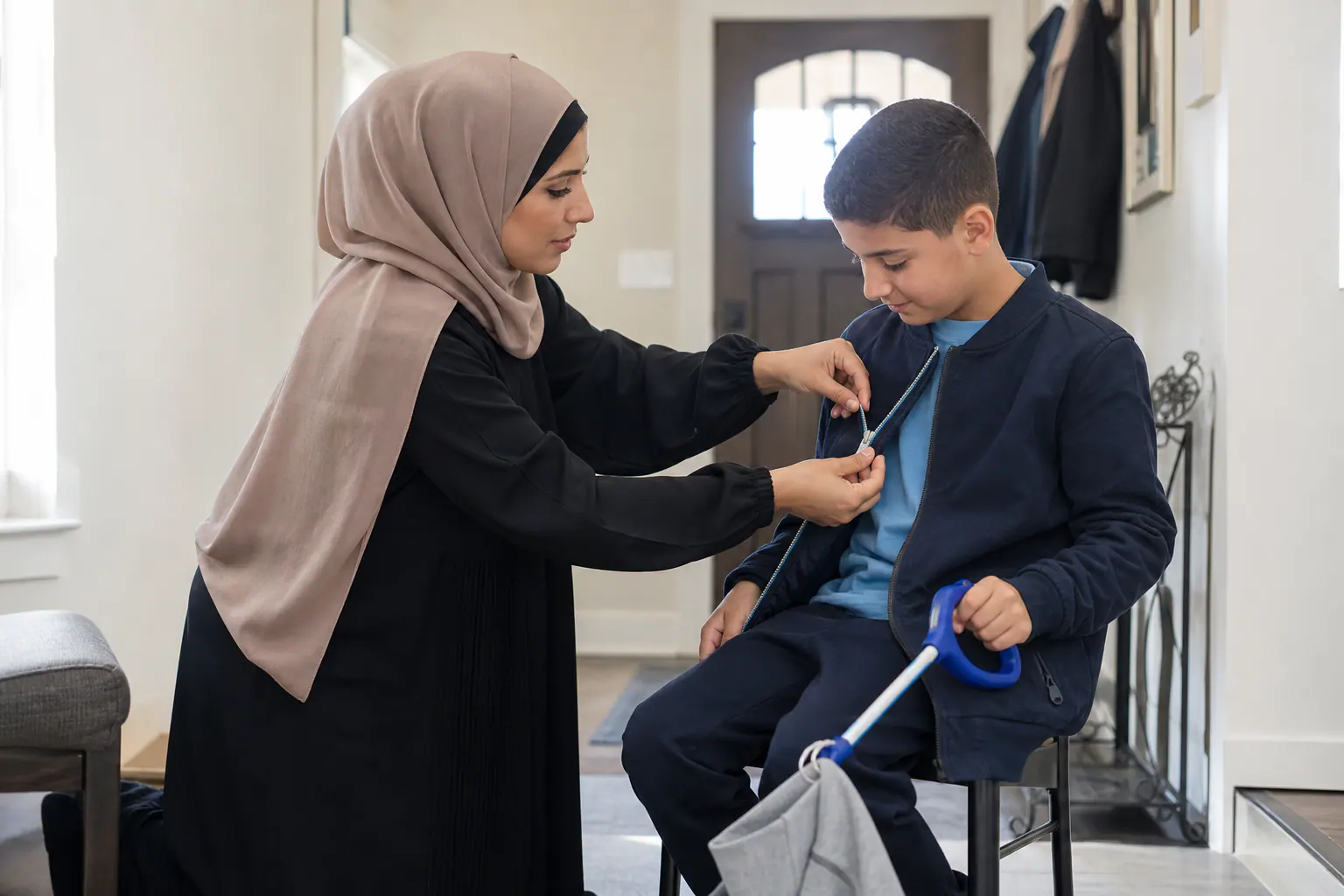
Dressing and dressing solutions
Helps children who have difficulty dressing, closing clothes, or handling certain fabrics.
- ● Gradual training on the steps of dressing
- ● Choosing clothes is easier at first
- ● Changes in the way clothes are presented
- ● Auxiliary tools for zippers or buttons when needed
- ● Illustrated tables for dressing steps
- ● Strategies for allergies to labels or fabrics
- ● Arrange clothes in a clear way
- ● Practice using your hands together
- ● Gradual independence instead of complete dependence on family
The goal is for the child to become more able to participate in dressing according to his age, even if he starts with just one step.
Bathroom and personal hygiene solutions
Helps baby perform bathroom skills, hand washing, teeth brushing and bathing in a safer and more organized way.
- ● Illustrated steps for using the bathroom
- ● Adjustments in sitting or standing position
- ● Tools to help reach the sink
- ● A toothbrush suitable for sensitivity or irritation
- ● Visual timer for brushing teeth or washing hands
- ● Solutions to reduce fear of water or siphons
- ● Gradual tolerance training for bathing or cutting nails
- ● Organize the environment to reduce stress
- ● A clear plan for the routine
These solutions are very important for children who refuse personal hygiene due to sensory or organizational difficulties.
Sitting and posture solutions
Sitting position affects writing, eating, paying attention, playing, and learning.
- ● Adjusting the height of the chair and table
- ● Support the feet while sitting
- ● Choose a suitable position for writing or eating
- ● A suitable seating cushion when needed
- ● Movement breaks before sitting
- ● Organizing the environment around the child
- ● Assess the need for specialized postural support
- ● Recommendations to the school about the child seat
Not every active child needs a seating device. Sometimes he needs structured movement before a task, sometimes he needs an adjustment in the chair, and sometimes the reason is sensory or attentional.
Sensory and organizational solutions
Some children need tools or strategies to help them organize their bodies and deal with sounds, touch, movement, or noise.
- ● Suitable deep pressure tools
- ● Sensory activities before tasks
- ● Regulated movement breaks
- ● Suitable calming tools
- ● A place with less distraction
- ● Noise-reducing headphones in some cases
- ● A clear visual routine
- ● A sensory tool box according to the child’s needs
- ● Alterations in clothing or environment
- ● Strategies for transitioning between activities
Sensory tools must be chosen carefully, because a child who seeks movement is different from a child who is sensitive to movement.
School solutions
The child may need modifications or tools to help him or her at daycare or school to participate better.
- ● Suitable seating place
- ● Extra time to write
- ● Reduce copies of the board when needed
- ● Suitable writing tools
- ● Short and clear instructions
- ● Visual schedule of tasks
- ● Divide the assignment into steps
- ● Short movement breaks
- ● Ways to organize the bag and tools
- ● Support in opening the food container or using the bathroom
- ● Recommendations to the teacher on how to help the child
These recommendations vary depending on the child's condition, and do not mean reducing learning expectations, but rather making the environment more suitable for his or her abilities.
Visual and organizational solutions
Some children need visual support to understand routines, remember steps, or rely less on verbal reminders.
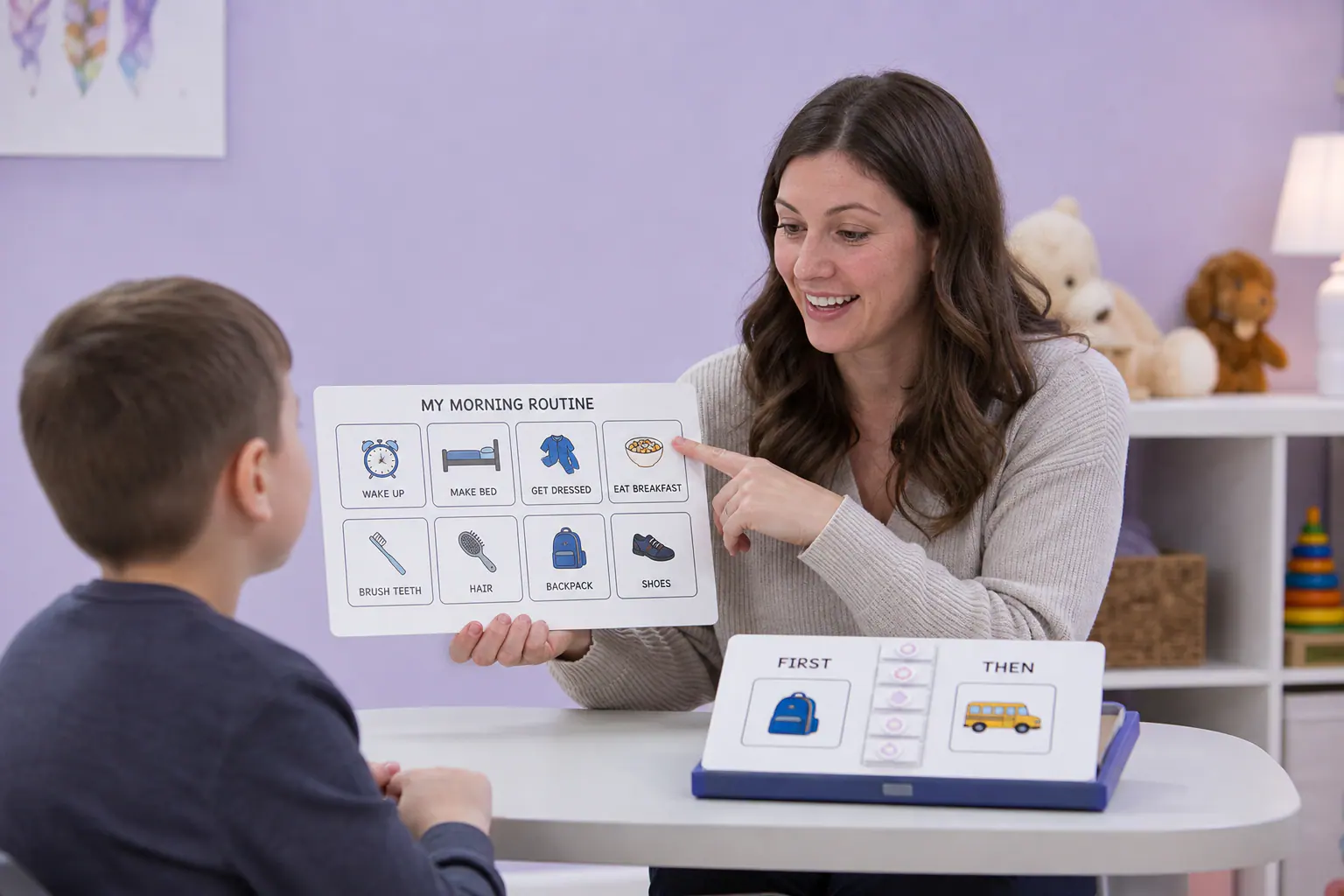
- ● Schedule a morning routine
- ● Illustrated steps for washing hands
- ● Dress schedule
- ● Pictures of arranging the bag
- ● Illustrated to-do list
- ● Visual timer
- ● “First Then” cards
- ● Colors to organize tools
- ● Visual instructions on the desk
- ● A schedule for moving between activities
These solutions are helpful for kids who forget steps, get distracted, or need greater clarity in routines.
Adaptive devices and solutions according to different situations
Each case needs an individual evaluation, because the same tool may help one child and disturb another.
Children with developmental delay
They may need tools to help them engage in daily living skills, such as eating, dressing, playing, and establishing routines.
Autistic children
They may benefit from sensory and visual solutions that help reduce stress, organize routines, support communication, and improve engagement in daily tasks.
Children with hyperactivity and attention deficit disorder
They may need solutions that help with concentration, sitting, organizing tools, dividing tasks, and structured movement breaks.
Children with cerebral palsy or motor difficulties
They may need tools to help sit, use their hands, eat, write, or participate in daily activities in a safer way.
Children with weak fine skills
They may benefit from tools for writing, cutting, eating, dressing, and opening tools.
Children with sensory sensitivity
They may need modifications in clothing, food, routine, environment, or appropriate sensory aids.
How is the need for adaptive devices and solutions assessed?
At AHLI Specialists Medical Center, the evaluation begins with understanding the daily difficulties the child faces at home or school. We choose the tool not only based on the name of the diagnosis, but also based on the task that is difficult for the child to perform.
The goal is to come up with a practical solution that works for the child, not just a list of tools.
What happens after the evaluation?
- ✓ Recommendation of specific tools
- ✓ Train the child to use the tool
- ✓ Modify the way the task is performed
- ✓ A simple home program
- ✓ Recommendations for school or nursery
- ✓ Train parents to gradually reduce help
- ✓ Follow up after a while to see if the solution is appropriate
- ✓ Modify the tool or strategy according to the child’s response
- ✓ Referral to another specialty if the problem requires medical, hearing, visual, or swallowing evaluation
It is important for parents to know that the tool requires training. Some children do not use the tool directly from the first time, but rather need gradual, encouragement and practice.
Steps to choose the appropriate adaptive solution
Define the problem precisely
We start by asking: What task is difficult for the child to perform? Is it writing? eater? Dress? sit? the bathroom? Routine? the school?
Understand the reason for the difficulty
Is the cause weakness in the hand? Sensory sensitivity? Poor balance? dispersion? Difficulty planning? fear? Not understanding the steps?
Try the simplest possible solution
The goal is not to choose the most expensive or complicated tool, but rather the simplest solution that actually helps the child.
Training the child to use
The tool does not work alone. The child needs training so that he knows how to use it at the right time and place.
Parent or teacher training
Parents and schools need to know when the child is using the tool, and how to help him without making him depend on it too much.
Follow the result
After a while, we review: Did the tool help? Does the child use it? Do you need to modify? Is it possible to gradually reduce dependence on it?
Do adaptive tools make a child dependent on them?
Not necessarily. When used correctly, tools can help a child succeed and participate rather than repeatedly fail. In some cases the tool is temporary until the skill develops, and in other cases it is an important part of the child's independence.
Sometimes tool use is the way to help a child be more independent, not less independent.
The role of parents in the success of adaptive solutions
- ✓ Adhere to the method of use explained by the specialist
- ✓ Do not force the child to use the tool forcefully
- ✓ Present the tool in a positive way
- ✓ Give the child time to get used to it
- ✓ Practice the skill in a quiet time
- ✓ Use the solution in your daily routine and not just during the session
- ✓ Note what helps and what doesn't
- ✓ Inform the specialist of any difficulty
- ✓ Do not buy many tools without a plan
- ✓ Praise the child’s small attempts
- ✓ Collaborate with the school if the tool is needed there
A successful tool is one that enters into the child's daily life smoothly and helps him perform the task in a better way.
School or nursery homes
Some adaptive solutions need to be implemented in school or nursery for the child to fully benefit.
- ● Use a pen grip or suitable writing instrument
- ● Adjusting the seating position
- ● Place your feet firmly while writing
- ● Use a visual schedule of tasks
- ● Reduce the amount of copies when needed
- ● Give short movement breaks
- ● Organize the child’s tools with colors or pictures
- ● Support the child in opening his meal
- ● Allow extra time for some tasks
- ● Reduce distractions in the workplace
- ● Use short, clear instructions
The goal is not to exempt the child from participating, but rather to help him participate in a way that suits his abilities.
The relationship between adaptive devices and fine motor skills
Many adaptive tools are related to fine motor skills, such as writing, eating, dressing, opening, closing, and cutting.
- ● Pen grip for improved grip
- ● A tool to stabilize the paper while writing
- ● Training scissors
- ● Cutlery with a larger handle
- ● Tools to help open cans
- ● Practice using both hands
But the tool alone is not enough if the child also needs to strengthen the hand or improve coordination, so training and the tool are combined as needed.
The relationship between adaptive systems and sensory integration
Some children need adaptive solutions because of sensory difficulties, rather than because of muscle weakness.
- ● Modify the type of clothing
- ● Remove annoying stickers
- ● Use a gradual bathing routine
- ● Noise reduction
- ● Use appropriate sensory tools
- ● Movement breaks
- ● Tools that help you sit and pay attention
- ● Reduce distractions in the environment
Sensory solutions must be based on evaluation; Because giving the child inappropriate sensory input may not help him and may increase distraction or discomfort.
The relationship between adaptive devices and daily living skills
When a task is easier and clearer, the child is more willing to try, and the family is less dependent on total assistance.
When do tools need to be revised or changed?
- ● The child no longer uses it
- ● Becomes small or unsuitable for his size
- ● Do not achieve the desired goal
- ● Cause discomfort or rejection
- ● A new difficulty has appeared
- ● The child improved and was able to do the task without her
- ● School requirements have changed
- ● The tool increases dependence instead of independence
- ● The family needs new training to use it
Follow-up is important so that solutions remain relevant and effective.
Common mistakes to avoid
- ✗ Buying many tools without evaluation
- ✗ Choose a tool based on another child's experience
- ✗ Forcing a child to use an aid without training
- ✗ Using a tool that is not suitable for the child’s size
- ✗ Relying on an assistive aid without developing the underlying skill
- ✗ Use random sensory tools
- ✗ Not involving the school in the plan
- ✗ Expect immediate results from the first day
- ✗ Do not review the tool as the child grows
- ✗ Considering the tool as a sign of weakness or failure
- ✗ Use complex tools while a simple solution is sufficient
- ✗ Ignoring the underlying cause of the problem
The right choice begins with a clear assessment and a specific goal.
Adaptive devices and solutions in Al Shamkha - Abu Dhabi
If you are looking for adaptive devices and solutions for children in Abu Dhabi or an occupational therapist in Al Shamkha to evaluate assistive devices, AHLI Specialists Medical Center provides an evaluation that helps choose the appropriate solutions for the child’s daily and school skills.
We help parents know if the child needs a tool, environmental modification, skill training, or a sensory and organizational plan, and then we develop practical recommendations that suit the child, home, and school.
Specialized evaluation
Evaluating an occupational therapy to select adaptive solutions.
Comprehensive understanding
Understanding the child's daily motor and sensory skills.
Practical recommendations
Recommendations for home and school.
Correct training
Training the child and parents to use tools.
Independence
Focus on independence, not overdependence.
Simple solutions
Choose solutions that are as simple and effective as possible.
Comprehensive support
Supports writing, eating, dressing, sitting, and organizing.
Follow
Follow up and modify recommendations according to the child’s development.
Quiet environment
A medical environment suitable for children and families.
Distinctive location
Close to Al Shamkha, Baniyas, Al Falah, Shakhbout and Abu Dhabi areas.
Services associated with adaptive devices and solutions
The child may need one or more of the following services depending on the assessment:
Assistance evaluation
To learn about tools or modifications that may help the child with daily or school tasks.
Assistive Device Prescription and Use
Evaluate and recommend appropriate tools for the child.
Therapeutic splints
Support my situation when needed.
Modifying the surrounding environment
Modifications at home or school to make tasks easier.
Adaptive solutions at home and school
Practical recommendations for home, nursery and school.
Writing and sitting solutions
Supports pen holding, sitting posture, and page organization.
Eating and drinking solutions
Convenient eating utensils and minimizing spillage.
Daily life skills
Support independence in daily tasks.
Parent training
Train the family to use solutions in the routine.
When do I book an appointment for my child?
Book an assessment if your child has:
- ● Difficulty writing or holding a pen
- ● Difficulty using a spoon or cup
- ● Difficulty in dressing, zipping, or buttoning
- ● Difficulty sitting while studying or eating
- ● Obvious distraction during daily tasks
- ● Allergy to clothing, water or toiletries
- ● Difficulty with bathroom or hygiene routine
- ● Need for school modifications
- ● Using many tools without obvious improvement
- ● Poor independence in skills appropriate for his age
- ● Motor or sensory difficulties that affect daily participation
The first step is an assessment that determines what the child actually needs: a tool, training, environment modification, sensory plan, or a combination of more than one solution.
Book an evaluation of adaptive devices and solutions for your child
If you feel that your child needs devices or modifications to help him write, eat, dress, sit, toilet, or participate in school, we can help you through an occupational therapy evaluation of devices and adaptive solutions and develop appropriate recommendations for his daily life.
AHLI Specialists Medical Center - Al Shamkha, Abu Dhabi
Al Qayed Street, Al Shamkha, Abu Dhabi
Frequently asked questions about adaptive devices and solutions
What are adaptive devices and solutions?
Does every child with difficulty need a device?
Do adaptive tools make a child dependent on them?
Is it possible to purchase tools from the Internet without evaluation?
Does occupational therapy provide the same devices?
Do adaptive solutions include school?
Are adaptive solutions useful for autistic children?
Do adaptive solutions help with writing difficulties?
Does the child need follow-up after choosing the tool?
What is the difference between an adaptive device and an adaptive solution?
Our specialized team


Book an evaluation of adaptive devices and solutions
02-448-7553 — Al Shamkha, Abu Dhabi