
Auditory-verbal rehabilitation for children in Abu Dhabi
Listening and speech training for hearing-impaired children at AHLI Specialists Medical Center - Al Shamkha
Does your child use a hearing aid or cochlear implant but doesn't respond to sounds as you expect?
Does he hear some sounds but does not understand speech well?
Is there a delay in speaking due to hearing loss?
Does he need training to learn to pay attention to sounds, distinguish them, understand them, and then use them in speech?
Do you want to help your child develop listening and spoken language in a structured way?
Auditory-verbal rehabilitation is a therapeutic program that helps children who have hearing loss, or use hearing aids or cochlear implants, develop listening, speech comprehension, and verbal communication skills. It is not enough for the child to just get a hearing aid or a cochlear implant; The brain needs continuous training in order to learn the meaning of sounds and words and use them in daily life.
At AHLI Specialists Medical Center in Al Shamkha - Abu Dhabi, we provide audio-verbal rehabilitation service for children within speech and language therapy services, through an individual plan that helps the child develop listening skills, understand speech, develop language, improve pronunciation, and increase daily communication with family and school.
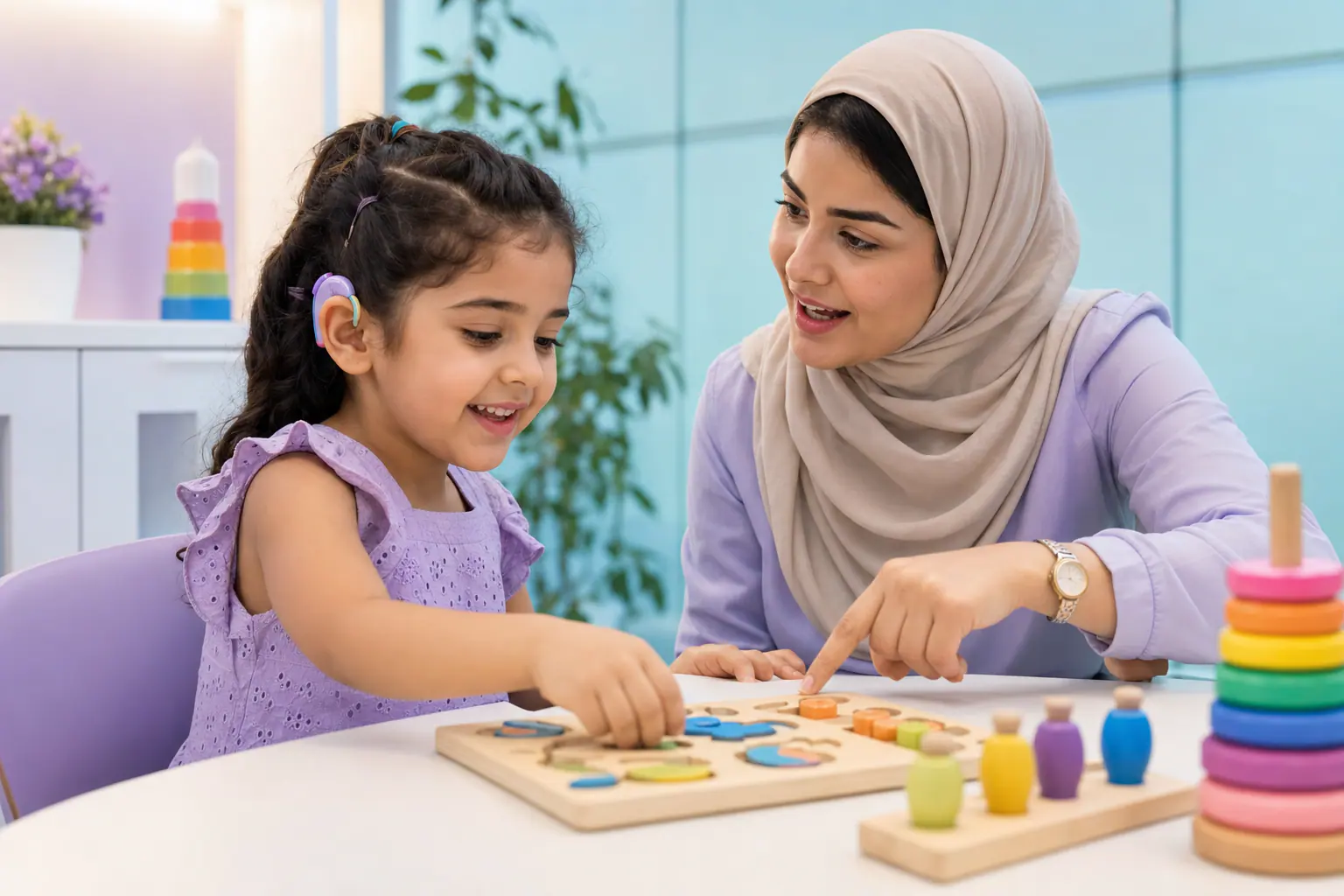
What is auditory-verbal rehabilitation?
Auditory-verbal rehabilitation is a therapeutic program that focuses on training the child to use hearing as a primary means of developing language and speech. It helps the child pay attention to sounds, distinguish them, understand their meaning, and then use them to communicate and learn.
The child does not learn to speak from hearing sound alone, but rather needs organized training in order to know the meaning of what he hears. The child may hear the sound of the door, the sound of his name, or the sound of a certain word, but he does not understand it or does not associate it with meaning. Here comes the role of auditory-verbal rehabilitation in transforming sound into understanding, then into language and speech.
It is suitable for children who have varying degrees of hearing loss, especially users of hearing aids, cochlear implants, assistive hearing devices, or children who have delays in listening and speaking after diagnosis of hearing loss.
- StethoscopesCochlear implantAssistive hearing devicesDelayed listening and speaking after diagnosis of hearing loss
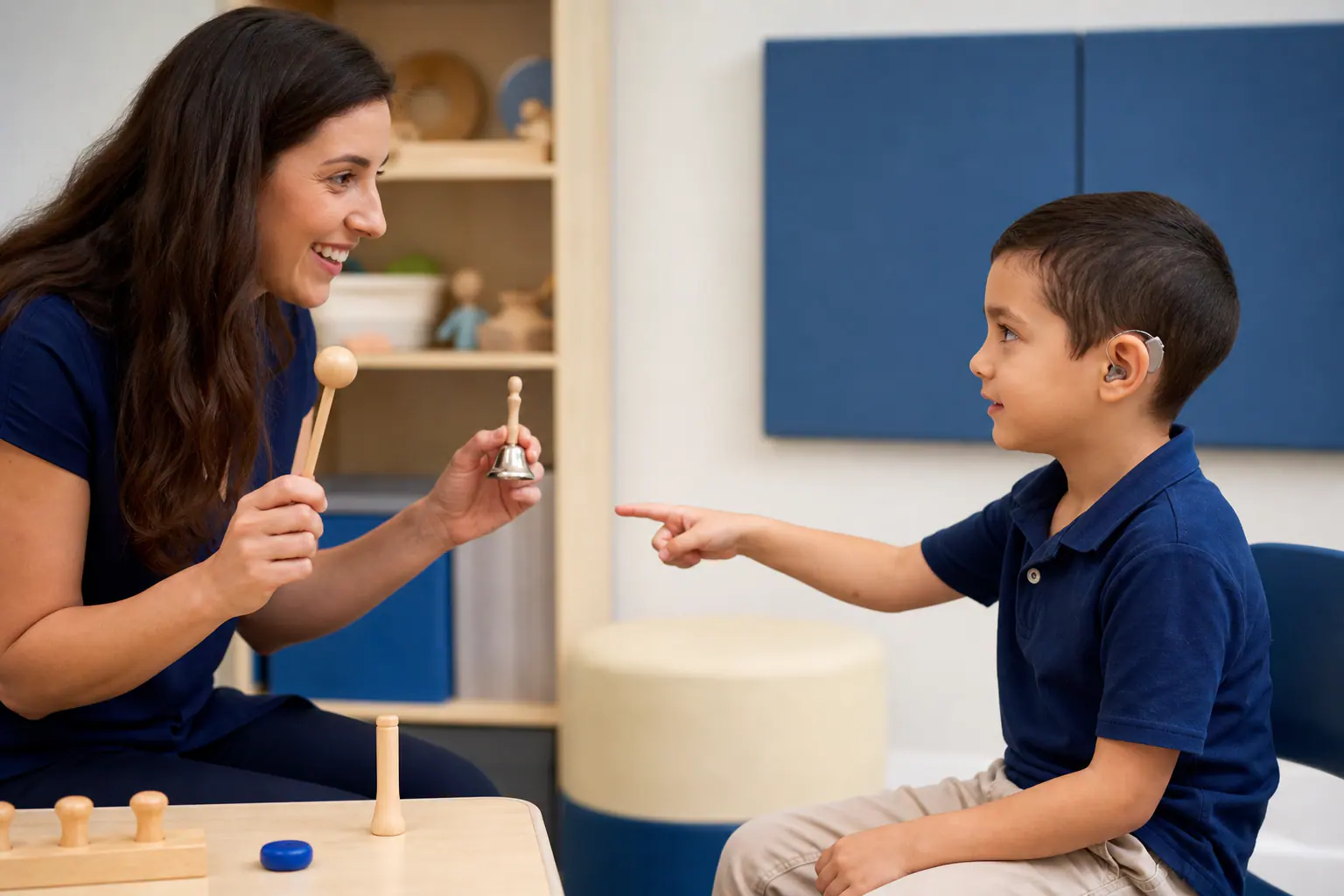
Is audio-verbal rehabilitation the same as speech therapy?
Auditory-verbal rehabilitation is a specialized part of speech and language therapy, but focuses more on listening as a route to developing spoken language.
The child may need general speech therapy, auditory-verbal rehabilitation, or both depending on the evaluation.
Speech and language therapy
- ● Speech delay
- ● Language delay
- ● Speech disorders
- ● Stuttering
- ● Social networking
- ● Difficulties in understanding and expression
Auditory-verbal rehabilitation
- ✓ Pay attention to sounds
- ✓ Detecting the presence of sound
- ✓ Distinguish different sounds
- ✓ Understanding audible speech
- ✓ Language development through hearing
- ✓ Improve pronunciation depending on what he hears
- ✓ Use of speech in daily communication
Who needs audio-verbal rehabilitation?
A child may need audio-verbal evaluation and rehabilitation if he has a hearing loss and shows one or more of the following signs:
The assessment helps to know the child's current level: What does he hear? What does he understand? How does he communicate? What is the appropriate plan to develop his skills?
The importance of early intervention for hearing-impaired children
The earlier a hearing-impaired child starts getting appropriate support, the greater his or her chances of developing better language and communication. Hearing is important for learning sounds, words, and sentences, and the first years of a child's life are very important for brain and language development.
When there is hearing loss, it is not enough to wait until the child “speaks alone.” The child needs:
- ✓ Clear audio diagnosis
- ✓ An appropriate device such as a hearing aid or a cochlear implant, depending on the case
- ✓ Follow up with the audiologist
- ✓ Organized audio-linguistic training
- ✓ Parent participation in daily rehabilitation
- ✓ An environment rich in speech and interaction
Early rehabilitation helps the child benefit from the hearing available to him, whether through headphones, cochlear implants, or any appropriate hearing aid.
Is a hearing aid or cochlear implant alone sufficient?
Hearing aids and cochlear implants are very important tools, but they are not the end of treatment. These devices help the child access sound, but the child needs training in order to learn to interpret this sound.
After installing a hearing aid or activating a cochlear implant, the child may hear many sounds for the first time or in a different way, and he needs time and training to link sounds to meanings, words, and sentences. Collaboration between the family, audiologist, otolaryngologist, and speech-language pathologist is very important.
Objectives of auditory-verbal rehabilitation
The goals vary from one child to another depending on his age, degree of hearing loss, type of hearing aid, history of using hearing aids or cochlear implants, and current language level.
The ultimate goal is to help the child use listening and speech in his daily life as much as possible and in a way that suits his abilities and needs.
Stages of development of listening skills
Auditory-verbal rehabilitation does not begin directly with speech and sentences. There are gradual stages that help the child build listening skills.
1. Sound detection
The child learns to pay attention to the presence of sound.
Example: He hears the sound of a door, the sound of a toy, the sound of his name, or his mother’s voice.
2. Sound discrimination
The child learns that sounds are different from each other.
Example: The sound of a car is different from the sound of water, and the sound of “mama” is different from “dada.”
3. Voice recognition
The child learns to associate sound with meaning.
Example: When he hears “ball,” he knows that what is meant is the ball.
4. Understanding speech
The child learns to understand words, sentences, and instructions through hearing.
Example: “Give the shoe,” “Open the door,” “Put the ball in the box.”
5. Use of language and speech
The child begins using words and sentences to express himself, gradually improving pronunciation and clarity.
Each stage requires training, patience, and repetition in sessions and at home.
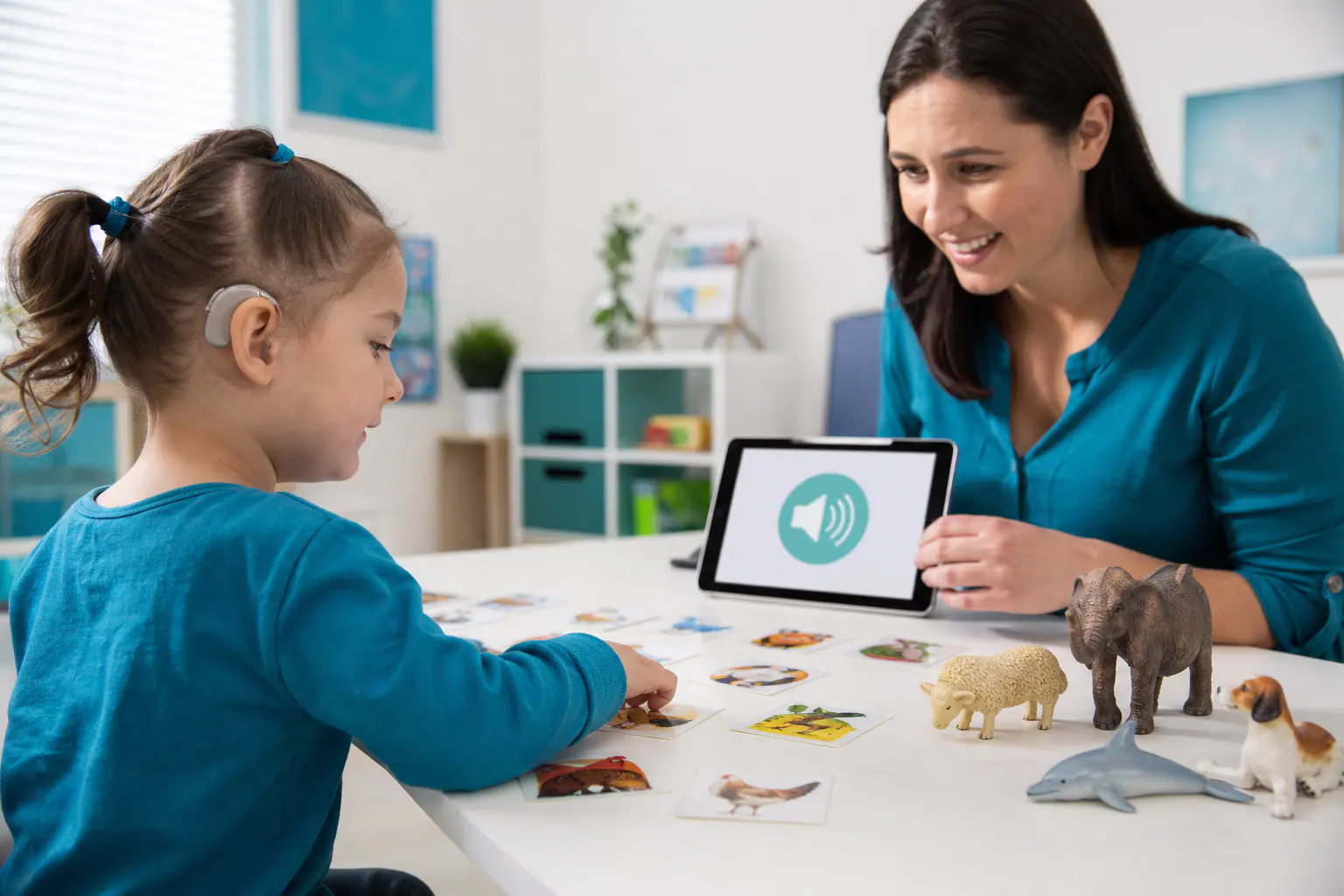
What does the auditory-verbal rehabilitation evaluation include?
At AHLI Specialists Medical Center, audio-verbal rehabilitation begins with a comprehensive assessment to understand the child’s current level of hearing, language, and communication.
- ✓ Know the history of hearing loss diagnosis
- ✓ Know the type and degree of hearing loss if reports are available
- ✓ Know the type of device used: hearing aid or cochlear implant
- ✓ Know how long the device is used daily
- ✓ Asking the parents about the child’s response to sounds
- ✓ Assess the child’s attention to environmental sounds
- ✓ Evaluate the child’s response to his name
- ✓ Evaluate the child’s ability to distinguish sounds
- ✓ Assess understanding of words and instructions
- ✓ Evaluate expressive language and the number of words and sentences
- ✓ Evaluate pronunciation clarity
- ✓ Observe the way the child communicates with the family
- ✓ Know the level of dependence on sign or lip reading
- ✓ Determine the need for audio follow-up or device examination
- ✓ Setting treatment goals appropriate to the child’s age and level
After the evaluation, the results are explained to the parents in a clear way, and a plan is developed to help the child gradually develop listening and speaking skills.
Steps for auditory-verbal rehabilitation
The plan varies depending on each child's condition, but often goes through several basic steps.
1. Ensure that the hearing aid is ready
Ensure that the child uses his hearing device appropriately, and that the hearing aid or cochlear implant is working and is followed up with the audiologist.
2. Determine the current listening level
Determine whether the child only detects sounds, distinguishes between them, understands words and sentences, or can follow instructions through hearing.
3. Establish individual treatment goals
Clear goals depending on the child's needs: responding to a name, distinguishing sounds, understanding words, building sentences, or improving pronunciation.
4. Train listening through play
Interactive sessions with games and activities that help the child pay attention to sound and link it to meaning.
5. Language development through hearing
Linking words to everyday situations so that the child understands their meaning and uses them.
6. Parent training
Teaching the family how to use daily routines to train the child to listen and speak.
7. Applying skills at home and school
The goal is for the child to use his skills in daily life, not just within the session.
8. Follow up on progress and modify the plan
Monitor the child's development and adjust goals according to his response, while cooperating with the audiologist or school when needed.
What is an auditory-verbal rehabilitation session like?
An auditory-verbal rehabilitation session is comfortable and interactive, and often relies on play and daily activities rather than rigid tests.
- ● Audio activities to attract the child's attention
- ● Games that help him distinguish sounds
- ● Train the child to respond to his name or to sounds
- ● Activities to understand new words
- ● Practice following simple auditory instructions
- ● Repetition of words and sentences within a natural context
- ● Pronunciation training according to the sounds the child hears
- ● Use stories, pictures and games
- ● Training parents on appropriate speech
- ● Give simple and appropriate homework
The session is not only for the child; It is also a training for the parents so that they know how to help him at home.
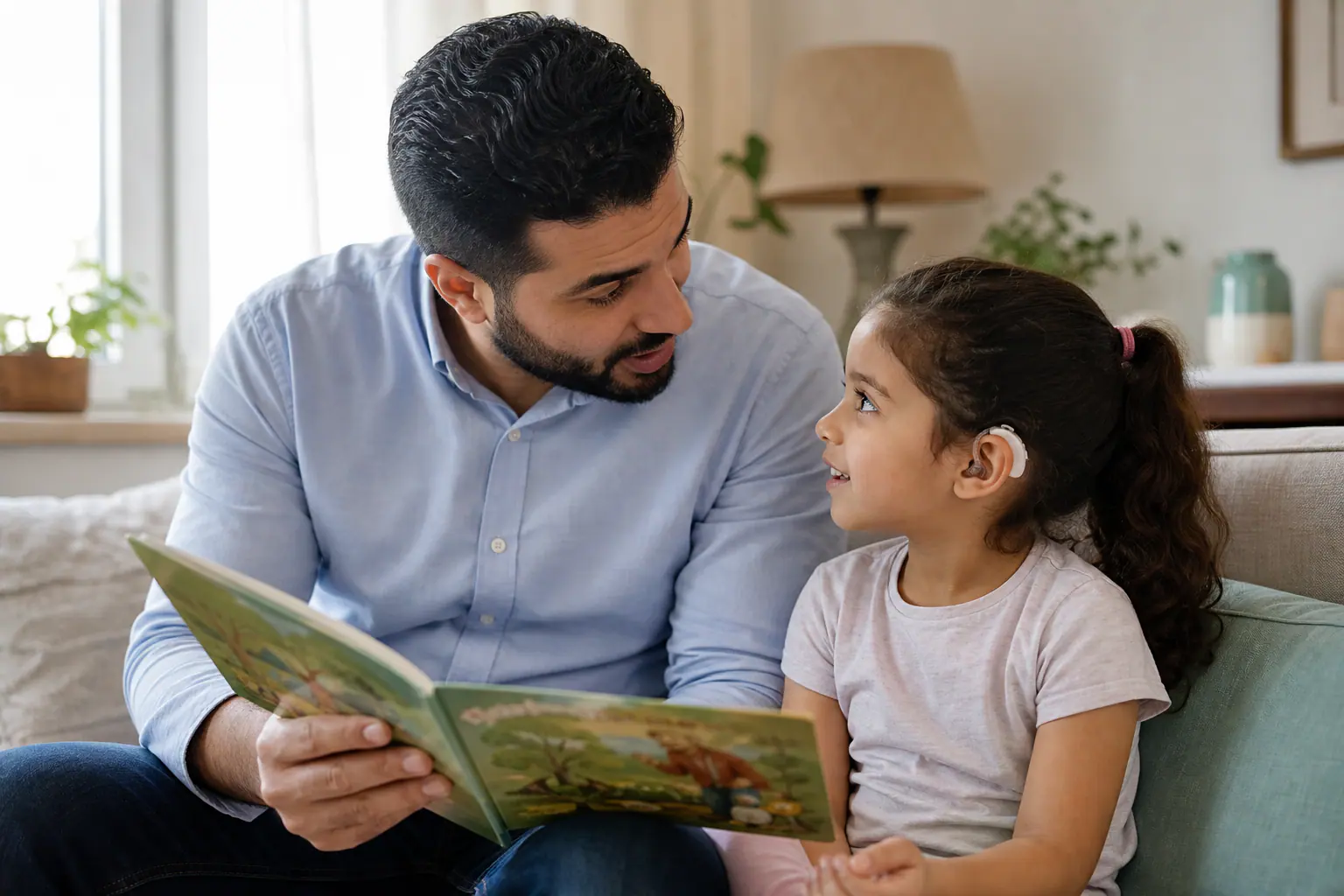
The role of parents in auditory-verbal rehabilitation
The role of the parents is very essential, because the child needs daily training during the normal routine. The session alone is not enough if the strategies are not applied at home.
- ✓ Make sure to wear the hearing aid or cochlear implant device according to the recommendations of the audiologist
- ✓ Talk to the child throughout the day in clear language
- ✓ Naming objects and actions in daily routine
- ✓ Reduce noise during training and speech
- ✓ Draw the child’s attention to the sound before giving instructions
- ✓ Use short, clear sentences
- ✓ Give the child time to respond
- ✓ Repeat words in everyday situations
- ✓ Read comic stories daily
- ✓ Encourage the child to listen before relying on the signal
- ✓ Turn play into an opportunity to listen and talk
- ✓ Quickly follow up on any problem in the hearing system
- ✓ Attend sessions regularly and share observations with the specialist
Parents are not only observers, but they are part of the treatment plan.
Auditory-verbal rehabilitation after cochlear implantation
After cochlear implantation and activation of the device, the child begins to receive sounds in a new way. He may hear sounds he never heard before, but he needs training to understand them.
- ● Getting used to new sounds
- ● Pay attention to environmental sounds
- ● Distinguish different sounds
- ● Gradually understand speech
- ● Develop words and sentences
Cochlear implants are not an immediate solution to speech. It is a means of accessing sound, while rehabilitation is what helps the child transform sound into language and communication.
Auditory-verbal rehabilitation with hearing aids
Children who use hearing aids may also need auditory-verbal rehabilitation, especially if they have a speech delay or difficulty understanding speech.
- ● Pay attention to everyday sounds
- ● Distinguishing speech from other sounds
- ● Understand words and sentences
- ● Improve response to instructions
- ● Speech and language development
- ● Reduce the difficulty of understanding in noise
- ● Supporting the child in the school environment
You must always ensure that the hearing aid is adjusted appropriately, that the child uses it regularly, and that there is regular follow-up with the audiologist.
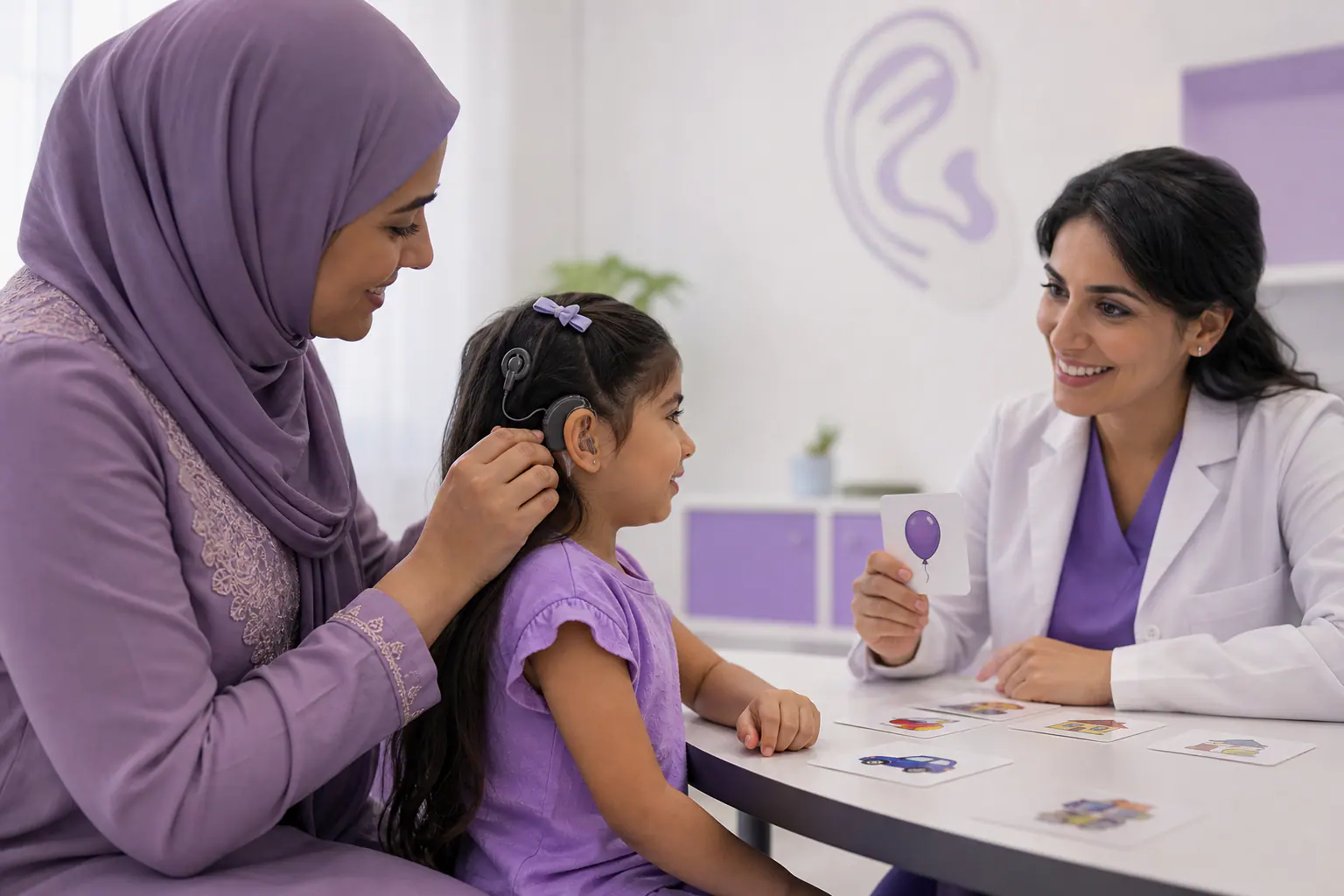
Auditory-verbal rehabilitation in school
Hearing-impaired children may face challenges in school, especially in crowded classrooms or noisy places.
- ● Not understanding the instructions the first time
- ● The need to repeat words
- ● Difficulty following the teacher
- ● Poor attention in class
- ● Delay in language or vocabulary
- ● Difficulty in participating
- ● Tired of listening all day
- ● Poor understanding of speech in noise
- ● Delay in reading or learning in some children
A treatment plan may help support the child in school with guidelines such as sitting in an appropriate location, reducing noise, making sure equipment is working, using clear instructions, and cooperating with teachers as needed.
Signs that the child is not making good use of the hearing system
The child may need to see an audiologist or doctor if the parents notice:
- ⚠ The child does not pay attention to sounds as before
- ⚠ Refuses to wear hearing aids or cochlear implants
- ⚠ Turns the TV volume up too much
- ⚠ Does not respond to his name
- ⚠ Asks to repeat words often
- ⚠ Seems tired or uncomfortable when wearing the device
- ⚠ Decreases in speech or response
Rehabilitation depends on reaching a clear and appropriate voice for the child. Therefore, monitoring the hearing system is an essential part of the success of the plan.
Is auditory-verbal rehabilitation suitable for all hearing-impaired children?
Auditory-verbal rehabilitation may be beneficial for many hearing-impaired children, but it must be appropriate to the child's condition, family goals, and available hearing and language abilities.
Some children benefit greatly from focusing on listening and speaking, and some require additional communication aids, visual support, sign language or a comprehensive communication plan depending on their condition. The most important thing is that the child gets early and clear language and communication, and that the plan is based on a specialized assessment and not on general expectations.
Common mistakes to avoid
- ✗ Installing a hearing aid or cochlear implant without follow-up rehabilitation
- ✗ Use the device for only a few hours
- ✗ Skipping assessment by an audiologist
- ✗ Talking to the child from afar or in loud noise
- ✗ Expect the child to speak immediately after installing the device
- ✗ Relying on sessions without home practice
- ✗ Not informing the specialist about the device’s problems
- ✗ Comparing the child with other children
- ✗ Correct each word in a way that puts pressure on the child
- ✗ Ignoring language delay because the child has “started hearing”
- ✗ Ignoring signs of ear pain or rejection of the device
Correct interaction begins with appropriate equipment, regular training, and a rich linguistic environment at home.
Auditory-verbal rehabilitation in Al Shamkha - Abu Dhabi
If you are looking for audio-verbal rehabilitation for children in Abu Dhabi or hearing and speech training for children in Al Shamkha, AHLI Specialists Medical Center provides an assessment and treatment plan that helps the hearing-impaired child develop listening and spoken language skills.
We help parents understand the child’s auditory and linguistic level, and develop a practical plan that helps him listen, understand speech, develop language, and improve daily communication.
Specialized evaluation
For listening and speaking skills.
Individual plan
For hearing-impaired children.
Hardware support
For users of hearing aids or cochlear implants.
Listening training
Discover, distinguish and understand sounds.
Language development
Through hearing and speech.
Parent training
Apply strategies at home.
Clear follow-up
For the child's development.
Suitable environment
Quiet medical treatment for children and families.
Distinctive location
Close to Al Shamkha, Baniyas and Al Falah.
Multiple collaborations
With an audiologist and doctor when needed.
Services related to auditory-verbal rehabilitation
Listening and language assessment
To know the child's level in discovering sounds, understanding speech, and using language.
Rehabilitation after cochlear implantation
To help baby understand new sounds and develop spoken language.
Spoken language development
To increase vocabulary, sentences, comprehension, and expression through hearing.
Delayed speech in children
Supporting children who are late in speaking due to hearing impairment or other causes.
Improve pronunciation
To help the child pronounce sounds and words more clearly.
Speech and language therapy
Comprehensive speech, language and communication services.
When should I book an appointment for my child?
Book an evaluation if your child has a hearing loss or uses a hearing aid or cochlear implant, and you notice that:
- ● Does not respond to sounds well
- ● He does not understand speech easily
- ● He has a delay in speech
- ● Does not use words or sentences appropriate for his age
- ● Relies on gestures more than speech
- ● Does not benefit from the device as you would expect
- ● Finds difficulty in school because of hearing or language
- ● Needs training after cochlear implantation or hearing aids
- ● He has unclear pronunciation due to poor hearing
The first step is to assess listening and language skills, then develop a plan that works for your child.
Book a review nowBook a verbal auditory rehabilitation assessment for your child
If your child uses a hearing aid or cochlear implant, or has a hearing loss that affects speech and language, we can help you with a hearing-verbal rehabilitation evaluation and develop an appropriate plan for listening and speech development.
AHLI Specialists Medical Center - Al Shamkha, Abu Dhabi
Al Qayed Street, Al Shamkha, Abu Dhabi
Frequently asked questions
What is auditory-verbal rehabilitation?
Does the child need rehabilitation after a cochlear implant?
Is a hearing aid alone enough?
When does auditory-verbal rehabilitation begin?
Is auditory-verbal rehabilitation suitable for every hearing-impaired child?
Can a hearing-impaired child develop speech?
How many sessions does a child need?
Do parents have to attend the sessions?
Does the child need to be followed by an audiologist?
Does auditory-verbal rehabilitation prevent the use of other means of communication?
Our specialists

Book your appointment now
Our medical team is ready to receive you. Book your appointment today or contact us via WhatsApp for a quick consultation.