
Pronunciation disorders in children in Abu Dhabi
Treatment of syllables and speech intelligibility difficulties at AHLI Specialists Medical Center - Al Shamkha
Does your child speak but his speech is not clear?
Does he replace some letters, such as “Talb” instead of “Kalb” or “Sara” instead of “Thara”?
Does he delete sounds from words, or do others have difficulty understanding what he says?
Does he know what he wants to say, but can't pronounce the words correctly?
Sound pronunciation disorders are common problems in children, and may appear in the form of difficulty pronouncing some letters, substituting sounds, deleting them, distorting them, or blurring speech compared to the child’s age. Sometimes a child is smart and understands well, but he cannot communicate his words clearly, and this may cause him frustration or shame at home or school.
At AHLI Specialists Medical Center in Al Shamkha - Abu Dhabi, we provide specialized evaluation and treatment for speech and letter articulation disorders in children, through a speech and language therapist, with an individual treatment plan that helps the child improve speech clarity and communicate with confidence.
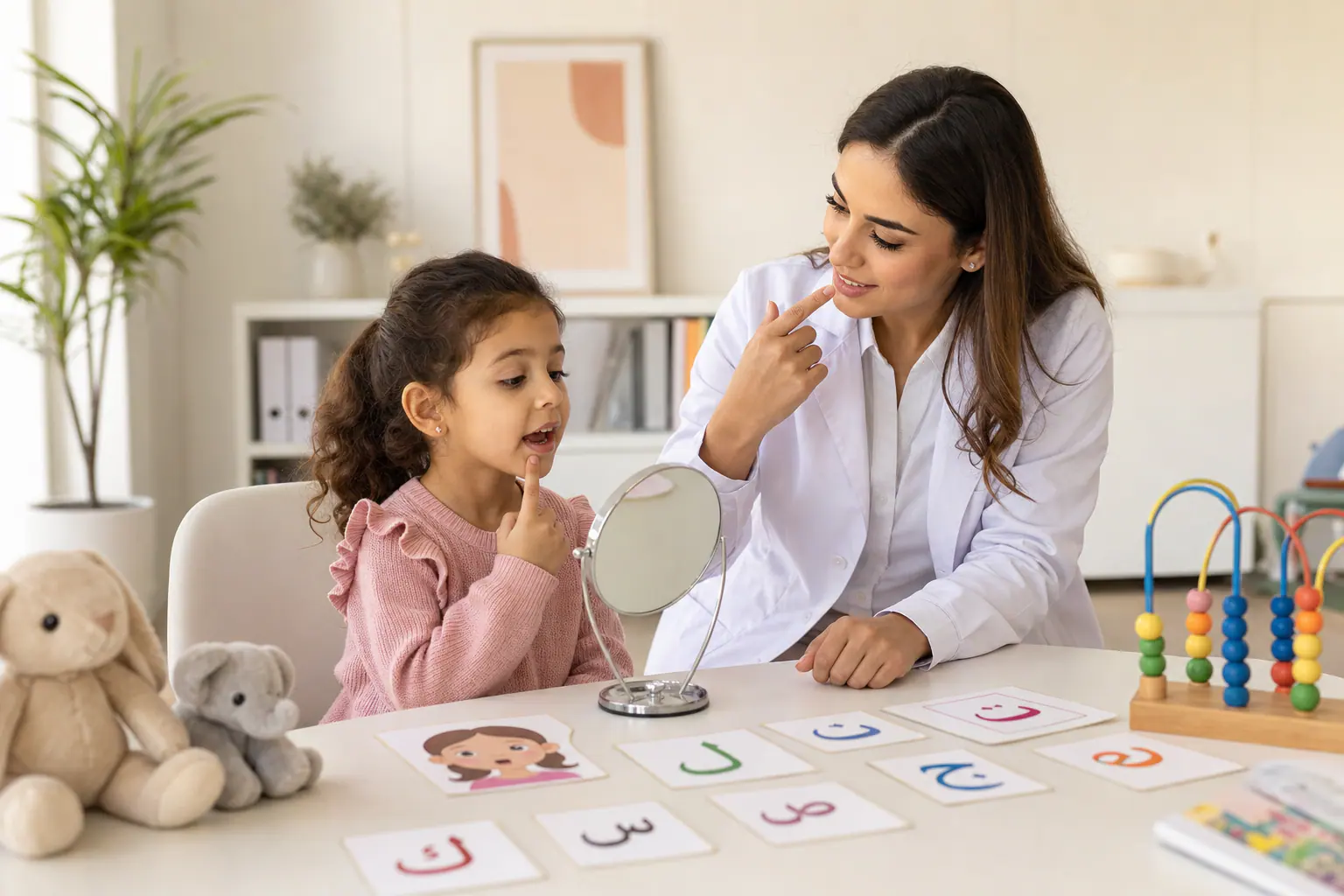
What are speech disorders?
Speech disorders are difficulties that affect a child's ability to produce speech sounds correctly and clearly. A child may be able to understand speech and use words, but have difficulty pronouncing certain sounds or their arrangement within a word.
Replace the “k” sound with “t”
Delete the end of the word
Transpose a letter at the beginning of a word
The goal of treatment is not just to “correct a letter,” but to improve speech clarity so that the child can express himself confidently at home, nursery, school, and social situations.
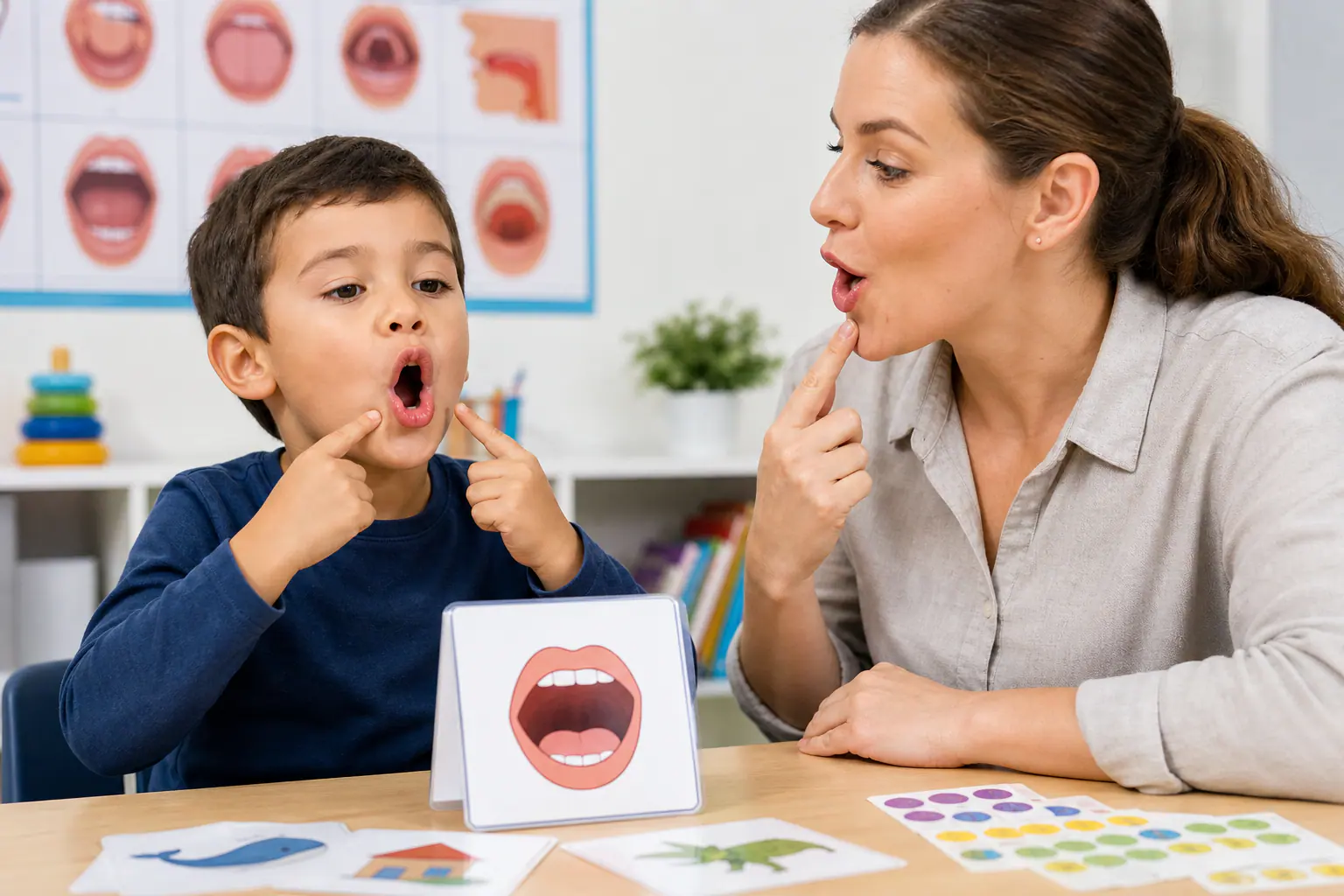
The difference between speech pronunciation disorders and speech delay
Many parents confuse delayed speech with speech pronunciation disorders, but there is an important difference:
Speech delay
The child does not use enough words or sentences for his age. He may have few words, not form sentences, or rely on gestures rather than speech.
Sound pronunciation disorders
The child speaks, but his pronunciation is unclear or contains errors in letters and sounds. He may have vocabulary and sentences, but others do not understand him easily.
Language disorders
Difficulty understanding speech or using words and sentences to express ideas and needs.
More than one aspect may occur in the same child, so the child needs a comprehensive speech and language evaluation to determine whether the problem is in speech only, or in speech and language together.
What are the types of sound pronunciation errors in children?
Speech errors vary from one child to another, and may appear in several ways:
Delete audio
The child removes a sound from the word, such as “ara” instead of “car,” or “tab” instead of “book.”
Switch sound
It replaces one sound with another, such as “tep” instead of “dog,” or “dimple” instead of “camel.”
Sound distortion
The sound is pronounced in a way that is close to correct but is not clear, such as pronouncing the s or ra inaccurately.
Add sound
The child adds an extra sound within a word, making the word different or unclear.
Simplify long words
The child shortens words or changes the order of sounds, especially in long or compound words.
Difficulties in phonological operations
A repetitive pattern in speech, such as changing back sounds to front ones, or deleting word endings.
These errors may be normal at a young age, but they need to be evaluated if they persist longer than expected or affect the child's speech clarity.
When are speech errors normal and when do they need evaluation?
It is normal for children to make mistakes in some sounds while learning to speak. Not every child who switches letters needs immediate treatment. But if the child's speech is incomprehensible compared to his age, or if the errors persist for a long time, or if the child begins to avoid speaking due to difficulty in pronunciation, then evaluation becomes important.
Evaluation does not necessarily mean that the child has a major problem, but it helps to know whether pronunciation errors are appropriate for his age or need treatment.
You are advised to book an assessment if:
- ✓The child's speech is not clear to people outside the family
- ✓Replaces or deletes many sounds
- ✓Parents have difficulty understanding the child
- ✓He gets angry because others do not understand him
- ✓The errors affect his participation in nursery or school
- ✓He avoids talking in front of people
- ✓The problem persists and does not improve
- ✓Suspicion of hearing loss or recurring ear infections
- ✓Speech delay or language difficulties with pronunciation problem

Signs of speech disorders
Your child may need to be evaluated by a speech and language therapist if you notice one or more of the following signs:
- ● His speech is incomprehensible compared to children his age
- ● Repeatedly replaces one letter with another
- ● Removes sounds from the beginning, middle, or end of a word
- ● He pronounces some letters in a distorted or unclear way
- ● He finds it difficult to pronounce long words
- ● He speaks quickly and his speech becomes less clear
- ● Parents need to translate his words to others
- ● He repeats the word several times until others understand him
- ● He feels frustrated when no one understands him
- ● Avoids participating or answering in class
- ● Subject to frequent correction or comment
- ● Difficulty in pronouncing sounds such as rā’, sīn, shin, kāf, jīm, and qāf
Every child is different — judging not only the type of letter, but also the child's age, clarity of speech, number of errors, and the impact of the problem on his or her daily life.
Causes of speech disorders
It may occur for various reasons. In many cases, the goal of the evaluation is to understand the nature of the error and develop a plan to help the child pronounce sounds more clearly.
- Delayed development of speech skills
- Difficulty learning how to produce some sounds
- Weakness in auditory discrimination between sounds
- Hearing loss or recurrent ear infections
- Difficulties in movement of the tongue, lips or jaw
- Problems with the arrangement of sounds within a word
- Family history of speech difficulties
- Language delay or other communication disorders
- Lack of linguistic interaction or excessive reliance on screens
- Developmental or neurological problems in some cases
- Difficulties in motor planning for speech
How do sound pronunciation disorders affect the child?
It may affect the child if his speech is not understood or if he becomes subject to constant correction.
Daily communication
Difficulty asking for what he wants or explaining what happened to him.
Self-confidence
He was ashamed if he was asked to repeat the words or if someone laughed at his utterance.
the school
Avoid reading aloud, answering in class, or sharing.
Social relations
Withdrawal from play if other children do not understand.
Learn later
It may be linked to phonological awareness skills that are important for reading and writing.
Polygraph therapy aims not only to pronounce a specific letter, but also to improve speech clarity, reduce frustration, and increase engagement.
How are phonation disorders evaluated?
Treatment begins with a comprehensive assessment from a speech and language therapist — in a way that is comfortable and appropriate for the child's age, often through play, pictures, words, dialogue, and observation.
- ✓Listen to the child's speech in words, sentences and conversation
- ✓Identify the sounds he pronounces correctly
- ✓Identify the sounds that it alters, deletes, or distorts
- ✓Determine whether the errors are in a single letter or in an entire phonetic pattern
- ✓Evaluate speech intelligibility for the child's age
- ✓Observe the movement of the tongue, lips, and jaw when needed
- ✓Assess the child's ability to imitate the correct sound
- ✓Assessing auditory discrimination between similar sounds
- ✓Know the impact of the problem on home and school
- ✓Asking parents about the development of speech and language
- ✓Recommending a hearing test if any indications are present
- ✓Determine an appropriate treatment plan
After the evaluation, the results are explained to the parents: What sounds are affected? Is the problem simple or does it require sessions? What is the first goal? How can a child be supported at home?
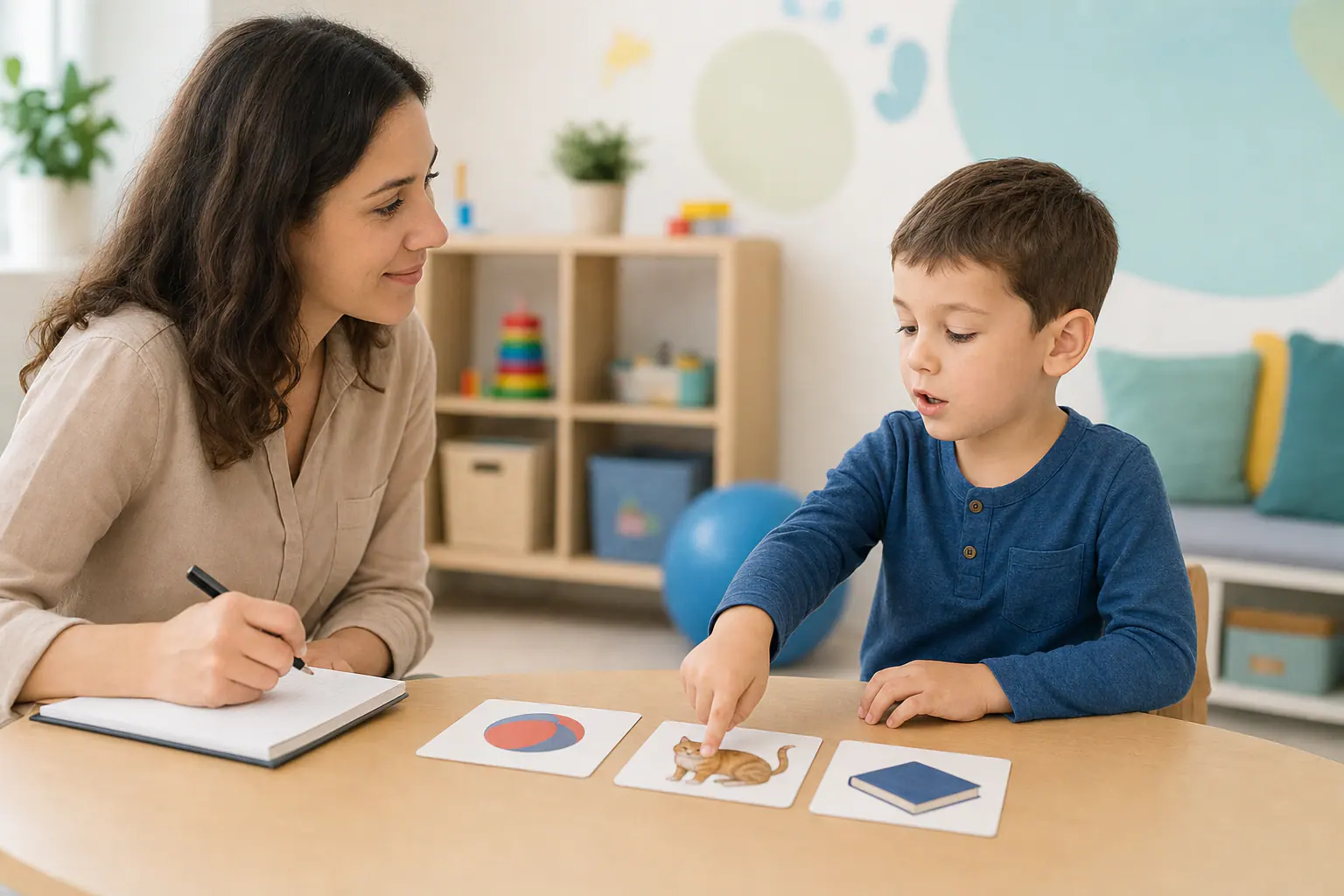
Steps to treat vocal pronunciation disorders
The plan depends on the type of error, the age of the child, the number of sounds affected, and his ability to imitate the correct sound.
Identify the target sound or style
We start with the sounds that most affect speech intelligibility.
Teaching audio production
The position of the tongue, the movement of the lips, the direction of the air — in a simple way.
Auditory discrimination
Hearing the difference between the correct and incorrect sound, such as “k” and “t”.
Voice training alone
Pronounce the sound individually correctly with appropriate repetition.
Within syllables and words
Sound at the beginning, middle, and end of a word as needed.
inside sentences
From short sentences to longer sentences.
In everyday speech
Automatically use voice in conversation — not just in session.
Home exercises for parents
Simple and clear exercises for application at home.
Follow up and modify the plan
Continue to improve and move on to the next goal.
Treatment of letter exits: Is it just repetition of the letter?
no. Random repetition may cause boredom or stress without a clear result. The correct treatment begins with understanding the cause of the error:
- ?Does the child not know where the tongue is?
- ?Does he not hear the difference between the two sounds?
- ?Can he pronounce the sound alone but makes mistakes within the words?
- ?Is the problem with one letter or with the entire phonetic system?
- ?Is the error appropriate for his age or late?
Therefore, treatment requires evaluation, clear goals, gradual training, and continuous follow-up.
The role of parents in treating speech disorders
The child needs practice outside the session, but in a correct way and without pressure.
- ✓Listen quietly and do not interrupt too much
- ✓Don't make fun of his pronunciation
- ✓Do not force him to repeat the word all the time
- ✓Repeat the word correctly in front of him in a natural way
- ✓Speak clearly and at a comfortable pace
- ✓Reduce noise and screens during interaction
- ✓Playing with toys that contain the target sound
- ✓Read short stories and focus on simple words
- ✓Apply exercises prescribed by the specialist only
- ✓Praise the attempt, not just the perfect pronunciation
- ✓Give him enough time to express
The most important thing is for the child to feel that speaking is a comfortable experience and not a constant test.
Common mistakes to avoid
- ✗Correct every word the child says
- ✗Asking to repeat the speech in front of others
- ✗Comparing the child with his siblings or peers
- ✗Laughing at his pronunciation
- ✗Focus on crafts all day
- ✗Press to say the word “correct” immediately
- ✗Use exercises from the Internet without evaluation
- ✗Waiting for years even though the child's speech is not understood
Best approach: Assess the situation, find out the appropriate target, then train in a short, fun and structured way.
Do speech disorders improve with time?
Some pronunciation errors naturally improve with age, but not always. If a child's speech remains slurred or the problem affects his confidence, treatment may be necessary.
The earlier and more appropriate the intervention, the easier it is to help the child correct pronunciation before errors stick around for a longer period.
Does the child need a hearing test?
Some children may need a hearing test, especially if they do not respond to sounds, have frequent ear infections, delayed speech with a speech disorder, or difficulty distinguishing sounds.
Hearing is very important for learning sounds. The child needs to hear the sound clearly so that he can pronounce it correctly.
Treatment of speech disorders in Al Shamkha - Abu Dhabi
If you are looking for speech therapy in Abu Dhabi or a speech therapist for children in Al Shamkha, AHLI Specialists Medical Center provides an appropriate evaluation and treatment plan for children who suffer from difficulty pronouncing sounds or unclear speech.
We help the child improve speech clarity step by step, and we help the parents practice at home without pressure or tension.
Why choose AHLI Specialists Medical Center?
Specialized evaluation
For disorders of the pronunciation of sounds and letters.
Individual plan
Depending on the age of the child and the type of error.
Interactive sessions
Play and interact — a comfortable environment.
Gradual training
From sound to word, then sentence and conversation.
Home guidance
Clear exercises for parents.
Continuous follow-up
Track speech clarity.
Family environment
Suitable for children in Al Shamkha.
Central location
Baniyas, Al Falah, Shakhbout, and Abu Dhabi.
Services related to phonation disorders
The child may need one or more of the following services depending on the assessment:
Treating letter exits
Difficulty producing some sounds correctly.
Treatment of speech disorders
Deleting, altering, or distorting sounds.
Treatment of typical voice disorders
A recurring pattern of errors affects clarity.
Assessing speech intelligibility
Determine the level of understanding the child’s speech according to his age.
Treatment of delayed speech
Few words or delayed sentences with difficulty in pronunciation.
Learn more →Parent training
Short, structured exercises at home.
Learn more →Related sections
When should I book an appointment for my child?
Book an assessment if your child's speech is slurred, you need to translate their speech, they change or delete many sounds, or difficulty speaking is affecting their confidence or engagement.
The first step is simple: a comprehensive assessment that clarifies whether the problem is appropriate for the child’s age or whether it needs treatment.
Book a phonation disorder assessment for your child
Don't wait until the child becomes shy to talk or avoids sharing. If you notice that your child's pronunciation is unclear, we can help you with a professional evaluation of grapheme and sound articulation disorders.
AHLI Specialists Medical Center - Al Shamkha, Abu Dhabi
Al Qayed Street, Al Shamkha, Abu Dhabi
Frequently asked questions about speech disorders
What are speech disorders?
What is the difference between speech disorder and speech delay?
Is switching letters normal in children?
Does treatment of syllables take a long time?
Is it possible to train a child at home only?
Do sound pronunciation disorders affect studying?
Should my hearing be tested before speech therapy?
Does the problem of pronouncing the letter “r” need treatment?
Can a sting in children be treated?
Speech and language therapist

Book a phonation disorder assessment for your child
AHLI Specialists Medical Center - Al Shamkha, Abu Dhabi — 02-448-7553